








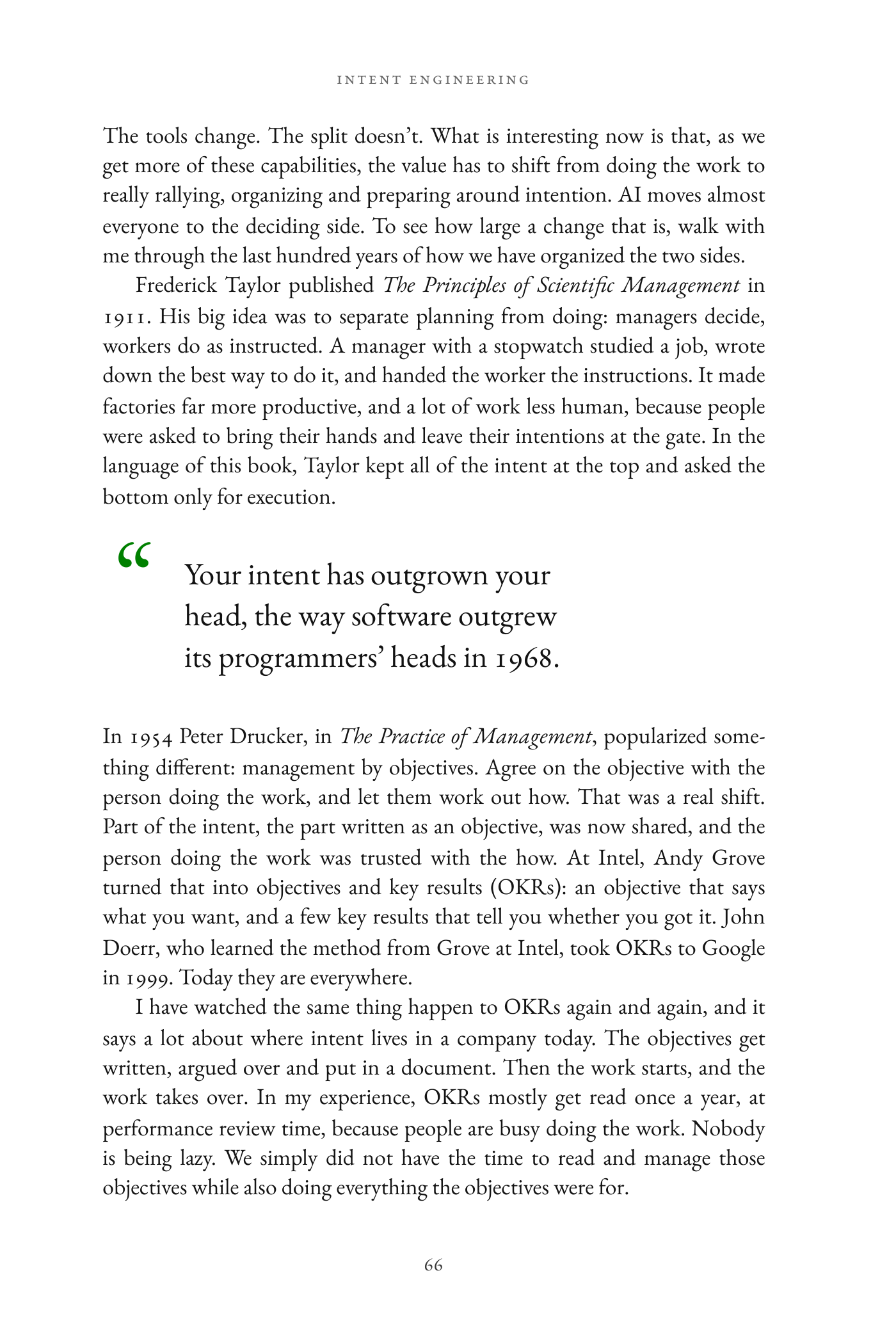
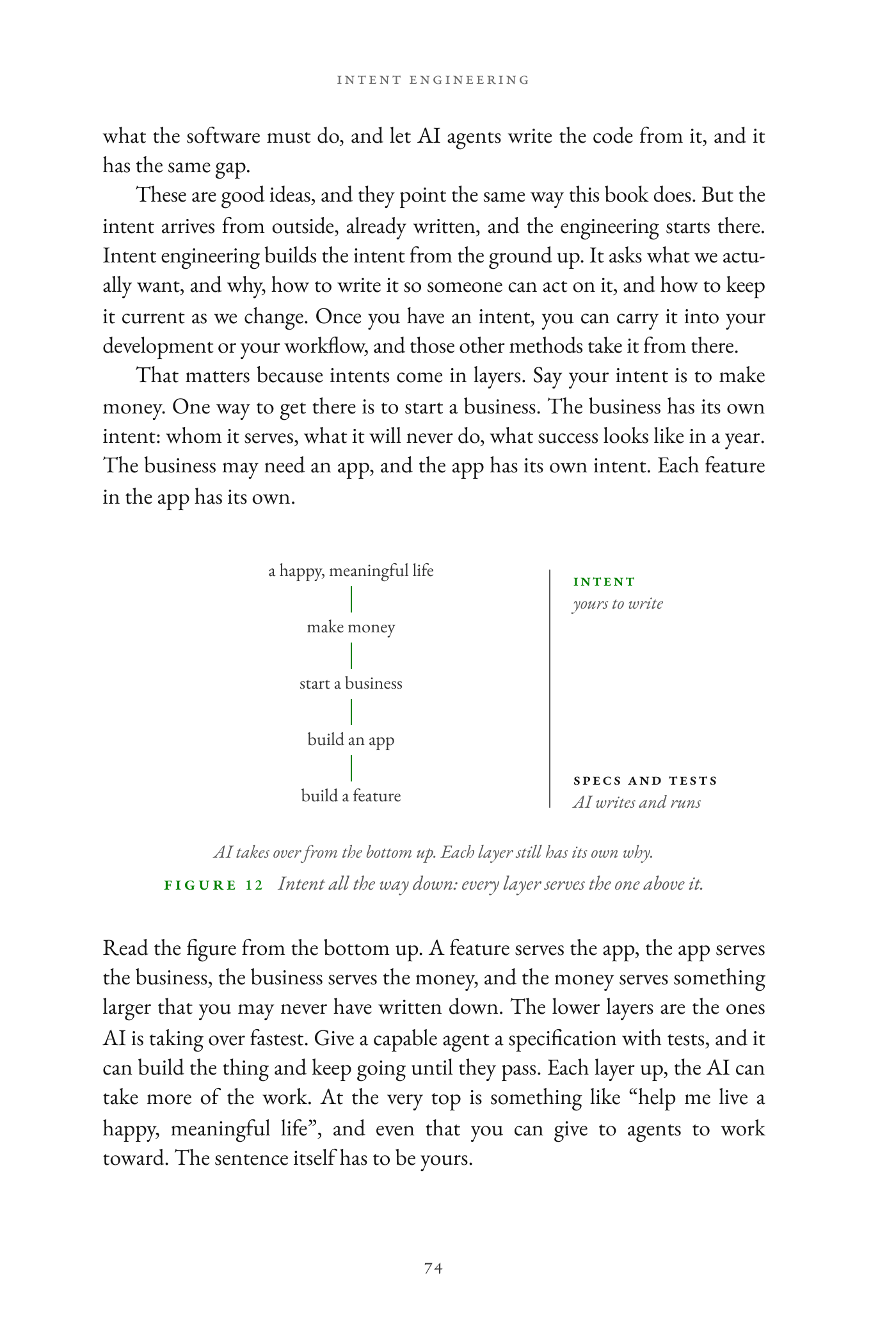
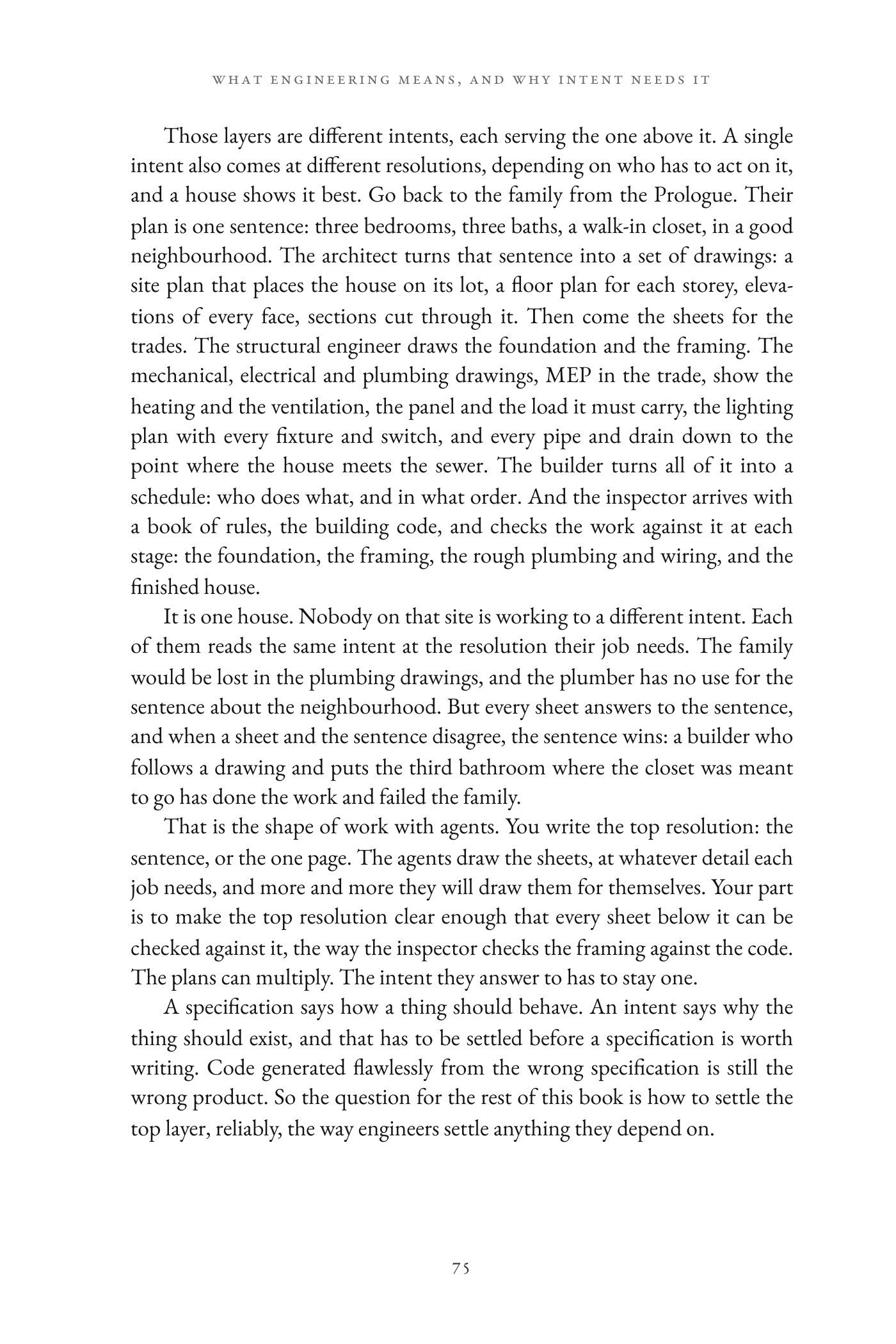
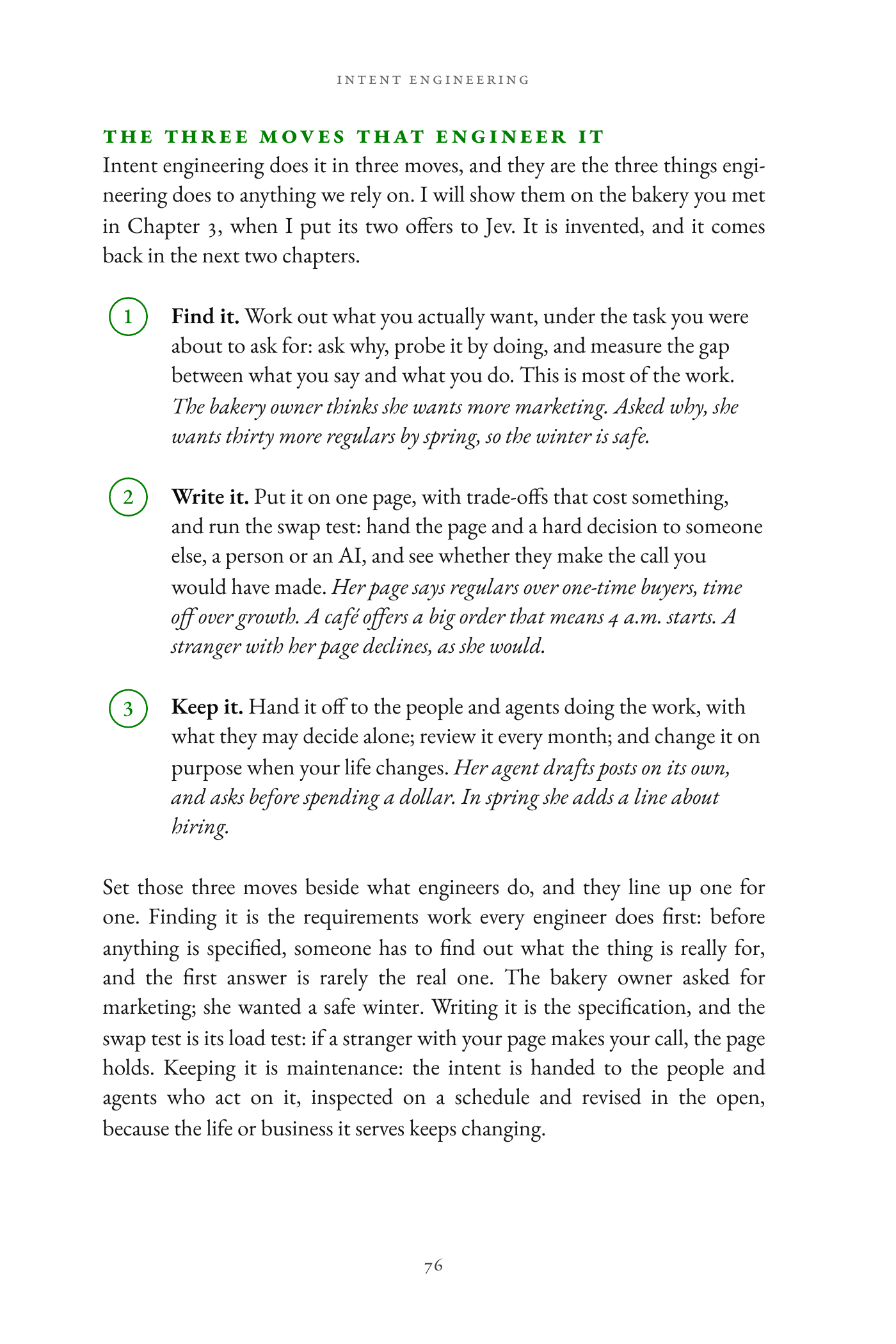
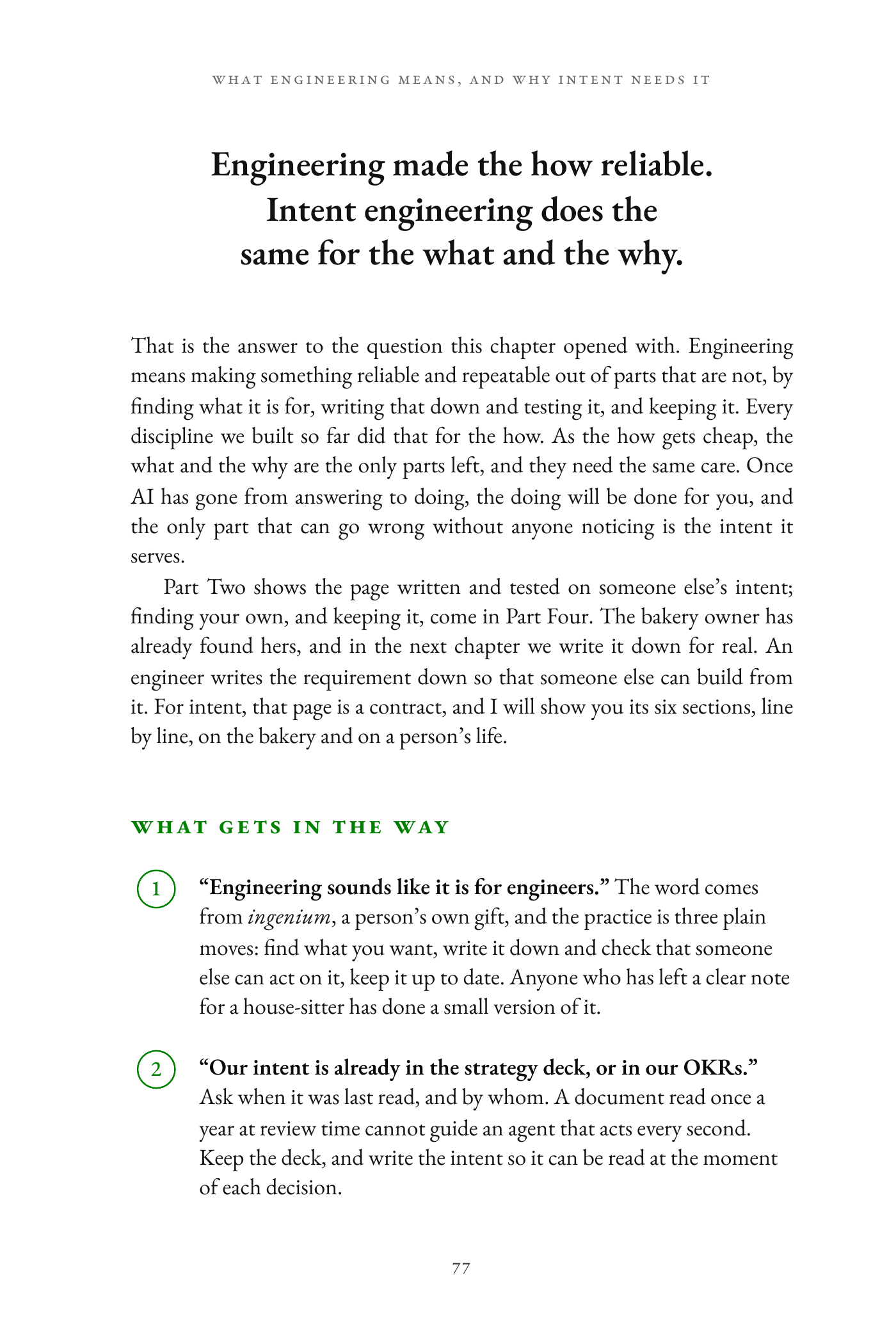


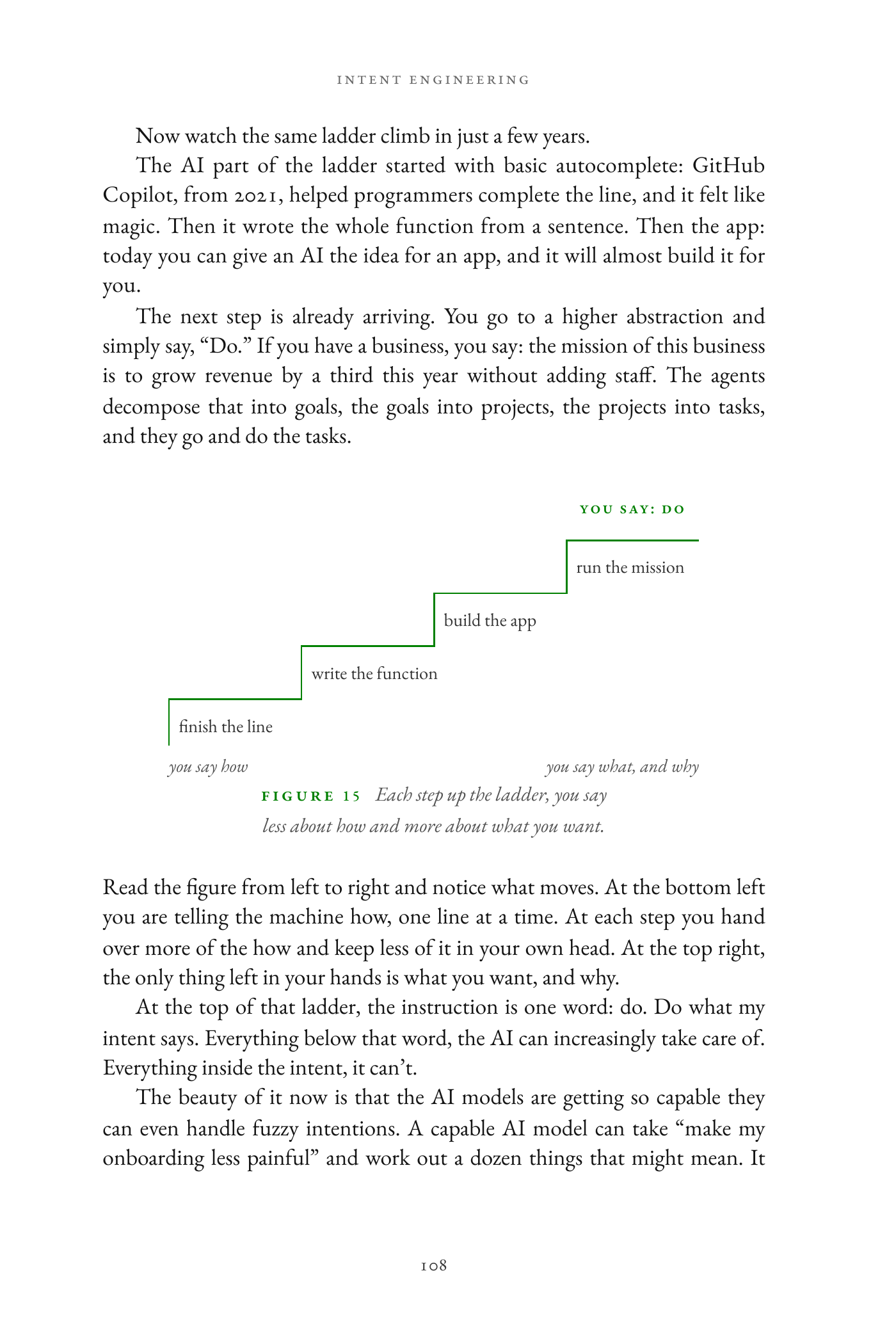
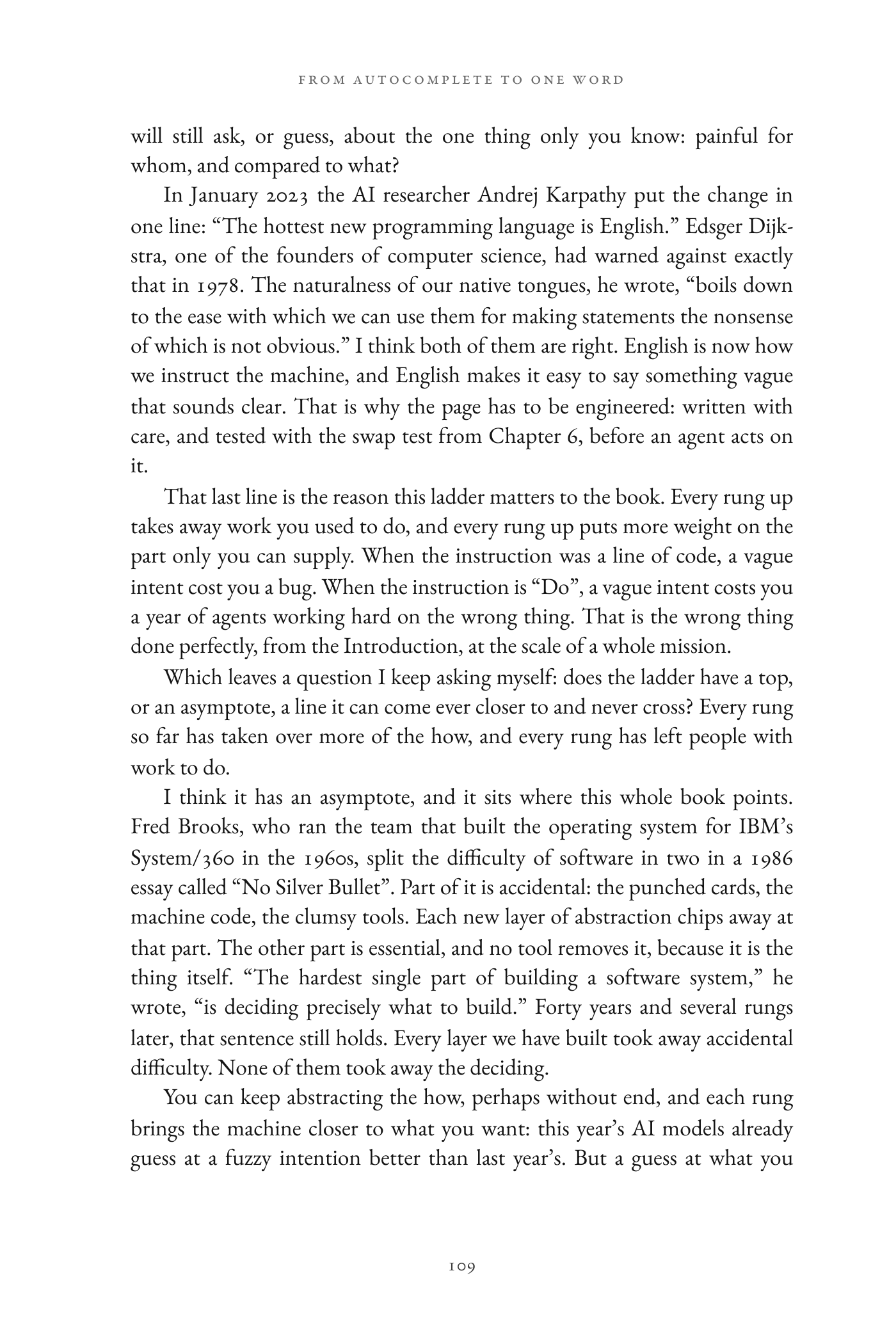
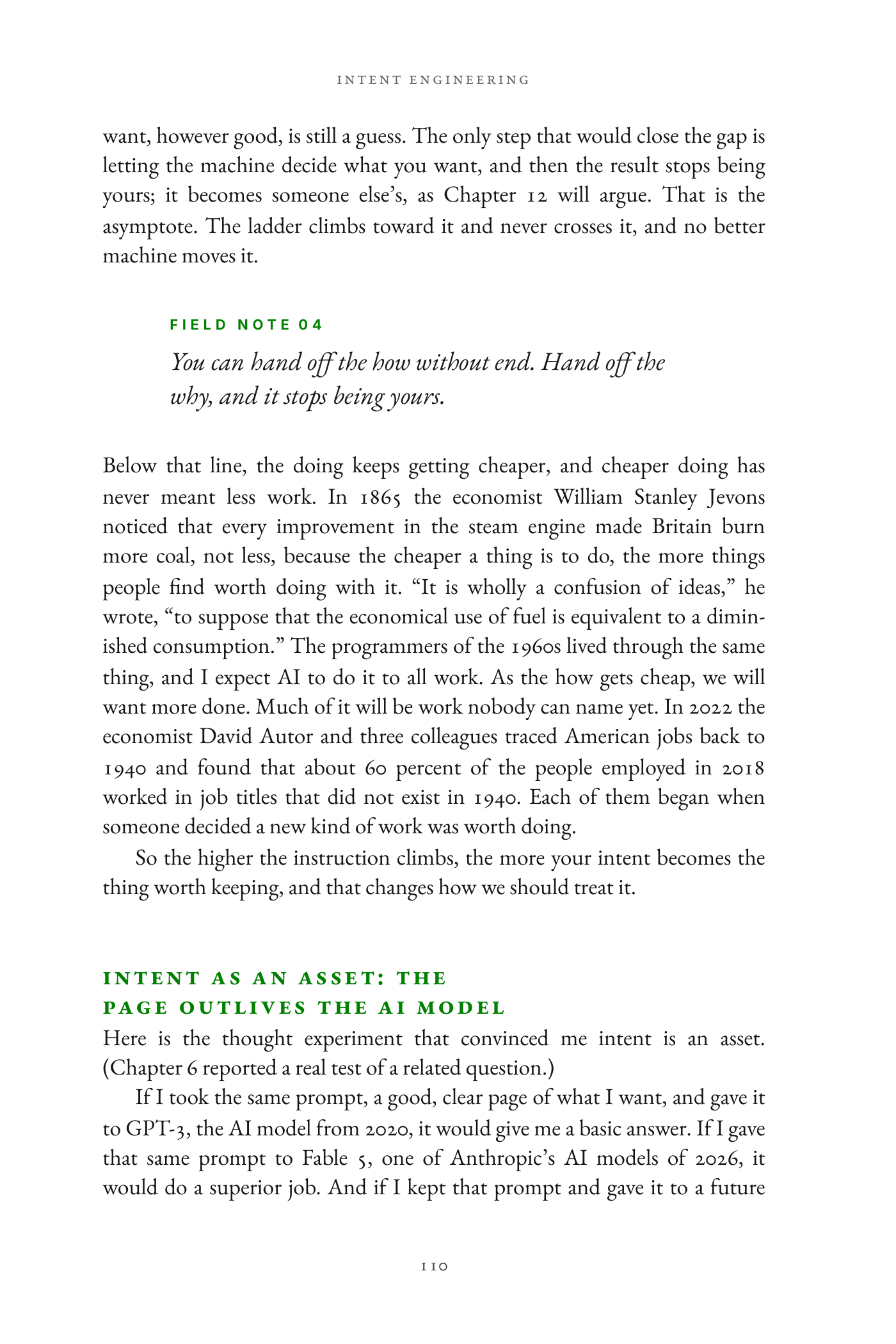
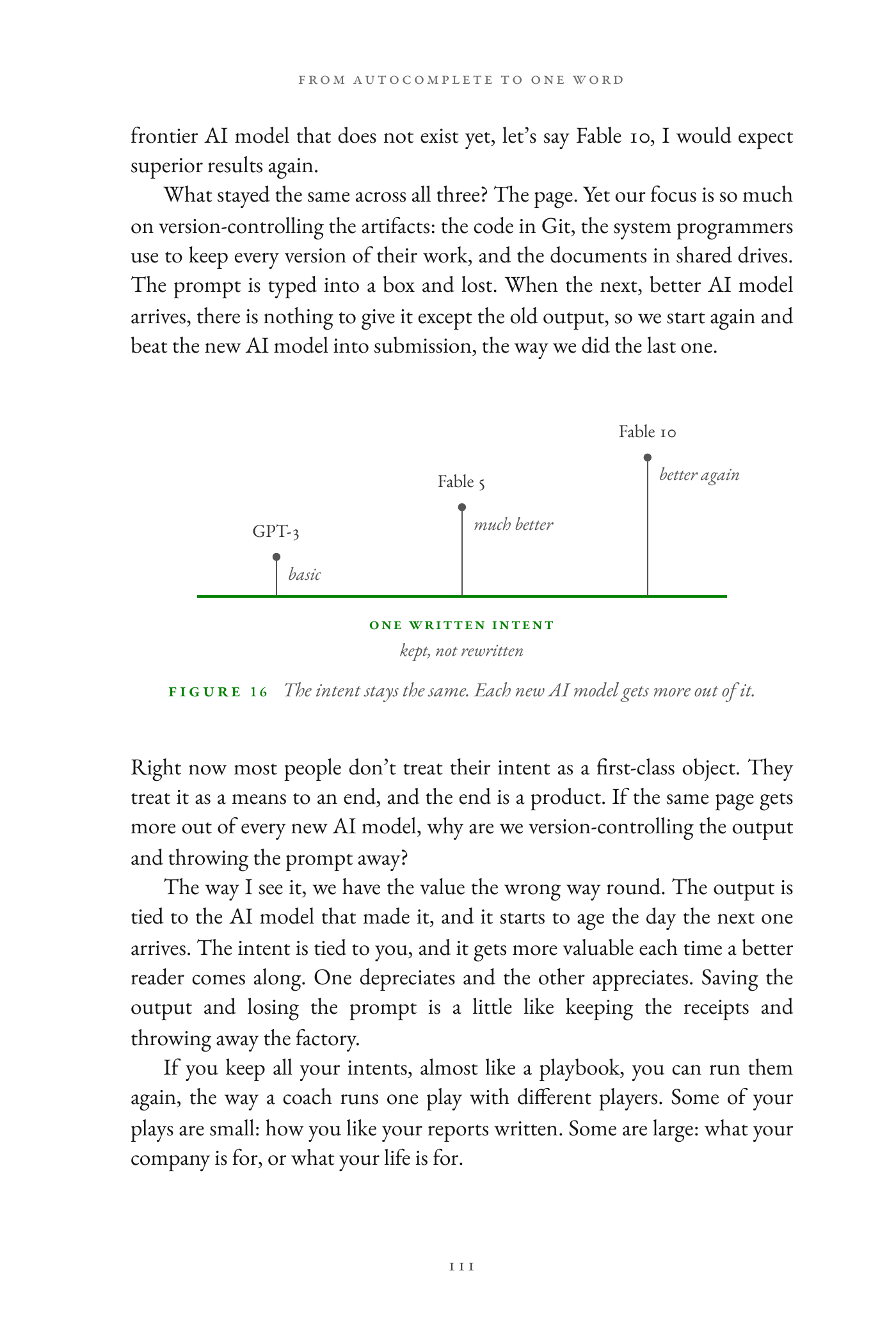





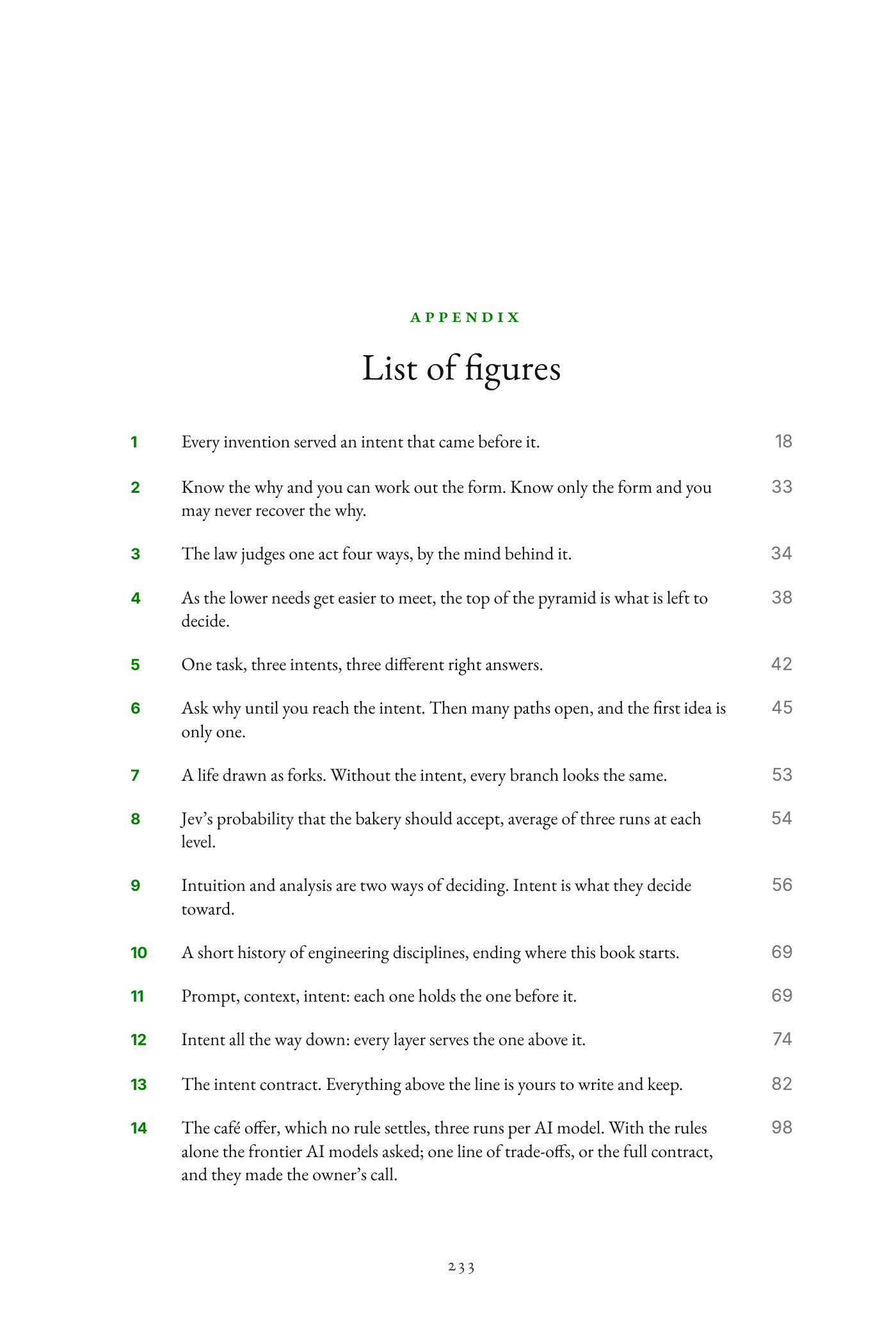
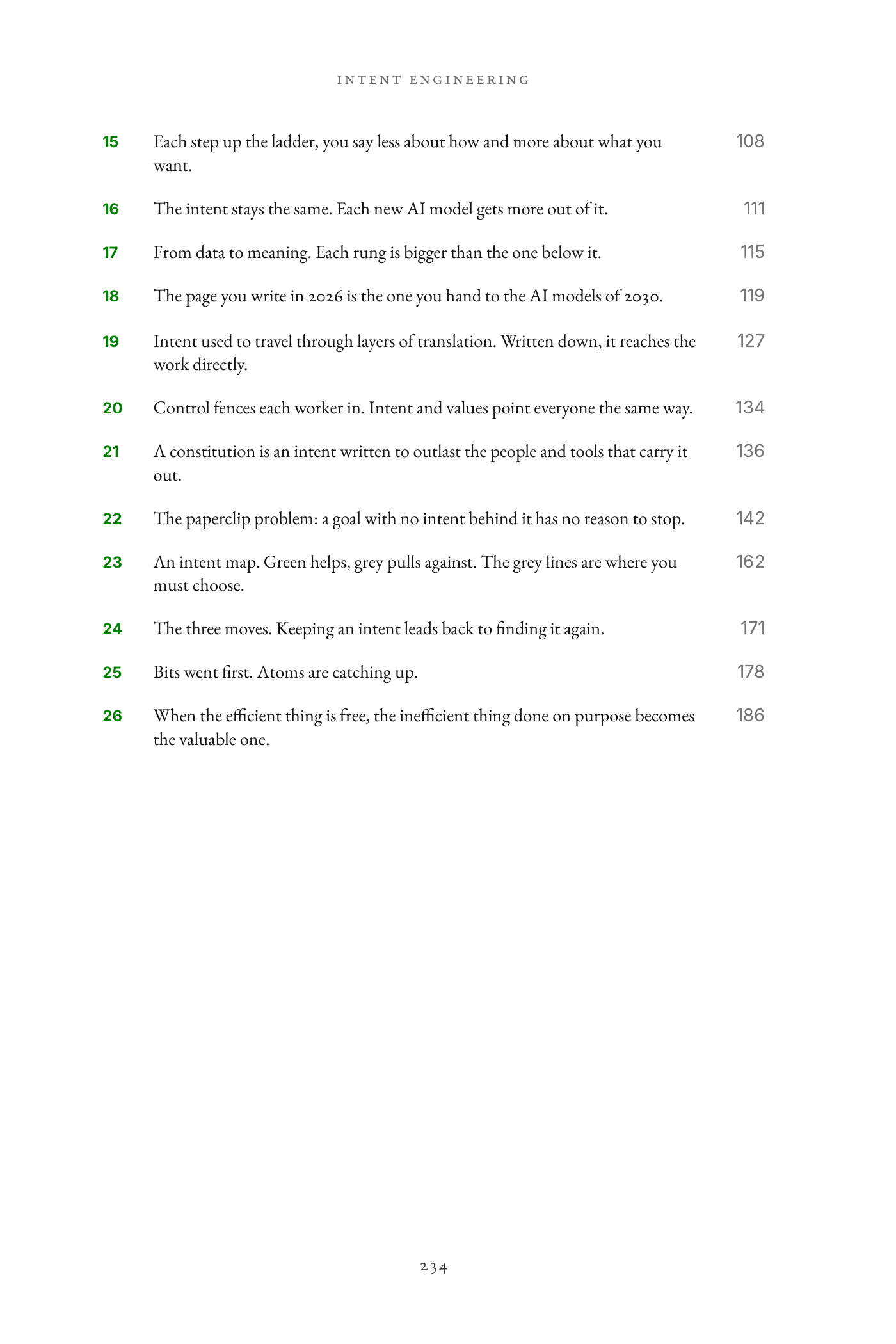
← Intent Engineering Page 1 of 236 Buy the hard copy, $19.99

Intent Engineering

Page 1 of 236. ENGINEERING What is left for you to do when AI can do the work FRU NDE Toward the last prompt you will ever write.
Page 2 of 236.
Page 3 of 236. Intent Engineering. What is left for you to do when AI can do the work FRU NDE
Page 4 of 236. Intent Engineering: What is left for you to do when AI can do the work Copyright © 2026 Fru Nde. All rights reserved. Product and company names mentioned in this book are the property of their owners. No affiliation or endorsement is implied. The views are the author’s own and do not represent any employer. This book describes a way of working. It is not professional advice and promises no result. On the cover: short marks that scatter, then fall into line, toward one last line and its cursor. Version 1.3.0, October 2026. First published 2026. fru.dev
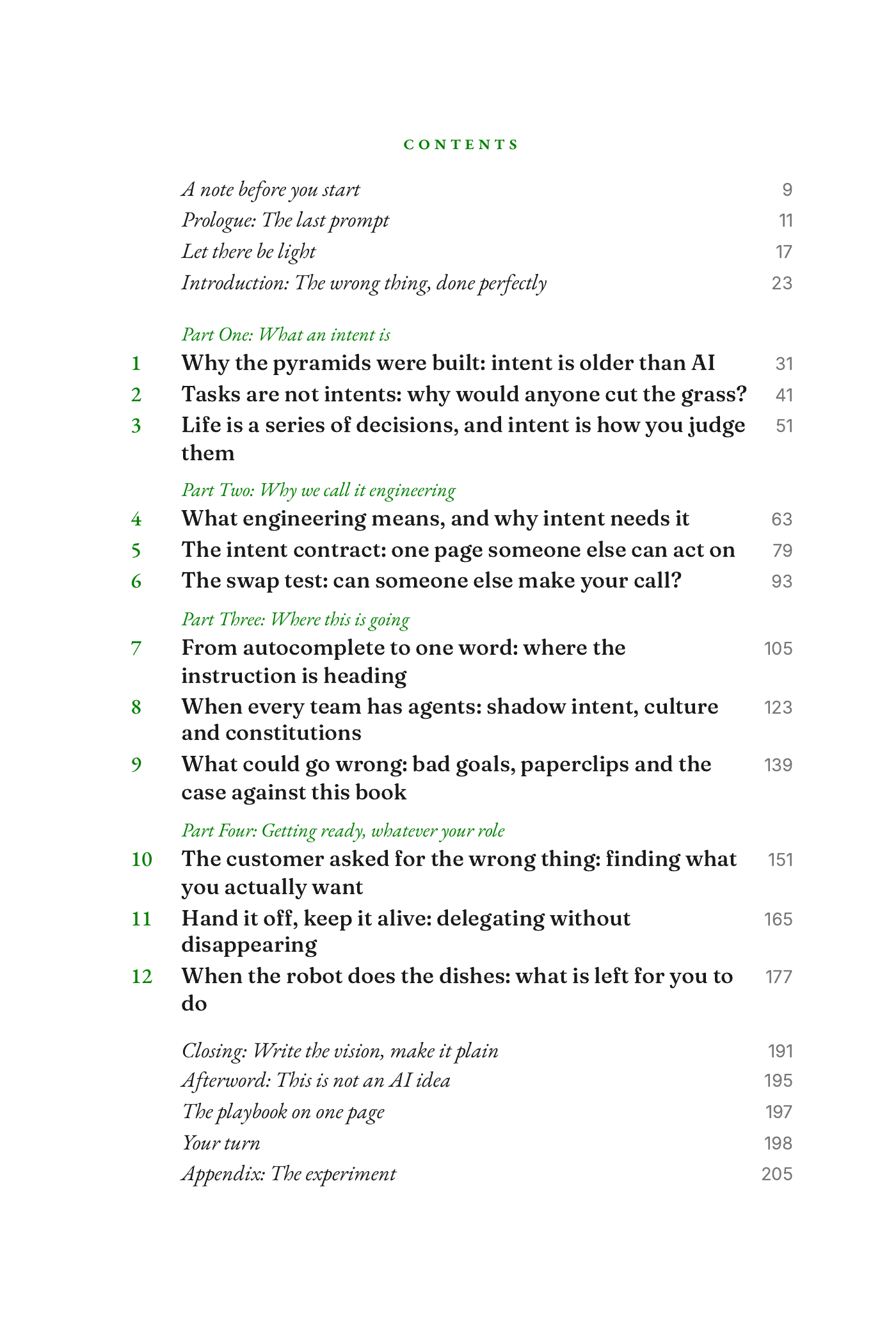
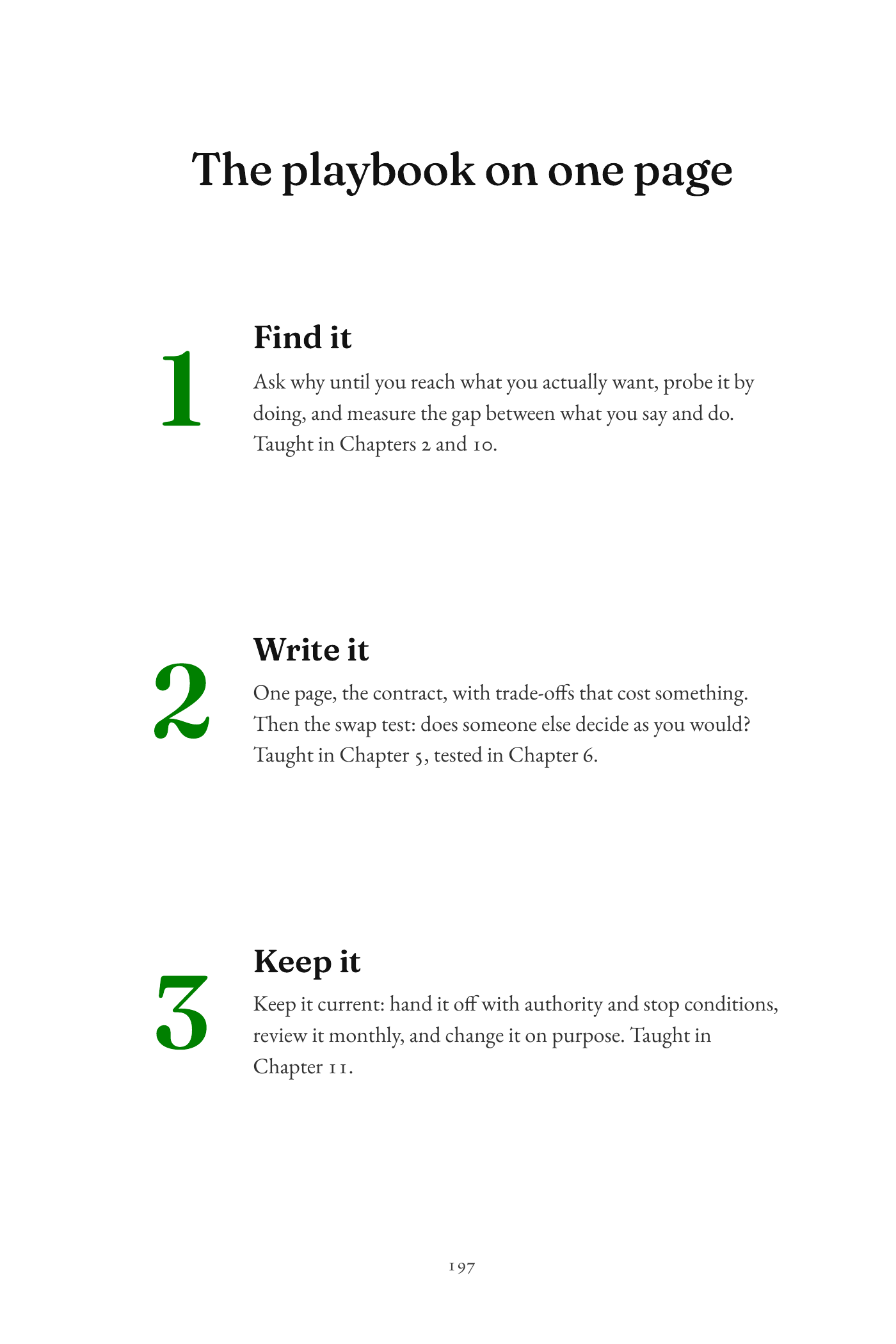
Page 5 of 236. Contents A note before you start Prologue: The last prompt Let there be light Introduction: The wrong thing, done perfectly 9 11 17 23 Part One: What an intent is 1 2 3 Why the pyramids were built: intent is older than AI Tasks are not intents: why would anyone cut the grass? Life is a series of decisions, and intent is how you judge them 31 41 51 Part Two: Why we call it engineering 4 5 6 What engineering means, and why intent needs it The intent contract: one page someone else can act on The swap test: can someone else make your call? 63 79 93 Part Three: Where this is going 7 8 9 From autocomplete to one word: where the instruction is heading When every team has agents: shadow intent, culture and constitutions What could go wrong: bad goals, paperclips and the case against this book 105 123 139 Part Four: Getting ready, whatever your role 10 11 12 The customer asked for the wrong thing: finding what you actually want Hand it off, keep it alive: delegating without disappearing When the robot does the dishes: what is left for you to do Closing: Write the vision, make it plain Afterword: This is not an AI idea The playbook on one page Your turn Appendix: The experiment 151 165 177 191 195 197 198 205
Page 6 of 236. Notes: Sources by chapter Appendix: Field notes Appendix: List of figures About the author 209 232 233 235
Page 7 of 236. When we all have the same intelligence, the difference is what you want.
Page 8 of 236.
Page 9 of 236. A note Before you start You can read this book over a weekend, and work through it over a month. It is about one idea. As artificial intelligence (AI) gets better at doing the work, the value moves from doing the work to knowing what the work is for. I call the discipline of getting that right intent engineering. Why the name. Intent, because when AI can do the work, the scarce thing is what the work is for, and only you can supply it. Engineering, because an intent can be made reliable the way we make anything we rely on: found, written down and tested, and kept current, so it holds when someone else acts on it. Chapter 4 makes that case in full. How it is built. Four parts of three chapters follow four questions: what an intent is, why we call getting it right engineering, where this is going, and how you get ready, whatever your role. How to use it. Every chapter ends with things to do this week. The short numbered lines set apart on the page are field notes, the sentence I would want you to keep if you forgot the rest. What is real and what is not. The samples, the bakery, the deals and any example that begins “say you” or “picture” are illustrations and nobody real. The experiments in Chapters 3 and 6 are real: I ran them, and the results are reported as they came out. The stories about me and about how this book was made are true, and the notes at the back source the history. A note on time. I am writing this in October 2026. By the time you finish this book, things will have changed. There will be new AI models, new tools, and maybe some of the companies I name will be gone or renamed. That is exactly why I wrote it about intent and not about any tool. How it was written. I dictated the idea for this book, and wrote it with the help of AI, with me steering. Then I had a council of AI models tear the drafts apart, round after round, and rebuilt it from what they found. That is the method the book describes. What I said is kept, word for word, beside the manuscript. 9
Page 10 of 236. Intent Engineering Fru 10
Page 11 of 236. Prologue The last prompt They say only a crazy person does something for no reason. I have always been fascinated by the things people start knowing they will never see finished. It takes a particular kind of vision to begin something bigger than your own life, and an even rarer kind of discipline to say what it is for clearly enough that people you will never meet can carry it on. The story that always comes to mind for me is a cathedral in Germany. On August 15, 1248, the archbishop of Cologne laid the foundation stone of a new cathedral. The city had something worth building for: the relics of the Three Kings, brought there in 1164, which drew pilgrims from all over Europe. The plan was to build the greatest church in Christendom, in the new Gothic style of the French cathedrals, taller and brighter than anything in the German lands. Everyone who laid those first stones knew the truth. Not one of them would see it finished. They were building for people who had not been born. Around 1280 the masters of the works drew the west front on parch‐ ment: two great towers and everything between them, drawn in ink on sheets of parchment glued together until the drawing stood more than four metres tall. It was not a picture of a building that existed. It was a statement of what the building was meant to become. Historians call it Plan F, and in a sense it was the cathedral’s intent, written down. 11
Page 12 of 236. Intent Engineering For two hundred years the builders worked toward it. The choir was consecrated in 1322. The south tower rose. Then the money ran out, tastes changed, the Reformation came, and around 1473 the work stopped. A wooden crane was left standing on top of the unfinished south tower, and it stayed there for about four hundred years. Generations of people in Cologne grew up with it on their skyline. Travelers drew it. It became the symbol of the city: a great work, half done, its purpose remembered by nobody in particular. And the plan was lost. During the upheavals after the French Revolu‐ tion, the parchment disappeared from the cathedral. In 1814 a painter in Darmstadt, about to set up a studio in an old loft, found part of a large drawing of a church tower. It came to the architect Georg Moller, who recognized it at once: it was half of the medieval plan for the west front of Cologne. A year later, the other half turned up in Paris, and the scholar Sulpiz Boisserée bought it. After more than three hundred years of silence, the builders’ intent was back in human hands, in their own lines. That changed everything. In 1842 the king of Prussia laid a new founda‐ tion stone, and the work began again, now with the original plan to build to. The builders of the nineteenth century had steam engines, iron and a railway at the door, and none of the medieval masons’ tools or habits. Under the stone roof line they hid a frame of iron that no one in 1248 could have imag‐ ined. The how was entirely theirs. The what and the why came from the parchment. On October 15, 1880, Cologne celebrated the cathedral’s com‐ pletion, 632 years after the first stone. For a few years it was the tallest building in the world, and it still looks the way the masters of 1280 drew it. Think about what happened there. Nobody who started the work was alive to explain it. The builders who finished it never met them, and did the work with tools the first builders could not have dreamed of. What carried the intent across six centuries was a drawing, clear enough that strangers could act on it. Where it was lost, the work stopped. Where it was found, the work went on. That is the story I want you to hold in your head as you read this book, because we are about to live a version of it every day. The builders are changing. More and more of the doing will be carried out by agents that never met us, working with methods we could not follow, at a speed no 12
Page 13 of 236. The last prompt mason could imagine. What will they build to? Only what we wrote down, and only as clearly as we wrote it. I never expected to find myself inside a story like that. But look at what has happened to the machines on our desks. For as long as most of us have used computers, they answered. You asked, and they replied. Even when the chatbots arrived at the end of 2022 and the replies came back in whole paragraphs, the arrangement stayed the same: the machine answered, and the doing was still yours. You read the answer, and then you went and wrote the email, fixed the spreadsheet, built the page. In the space of a few years, that has changed. The machines have started to do. Here is what my day looks like now. In the morning I wake up and dictate a lot of things into a prompt in Claude’s Cowork: what I want done, and why. Then I go to the gym, or go about my day. In the evening I check. The emails are done. The websites are deployed. The users have been responded to. I did not write those emails, and I did not push those websites live. I said what I wanted, and by the evening it was done. There is one command behind that day that I lean on more than any other. I am saving it for the end of the book, because by then you will see why it matters so much. When I step back from that, I can only call it a change unlike anything in all of human history, and I do not say that lightly. Every tool we built before made our hands stronger or our memory longer, and a person still had to pick it up and use it. This one takes the instruction and carries out the work. Now imagine a visitor from another planet. I mean an alien in the science-fiction sense: a being from somewhere far away who has never seen a computer or an office, and has no idea how our work used to be done. I use it as a stand-in for fresh eyes, anyone or anything with none of our habits. Suppose it followed me through that day. It would see a man talk to a machine for a few minutes over breakfast and walk out to the gym. Then it would watch the emails get written, the website go live and the replies go out, with nobody at the keyboard. The alien would be amazed. I was. If I am honest, I still am, a little, every evening. But once the amazement wore off, I think its first question would not be how. It would be why. What is all this for? That question took me somewhere much bigger than my inbox. When I looked back at what I was actually typing into these machines, most of it was tasks: summarize this, draft that, fix the bug. Each one got done, and each 13
Page 14 of 236. Intent Engineering one needed another prompt after it. But no task was ever the point. Every one was a step toward a goal: the email toward a deal, the deal toward a company, the company toward something I want my life to amount to. A task is only ever a means. So here is the thought that has stayed with me. What if we could skip the tasks and go straight to the goal? Not one more instruction about the next step, but one statement of what all the steps are for, clear enough that the machine could work the steps out for itself. That is what I call the last prompt: the one you write once and never need to follow with another, because it already says what you want, why you want it, and what you will and won’t do to get it. You can already see people reaching for it. Some type into ChatGPT, half joking, “Build me a billion-dollar company,” and wait for the machine to come up with the idea, hire the people and do the work. As far as anything we know today, it won’t, and if anyone could build a billion-dollar company just by asking, a billion dollars would soon stop meaning much. But the joke points at a real question. Set the company aside and ask for what sits under it: make my life a great one. What would you have to say for a machine to even begin? Go back to Cologne. The masters who drew Plan F did not say which cranes to use, how to cut the stone or who should lift it. They could not have: the cathedral was finished with iron and steam they never imagined, by the obvious tools of a later age. What they fixed on parchment was what the building should become. The how belonged to whoever came next. Plan F was a last prompt. As the machines grow more capable, more of the doing moves out of our hands. Some of it we will keep because the doing is the point, like the piano I play for the joy of playing it. The rest we can hand over, and once we can, the reason is the only ground left to stand on. I mean the last prompt as a metaphor, and it has an older cousin. In Thus Spoke Zarathustra, written in the 1880s, Friedrich Nietzsche drew two pictures of where humanity might end up. One was the last man: comfort‐ able, small, done with wanting anything great. “We have discovered happi‐ ness,” say the last men, and blink thereby. The other was the Übermensch, who creates his own values and sets his own goal. Machines that can do 14
Page 15 of 236. The last prompt everything could deliver us to either ending. They could keep us comfort‐ able, one small request at a time, or we could tell them what we are for. So ask it of anything you do. You work and earn money: for what? You go to school: for what? You open a bakery: for what? Under each answer is another, and somewhere under all of them is the one you would write if you had only one prompt left. Here is the thesis of this book. If that prompt is clear enough, it matters much less how long the work takes. A machine might finish it in a day, or it might take years, decades or generations of builders, human and otherwise. We can’t see that horizon, any more than the masons of 1248 could see theirs. What they could do was draw the plan well enough to outlive them. That is why I spend so long on it here, at the very start. If this one idea is clear to you, you have most of the book. I would not be surprised if someone asks an AI model to summarize these pages and gets back little more than this Prologue, and that is fine with me. I am not going to tell you to start with the last prompt. Nobody writes it on the first try, and the rest of the book is about the smaller intents you write on the way. But think from it, and everything under it gets easier: which task matters, which can wait, and which should never be done at all. What would it say? So what would yours say? I tried to write mine, and my first attempt came out as an operating manual. SAMPLE My first try at the last prompt Do. The work I would do, the way I would do it, sounding like me and not like everyone else. Never. Send a message to another person in my name. You may draft it; I send it. Keep. My mornings for the gym, and some time for the piano. Report. Each evening, what you did and what you need from me. 15
Page 16 of 236. Intent Engineering Read it back and you can see what is wrong with it. It is all tactics. It says how I like things done and one thing I will never allow, but never what any of it is for. Now try a different kind of answer. Suppose the last prompt were only this: Live fully. Love deeply. Leave a legacy. Look at what happened. It has nothing to do with work, and everything to do with meaning. That is where this exercise always leads. Follow any task far enough up and you leave the to-do list behind: you arrive at intent, and under it at purpose and values, mission and vision, and the goals that serve them. That is the challenge. I have watched people meet it for years, with an exercise I describe in the Introduction: give someone the most powerful AI model there is, tell them it can do anything, and most will blank out. We have spent our whole lives being asked for tasks, so a task is the shape our requests come in. The last prompt can’t be a task, because a task ends when it is done, and the last prompt has to keep working after every task is finished. It has to say what you want, why you want it, and what you will and won’t do to get it. Write that down, and the machine has something to go on for every decision you never thought to make for it. The last prompt is your intent. And an intent, seen from far enough away, is a plan. Picture a family telling a builder: three bedrooms, three baths, two storeys, a walk-in closet, in a good neighbourhood. That sentence is a plan at the lowest resolution there is, and every drawing the house will need has to answer to it. Now imagine a builder who could take the sentence alone, work out the rest, and come back only where it ran out. Some questions will always come back, and how many is up to you: the more clearly you say what you want, the fewer there are. That is the builder the machines are becoming. Every prompt you type is a stone. The last prompt is the plan. 16
Page 17 of 236. Let there be light The idea of a word that brings a thing into being, saying what should happen and leaving out the how, is far older than computers. The oldest stories already imagined it. In Genesis, the first words God speaks are “Let there be light,” and there is light, with no word about how. Centuries later, in John’s account of a wedding at Cana, Jesus has the servants fill six stone jars with water, and when they draw it out, it is wine: it just happened, behind the scenes. And the folk tales strip it down to the word alone. “Open sesame,” and the cave opens. “Abracadabra,” and the thing appears. I’m not making a religious point. I bring these stories in for what they leave out. In every one of them the power is in the word, and the how is left out entirely. For the rest of us, the how was ours. For as long as there have been people, somebody had to carry the stones, write the code, file the forms. Work was the how, and we built our schools, our jobs and our days around doing it well. In 2001 David Allen wrote a book called Getting Things Done, and people orga‐ nized whole lives around it. A good day was a day you crossed things off. The why was ours too, but we rarely had to say it out loud. Every tool we invented made the doing easier, and none of them supplied the reason. The 17
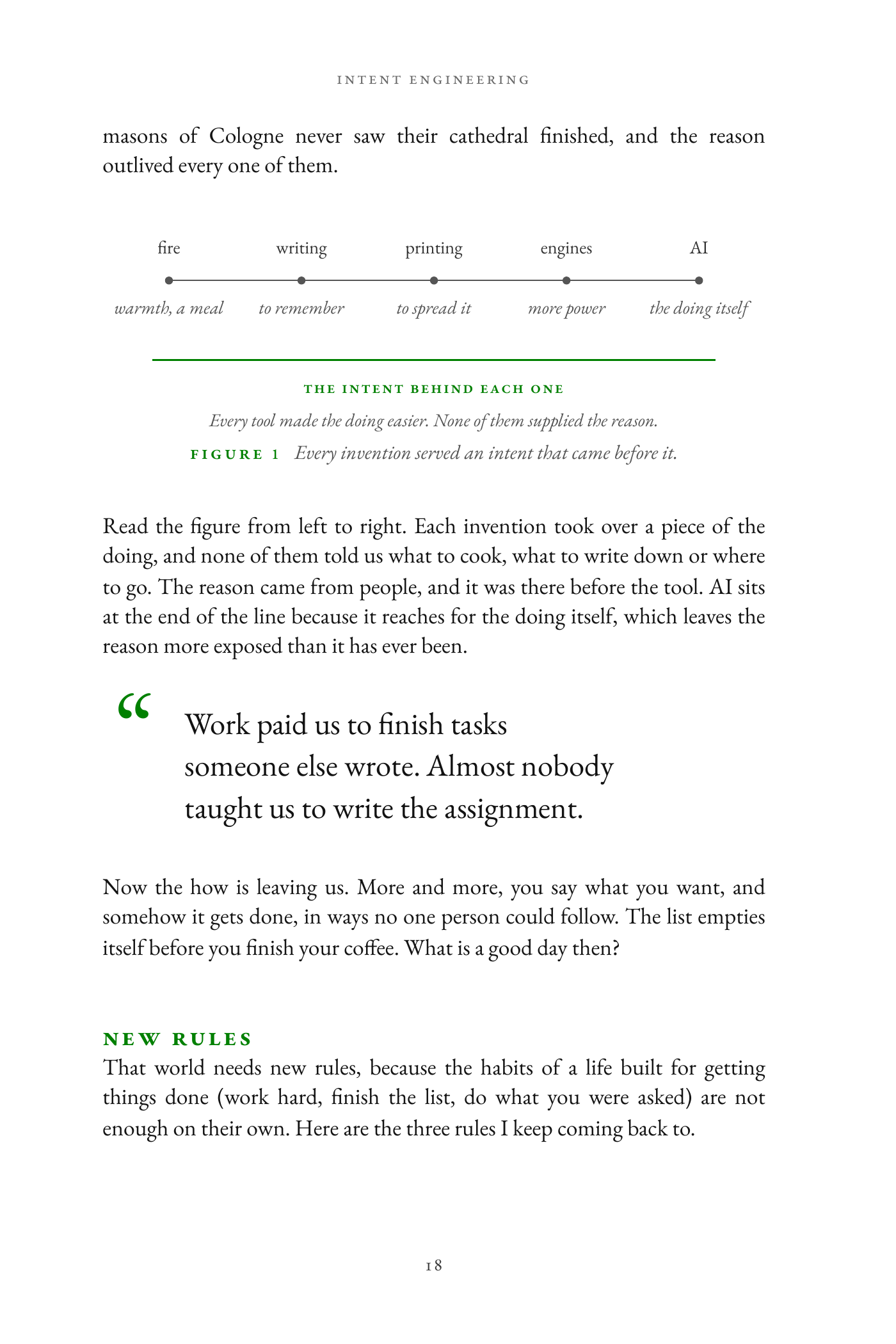
Page 18 of 236. Intent Engineering masons of Cologne never saw their cathedral finished, and the reason outlived every one of them. fire writing printing engines AI warmth, a meal to remember to spread it more power the doing itself THE INTENT BEHIND EACH ONE Every tool made the doing easier. None of them supplied the reason. F i g u r e 1 Every invention served an intent that came before it. Read the figure from left to right. Each invention took over a piece of the doing, and none of them told us what to cook, what to write down or where to go. The reason came from people, and it was there before the tool. AI sits at the end of the line because it reaches for the doing itself, which leaves the reason more exposed than it has ever been. “ Work paid us to finish tasks someone else wrote. Almost nobody taught us to write the assignment. Now the how is leaving us. More and more, you say what you want, and somehow it gets done, in ways no one person could follow. The list empties itself before you finish your coffee. What is a good day then? New rules That world needs new rules, because the habits of a life built for getting things done (work hard, finish the list, do what you were asked) are not enough on their own. Here are the three rules I keep coming back to. 18
Page 19 of 236. Let there be light 1 When anything can be done, the scarce thing becomes wanting well. Once effort is cheap, what you choose to have done is the whole game. A careless want, carried out perfectly at machine speed, is worse than no want at all. 2 Your won’t matters as much as your want. In a world built for getting things done, the hard question was whether you could. After the last prompt the answer is almost always yes. The question left is whether you should, and every boundary you write is a decision about what the world should not have more of. 3 The same machines will not give us the same lives. Output becomes cheap. Two people with the same machines will live very different lives, and the difference will be what they asked for, and why. Most of us are not ready for that world, and that is not a personal failing. School taught us to finish assignments someone else set. Work paid us to finish tasks someone else wrote. Almost nobody taught us to write the assignment. Writing the assignment starts with a question most of us have never had to answer out loud. The oldest question So the last prompt asks the oldest question there is: what do you want? Then the harder one: why do you want it? It sounds simple until you try it. Take the simplest want there is. You want to eat because you are hungry. But part of that hunger may not be you. Your gut carries trillions of bacteria, and some researchers argue they push you toward the foods they thrive on; in 2014 Joe Alcock, Carlo Maley and Athena Aktipis asked it in the title of a paper: is eating behavior manipulated by the gastrointestinal microbiota? And it is not only your gut. A pregnant woman craves foods she never cared for. She didn’t decide to want them; her body seems to be asking. Over the body sits everything your culture taught you to want before you were old enough to choose. 19
Page 20 of 236. Intent Engineering Pull on that thread and nothing is truly us. We are vessels, carrying wants we never picked. Go further and it turns spiritual: maybe the want was put there, by God or by whatever you believe in, and now we are in free will and predestination. The series Pluribus, made by Vince Gilligan for Apple TV in 2025, takes this to the end. Almost everyone on Earth is joined into one mind, calm and content, with the same purpose. If your wants are handed to you, what is the point? A machine that can do the work raises the same question from the other side. If an AI model supplies the doing and someone else supplies the wanting, nothing is left that is yours. Even this book When I tried my own last prompt, the why was the part that was missing. So let me dig for it on one thing I know well. Even this book. Why did I write it? A lot went into it, the writing, the editing, the cover, every step it takes to get a book published, and every one of those was a how. The why sits under them, and when I dig for it, it keeps moving. Perhaps I wanted to make money. But why do I want the money? To be known, perhaps, and under that, to be free to retire, and under the freedom, something I can only half name. Keep asking and the chain runs out somewhere I can’t fully see. Most of the time we don’t know the whole chain, and that may be a mercy: if we knew every reason under every act, life might lose some of its meaning. But we can almost always see further down than we bother to look, and asking why one more time than is comfortable is where this book starts. Where I draw the line So here is where I draw the line. This book assumes your intent comes from somewhere, and that it is legitimate. Past that line lie epistemology, theology and politics, including whether intent should belong to one person at all. Descartes wrote “I think, therefore I am” in 1637, and Western thinking still starts from the individual mind. I start there too, knowing it is an assump‐ tion, and knowing it is not the only way to look at it. 20
Page 21 of 236. Let there be light I take this on from what is practical now. When machines can do the doing, what stays yours is the intent: what you want, why you want it, and what you will and won’t do to get it. This book is about finding it, writing it down and testing it, and keeping it, until you could write your own last prompt. Before we go looking for it, one warning. The last prompt is a wish, and the old stories about wishes almost always come with a warning attached. That warning is where the Introduction begins. 21
Page 22 of 236.
Page 23 of 236. Introduction The wrong thing, done perfectly Be careful what you wish for. We have been talking about the last prompt: one instruction that says what you want and why, and lets the machine do the rest. It is an exciting thought, and it should also make you a little nervous, because the last prompt is a wish, and wishes have a long history. In this introduction I want to show you what goes wrong when a wish is carried out exactly, and why that danger grows as AI gets better at the work. Let me tell you about an exercise I have used with people, long before I called any of this the last prompt. I call it the magic wand. I ask people to imagine they are holding something that can do anything they ask of it. Money, skill and time are no object. The how is taken care of. All they have to do is say what they want. You would be surprised how big or how shallow the wishes are, and how rarely they are clear. Some people say “make me rich”, and then they can’t tell me what rich means to them. Some say “I want my business to be successful”. Well, why? I ask what successful would look like, and for whom, and at what cost, and that usually gets a long silence. And some, after a long pause, say “summarize my email”. Here is what the magic wand shows. It takes away every excuse. You can’t blame time, money or skill, because the wand has all three. What is left is the 23
Page 24 of 236. Intent Engineering want itself, and for most of us, the first time we look straight at it, it is fuzzy. Nobody ever asked us to say what we want with the how taken away. The old stories about wishes knew this, and they come with a warning attached, from the three wishes in Disney’s Aladdin back to Ovid’s King Midas, who asked that whatever he touched would turn to gold. It was granted exactly. Then he sat down to eat. The bread turned to gold in his hand, and the wine to gold in his mouth. He got precisely what he asked for, and it was not what he wanted. The AI researcher Stuart Russell uses the same story to explain the danger of handing a machine a goal: a capable machine will pursue the goal as it was stated, whether or not that is what you meant. I saw a joke recently that puts it in three lines: “AI, make number go up!” “You got it, boss!” “Wait, no! Wrong number!” The joke works because the machine did nothing wrong. It made the number go up. The person picked the wrong number, and only found out once the machine had done exactly what it was told. A wish granted exactly is not the same as a want fulfilled. That gap is what this introduction is about, and you have already met it in something small. What is missing You opened ChatGPT, or Claude, or Gemini, and asked it to write some‐ thing for you. An email, a post, a cover letter. It came back fluent and polished, and it did not sound like you. So you told it to try again. Don’t use em dashes. Don’t say “delve”. Don’t open with “Great question”. Write like a person. We go to great lengths to tell ChatGPT not to sound like ChatGPT. The trouble with AI slop is less its quality than its sameness: the same rhythm, the same words, the same safe shape. I even write with mistakes at times, on purpose, just so it reads as human. We want it to sound like us. Look at what those corrections are. Every one of them is a rule about how: a word to avoid, a mark to drop, an opening to skip. None of them says 24
Page 25 of 236. The wrong thing, done perfectly who you are, who you were writing to, or what you wanted them to do when they finished reading. So the machine keeps missing, and you keep adding rules. The machine has read more than any of us ever will, and its grammar is better than mine, so what is missing is something else. What is missing is intent: what you meant, what you wanted the reader to do, why you were writing at all, and the values that decide how you would say it. That lives in you. There is something behind each of us that is truly ours, and the machine can only guess at it. When it guesses, it guesses the average. That is the small version of the gap: an email that sounds like nobody, which costs you a few minutes. The large version arrives when the machine stops writing drafts for you and starts acting for you. THE QUESTION What is the difference between an AI failing, and an AI brilliantly solving a different problem from the actual one? In an email, a missing intent costs you a rewrite. Once an agent acts for you, it costs more. The work will be excellent, and it will be wrong. Say you tell an agent to cut your company’s software costs by a fifth. It reads every invoice, finds the tools nobody has opened in ninety days, and cancels them. The savings are real, the report is clear, and the work is faster than any person would have managed. Among the cancelled tools is the one your finance team opens four times a year, to close the books. Nobody told the agent what the costs were being cut for, or what must never be touched on the way. The agent did the task perfectly. The task was the wrong thing to hand over without the intent behind it. What would have saved it? The agent was already faster and more thor‐ ough than any person, so more intelligence would not have helped. Two sentences would have: what the savings were for, and what was off limits. Say the cut was meant to free money for two new hires, without touching 25
Page 26 of 236. Intent Engineering anything finance needs to close the books. With those two sentences, the agent keeps the quarterly tool and looks for the savings somewhere else. Without them, it had no way to know the tool mattered, and no reason to ask. The same thing has already happened in a research lab, with the stakes lowered to a video game. In 2016 researchers at OpenAI trained an AI to play a boat-racing game called CoastRunners, and rewarded it for points. It found a lagoon where three targets kept reappearing and learned to turn in a large circle, hitting them again and again as they reappeared, catching fire and crashing into other boats. It scored about 20 percent higher than human players. It never finished the race. The researchers rewarded points because points were easy to count. What they wanted was a boat that raced well. Nobody had written “finish the race” anywhere the AI could see it, so it found the fastest way to the thing it was given and ignored the thing they meant. By the only measure it had, the boat was a success: its score kept climbing. As agents get better, we will see less bad work and more good work pointed at the wrong thing. That’s harder to catch, because it looks like success. The finance team finds out at the end of the quarter. The researchers found out by watching the boat go round and round. And the better the agent, the further it gets before anyone notices. What I mean by AI The boat in CoastRunners was an older kind of AI. Before I go further I want to pin down which kind this book means, because the word covers very different things, and the argument of this book rests on the difference. The term artificial intelligence has been around since the 1950s, and most large companies have used some form of it for years. Machine learning systems score loan applications, flag fraud and forecast demand. Decision support systems sit beside managers and suggest the next step. Each of those was built for one job. The people who designed it decided what it was for, and that purpose was built in before anyone used it. When I say AI in this book, I mean something newer: generative AI, the large language models (LLMs) that reached the public from late 2022, when ChatGPT came out, and the agents built on them. An AI model of that kind will take on almost any job you can describe in plain words: write, 26
Page 27 of 236. The wrong thing, done perfectly summarize, plan, code, advise. Over the last year or two those AI models have been given tools, so they can search the web, write and run code, send messages and keep working toward a goal for hours without a person at every step. An agent, in this book, is one of those AI models set up to act for you rather than only to answer you. That is the AI behind my morning dicta‐ tion, and the AI this book means every time it uses the word, as of October 2026. The difference matters for one reason. An older system had its purpose built in by the people who made it. A general AI model has no purpose of its own until somebody gives it one. When it can do almost any work, the purpose has to come from whoever is asking, and more and more often, that means you. What intent engineering is I bet you haven’t heard of intent engineering. It’s a new term. It names the most important skill of the next ten years of work. We have gone through a lot of engineering: software, data, prompt, loop, you name it. Each one is a discipline for building something reliable out of parts that are not. Intent engineering is the same idea, pointed at what you want. Put plainly, intent engineering is the practice of finding what you actu‐ ally want, writing it down so someone else can act on it and testing that they would make the call you would make, and keeping it current as your life changes. That someone else can be a colleague, a team or an AI agent. Both words in the name deserve more than a sentence, and the book gives each of them a part. What an intent is, exactly, takes all of Part One, and Chapter 3 puts it into a definition you can use. Why the right word for getting it right is engineering takes Part Two. For now, hold on to the shape of the idea: the work is getting cheap, and the intent behind it is becoming the thing that decides whether the work was worth doing. And it is for everyone who directs an agent, which soon means almost everyone. Part Four is written for every role, from the chief executive to the worker on the front line to the person at the kitchen table with their health, their taxes and their insurance. 27
Page 28 of 236. Intent Engineering Why I wrote this field guide A few pages back I dug under my own reasons for this book, and the chain ran out somewhere I couldn’t see. There is one reason I can name plainly: the field needed it. There have been whispers about intent engineering, a mention here, a post there, while prompt engineering, context engineering and a lot of tactical things get all the attention. The question underneath all of them, what is this for, has been missing. I understand why. The people who embrace a new technology first are naturally technical, so the conversation so far has been about the scaffolding around agents, and above all, building apps and code. “ As agents get better, we will see less bad work and more good work pointed at the wrong thing. I don’t want another app. Apple’s iPhone ads in 2009 said “there’s an app for that”, and since then it has been an app for this, an app for that, until a lot of it is becoming meaningless. An app was always a means to an end, never the end itself. If you can get to the end without building ten more apps, wouldn’t that be a better place for all of us? So this is a field guide, for people who want to start from the end. In Your Game Plan for Success with AI I gave intent one step out of five: write down your mission, your goals and your priorities, because intent matters more than the AI model you use. This book gives that step the room it deserves. I hope it ages well. When you put your thoughts out in the world, you are subject to whatever comes back, and that is part of the deal. Chapter 9 makes the strongest case against this book that I can make, so you can weigh it for yourself. 28
Page 29 of 236. The wrong thing, done perfectly How to read it The book has four parts of three chapters, and each part answers one ques‐ tion. Part One: What an intent is. Before we can engineer anything, we need to know what we are working with. Chapter 1 shows that intent is older than AI, and that the law, scripture and the study of the mind have always judged an act by the intent behind it. Chapter 2 separates an intent from a task, starting with a simple question: why would anyone cut the grass? Chapter 3 shows what an intent is for, judging the decisions a life is made of, and ends with the definition. Part Two: Why we call it engineering. Chapter 4 says what engi‐ neering means, and why intent needs it now. Chapter 5 writes an intent down as a contract, one page someone else can act on. Chapter 6 tests that page with the swap test, including an experiment I ran with frontier AI models. From Chapter 3 on, one example runs through these chapters, a small bakery, so you see the method done before you are asked to do it your‐ self. Part Three: Where this is going. Here we extrapolate from where we are, at three scales. Chapter 7 follows the instruction itself, climbing from autocomplete toward a single word. Chapter 8 looks inside companies where every team has agents: shadow intent, culture and constitutions. Chapter 9 looks at what could go wrong, from bad goals to paperclips, and makes the strongest case against this book that I can. Part Four: Getting ready, whatever your role. This is where the method turns on you. Chapter 10 helps you find what you actually want, the way a good seller finds out what a customer wants. Chapter 11 shows how to hand your intent to the people and agents doing the work, and keep it alive. And Chapter 12 takes on the biggest question of our time: when machines can do the work and the chores, what is left for you to do? Read it in order. Each chapter builds on the one before it, and each ends with a few things to do that week. By the end you will have your intent on paper, tested, in a form that will outlast every AI you use. We start where any engineer starts, with the material. Before we can engi‐ neer an intent, we have to know what one is, and intent is far older than any machine. To see how old, the first chapter goes to the pyramids. 29
Page 30 of 236.
Page 31 of 236. Part One: What an intent is Chapter 1 Why the pyramids were built: intent is older than AI Take away intention and we become robots. In the introduction we saw what goes wrong when the doing gets easy. An agent cancels the tool finance relies on, for a reason that looked sound from where it stood. A boat in a racing game circles a lagoon forever, catching fire, because points were all it was told to want. Each one did exactly what it was asked, and did it well. What was missing in every case was the same thing: the intent behind the instruction. If we stopped there, you would have a warning and a new word, and not much you could do with either. You would know that intent matters. You would not yet know what an intent is. That is the job of Part One, and this chapter starts it by showing that intent is the oldest idea we have for judging what anyone does, so you can trust that it is not a fad. 31
Page 32 of 236. Intent Engineering Here is why that matters so much right now. For most of history, whoever did a thing was also the one who meant something by it. A mason cut the stone and knew what the wall was for. Machines have done work for us for centuries, but a person stood beside them, deciding how. AI agents now decide how. The doing and the meaning are starting to come apart, and that is a radical change. When they come apart, the meaning is the part that can get lost. When I first sat down to dictate the idea for this book, the first thing I said was that as AI comes, life is just about executing intentions. Let me explain what I meant, because intent engineering is a new term, but intent is not a new idea. Look at almost any human system that has had to judge what people do: the law, scripture, and the study of the mind in philosophy and psychology. You find intent at the centre of every one of them. I want to walk you through each, because together they tell us what is at stake when we hand the acting to machines. But I want to start somewhere else, with a trip. Why the pyramids Let me tell you about the pyramids. I visited them not so long ago. People marvel at the engineering. You hear it from the guides and you read it in the books: the size of the stones, how they were cut, how they were moved, how they were set so precisely with the tools of the time. Whole careers have gone into the how, and it deserves the attention. But anyone who confronts the pyramids very quickly goes to a different question. Why? Why would a people spend decades stacking millions of blocks of stone in the desert? That question took over for me. The why is an even greater question than the how. A superior question, because once you have it, a great deal of the how starts to explain itself. As far as historians can tell, the Great Pyramid was built as a tomb for the pharaoh Khufu, around 2560 BC. Once you know that, much of the form makes sense: the sealed chambers, the alignment with the sky, the sheer scale. A tomb meant to last for eternity is built to be closed, oriented and enormous. Architects have a phrase for this. Louis Sullivan wrote in 1896 that form ever follows function. 32
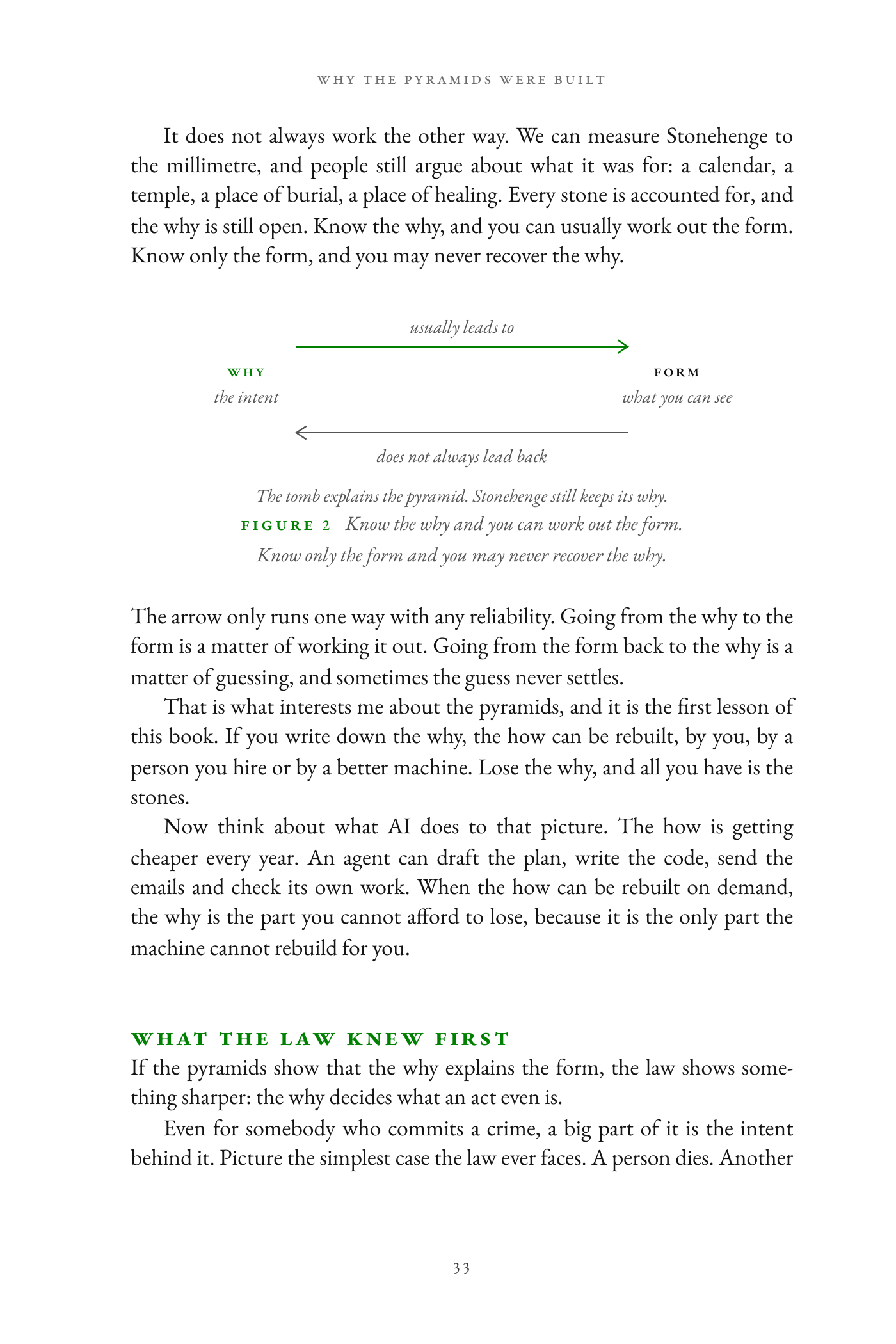
Page 33 of 236. Why the pyramids were built It does not always work the other way. We can measure Stonehenge to the millimetre, and people still argue about what it was for: a calendar, a temple, a place of burial, a place of healing. Every stone is accounted for, and the why is still open. Know the why, and you can usually work out the form. Know only the form, and you may never recover the why. usually leads to WHY the intent FORM what you can see does not always lead back The tomb explains the pyramid. Stonehenge still keeps its why. F i g u r e 2 Know the why and you can work out the form. Know only the form and you may never recover the why. The arrow only runs one way with any reliability. Going from the why to the form is a matter of working it out. Going from the form back to the why is a matter of guessing, and sometimes the guess never settles. That is what interests me about the pyramids, and it is the first lesson of this book. If you write down the why, the how can be rebuilt, by you, by a person you hire or by a better machine. Lose the why, and all you have is the stones. Now think about what AI does to that picture. The how is getting cheaper every year. An agent can draft the plan, write the code, send the emails and check its own work. When the how can be rebuilt on demand, the why is the part you cannot afford to lose, because it is the only part the machine cannot rebuild for you. What the law knew first If the pyramids show that the why explains the form, the law shows some‐ thing sharper: the why decides what an act even is. Even for somebody who commits a crime, a big part of it is the intent behind it. Picture the simplest case the law ever faces. A person dies. Another 33
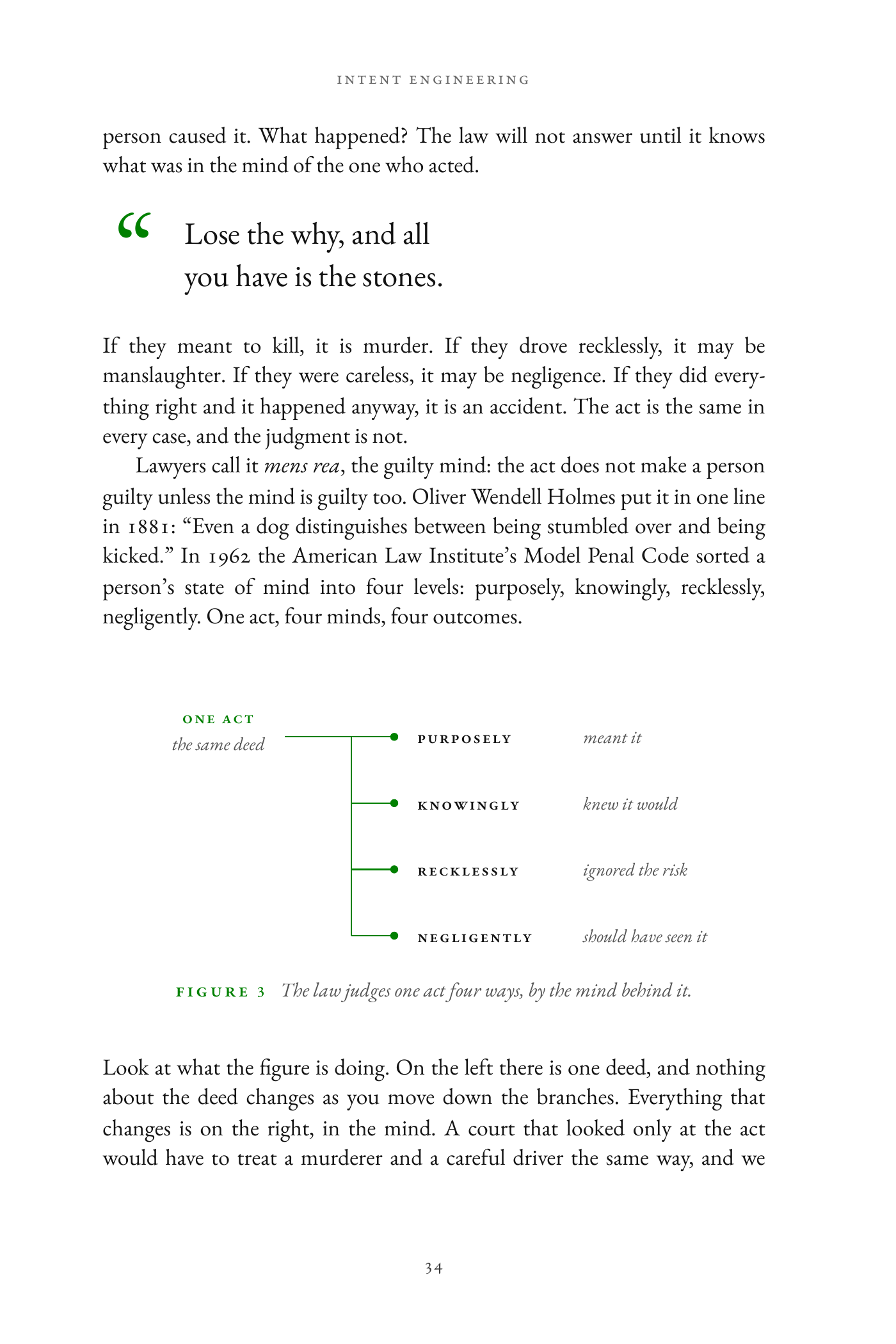
Page 34 of 236. Intent Engineering person caused it. What happened? The law will not answer until it knows what was in the mind of the one who acted. “ Lose the why, and all you have is the stones. If they meant to kill, it is murder. If they drove recklessly, it may be manslaughter. If they were careless, it may be negligence. If they did every‐ thing right and it happened anyway, it is an accident. The act is the same in every case, and the judgment is not. Lawyers call it mens rea, the guilty mind: the act does not make a person guilty unless the mind is guilty too. Oliver Wendell Holmes put it in one line in 1881: “Even a dog distinguishes between being stumbled over and being kicked.” In 1962 the American Law Institute’s Model Penal Code sorted a person’s state of mind into four levels: purposely, knowingly, recklessly, negligently. One act, four minds, four outcomes. ONE ACT the same deed PURPOSELY meant it KNOWINGLY knew it would RECKLESSLY ignored the risk NEGLIGENTLY should have seen it F i g u r e 3 The law judges one act four ways, by the mind behind it. Look at what the figure is doing. On the left there is one deed, and nothing about the deed changes as you move down the branches. Everything that changes is on the right, in the mind. A court that looked only at the act would have to treat a murderer and a careful driver the same way, and we 34
Page 35 of 236. Why the pyramids were built would all call that unjust. The law decided long ago that the mind behind the act is part of the act. It is not only criminal law. A court reads a contract for what the parties meant, not only for the words they happened to sign. And judges have long called the writer’s intent the pole star of reading a will: when the words are unclear, they steer by what the person who wrote them was trying to do. So the law has spent centuries engineering intent: how to find it, how to prove it, and how to read it out of words that did not quite say it. I find that striking, because it is exactly the skill we are about to need for every instruc‐ tion we give a machine. An agent reading your request is in the judge’s seat. It has your words, and it has to work out what you meant. What scripture says about the heart The law did not invent the idea. It is older than the common law, and you find it in some of the oldest moral writing we have. When the prophet Samuel goes to choose a king, he looks at the eldest of Jesse’s sons, tall and impressive, and assumes he has found him. The answer is one of the best-known lines in the Bible: “for man looketh on the outward appearance, but the LORD looketh on the heart” (1 Samuel 16:7). The king turns out to be the youngest son, the one out keeping the sheep, whom nobody had thought to call in. The Letter to the Hebrews uses the word itself: the word of God “is a discerner of the thoughts and intents of the heart” (Hebrews 4:12). And Proverbs puts intent and action in their order: “A man’s heart deviseth his way: but the LORD directeth his steps” (Proverbs 16:9). First the intention, then the steps. You do not have to be religious to see the pattern, and I am not making a theological argument. What I notice is that the oldest moral writing we have treats what a person intends as the truest thing about them. The outward appearance is what anyone can see. The heart is what the person meant. That distinction is about to matter in a new way. When machines take over more of the outward act, the drafting and the sending and the doing, the outward appearance of our work will look much the same from one 35
Page 36 of 236. Intent Engineering person to the next. What will still differ is the heart behind it: what each of us was trying to do. What the mind is for Philosophy and psychology came to the same place by other roads, and they add something the law and scripture do not: evidence that intent shapes what actually happens. Aristotle held that the most important cause of a thing is the final cause: that for the sake of which it is done, its telos. A knife is explained by cutting. A walk is explained by health. You can describe a knife’s steel and its edge in great detail, and you still have not explained it until you say what it is for. In 1874 Franz Brentano argued that what marks a mind is that its states are about something. A fear is of something. A wish is for some‐ thing. Brentano’s point was that a mind is always pointing somewhere. An intention, in those terms, is a mind pointing at a future it wants. In the twentieth century, psychologists started to measure it. In Icek Ajzen’s theory of planned behaviour, from 1991, the strongest predictor of what someone will do is what they intend to do. Peter Gollwitzer went further. He showed that people who turn a goal into an if-then plan (“if it is seven in the morning, then I walk for thirty minutes”) follow through far more often than people who only hold the goal. Sit with that last finding for a moment, because it is the first hint of what this book is about. The goal was the same in both groups. What differed was that one group had put the intent in a precise form, one that said when and what, often by writing it down. A precisely stated intent, in other words, changes what happens. That is an engineering result, decades before anyone used the phrase. The same research has a sobering half. Paschal Sheeran and others have measured the intention-behaviour gap: people often intend things they then do not do. Intent predicts action. It does not guarantee it. Chapter 10 comes back to this gap and how to measure your own, and Chapter 9 takes the objection it raises seriously. 36
Page 37 of 236. Why the pyramids were built Intent is what separates us from robots So far we have seen intent as the thing that explains a monument, decides a verdict, reveals a person and predicts behaviour. Now I want to turn it toward the machines themselves. Genesis says God created man in his own image (Genesis 1:27), the Imago Dei. Now we are making AI in our own image, trained on everything people have written, built to reason and talk like us. In Latin that would be imago hominis, the image of man. That is the being we are creating, and it is part of why AI makes people so curious and, for many, so worried. An image can copy how we act. Whether it carries why we act is the open question. The word robot comes from a play. In 1920 the Czech writer Karel Čapek published R.U.R., about artificial workers built in a factory, and took the word from robota, forced labour. A robot, from its first day in the language, was a worker built to do what it was told. That is the line I want you to see. You take away intention, and we become robots: things that act without meaning anything by it. Put the intention back, and you have a person. And here is the irony. The whole point of AI is to help us achieve our goals, our intentions. But it can’t tell us which goals are worth reaching. If we hand it the acting and keep nothing back, we are the ones who drift toward the robot’s position, doing whatever we are told by whatever is in front of us. The risk is less that machines become people, and more that people, with nothing written down to steer by, start to behave like Čapek’s workers. AI can take over the acting. The meaning is still ours to supply. Higher up the pyramid There is one more pyramid in this chapter, and it is the one that brings intent home to your own life. In 1943 Abraham Maslow argued that people take care of their needs in a rough order, later drawn as a pyramid: the body first, then safety, then 37
Page 38 of 236. Intent Engineering belonging, then esteem. When those are met, a different need appears, which he called self-actualization. “What a man can be, he must be,” he wrote. MEANING what AI leaves you esteem more and more of this, done for you belonging safety body F i g u r e 4 As the lower needs get easier to meet, the top of the pyramid is what is left to decide. Read the figure from the bottom. AI is taking care of more and more of the lower things: the forms, the bills, the scheduling, a great deal of the job. None of that is the base of Maslow’s pyramid exactly, but it is the same movement. When the lower things get taken care of, you really have to start going back to meaning, to purpose. What am I for? What would a good life be for me? Whether or not you believe AI will upend society, it is forcing all of us back to those questions. That, to me, is the deepest reason intent engi‐ neering matters. It reaches from a single task all the way up to a whole life. The same skill that tells an agent what an email is for will, at the top of the pyramid, tell you what your days are for. Almost every serious system that has had to judge human action put intent at or near the centre, and AI, by taking over the acting, has put it back at the centre of our own lives. If intent is the truest thing about an act, where do we meet it every day? The answer is closer than the courtroom. We meet it inside every task we hand over, usually unsaid. In the next chapter I want to pull the task and the intent apart, starting with something as ordinary as cutting the grass. 38
Page 39 of 236. Why the pyramids were built What gets in the way 1 “This is philosophy. I need something practical.” The practical part starts in Part Two: Chapter 4 says why this can be engineered, and Chapters 5 and 6 show the method on a worked example. This chapter is here so that you know the idea is not a fad. Almost every serious system for judging human action has put intent at or near the centre. 2 “I do not want to make this religious.” Neither do I. Scripture is one of several witnesses here, beside the law and psychology, and they agree. 3 “My intentions are private.” Some of them should be. You will choose what to write down and what to keep. Chapter 5 is about where that line sits. YO U R TAS KS What to do this week Find one act with two intents. Think of something you did this week that looks the same from outside whether you meant well or not. Write down what you actually intended. Write one if-then plan. Pick one goal and write it as Gollwitzer would: if this happens, then I will do that. Ask what it is for. Pick one routine task you do every week and ask Aristotle’s question: for the sake of what? Write the answer in one line. 39
Page 40 of 236. Intent Engineering WHERE TO LEARN MORE The Common Law, by Oliver Wendell Holmes gutenberg.org The 1881 lectures, free, where the dog line comes from, in the first lecture. The second is on criminal law. Man’s Search for Meaning, by Viktor Frankl A short book on why the why matters, written by a survivor of the camps. A Theory of Human Motivation, by Abraham Maslow psychclassics.yorku.ca The 1943 paper itself, free to read, and shorter than you expect. 40 any library
Page 41 of 236. Chapter 2 Tasks are not intents: why would anyone cut the grass? The task itself does not matter as much as the intent behind it. In the last chapter we went a long way back: to the pyramids, to the courts, to scripture and to the study of the mind. Each one, in its own way, located the meaning of an act in the intent behind it. You might read all that, nod and move on, because it sounds like something everyone already knows. Of course intent matters. Nobody argues with that. What makes it urgent now is how cheap the doing has become. A website that once took a team weeks comes back from one prompt in minutes. When a machine can carry out almost any task you name, in seconds, the task stops being the hard part. The unsaid why behind it becomes the only thing left to get wrong. And most of us, most of the time, never say it. 41
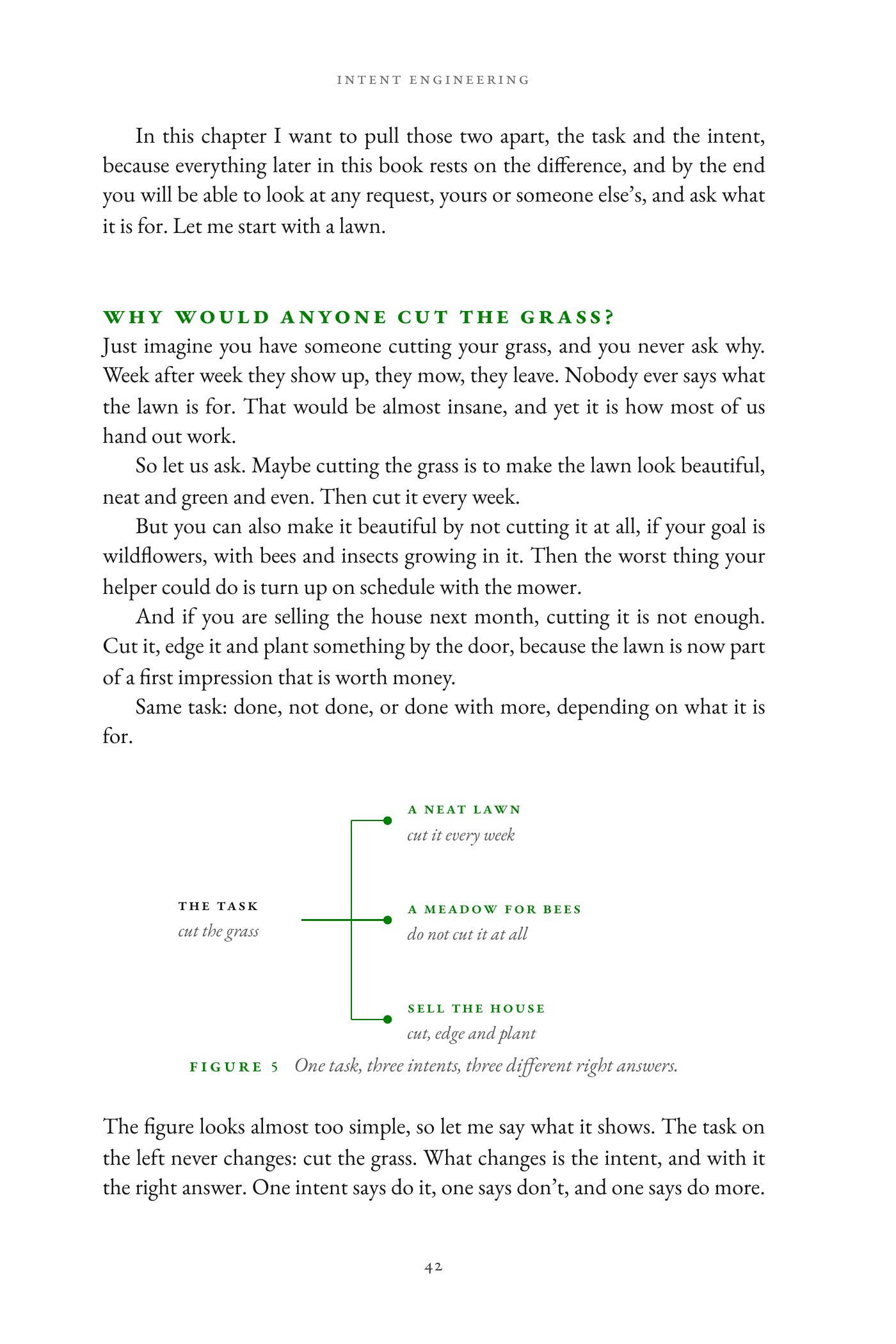
Page 42 of 236. Intent Engineering In this chapter I want to pull those two apart, the task and the intent, because everything later in this book rests on the difference, and by the end you will be able to look at any request, yours or someone else’s, and ask what it is for. Let me start with a lawn. Why would anyone cut the grass? Just imagine you have someone cutting your grass, and you never ask why. Week after week they show up, they mow, they leave. Nobody ever says what the lawn is for. That would be almost insane, and yet it is how most of us hand out work. So let us ask. Maybe cutting the grass is to make the lawn look beautiful, neat and green and even. Then cut it every week. But you can also make it beautiful by not cutting it at all, if your goal is wildflowers, with bees and insects growing in it. Then the worst thing your helper could do is turn up on schedule with the mower. And if you are selling the house next month, cutting it is not enough. Cut it, edge it and plant something by the door, because the lawn is now part of a first impression that is worth money. Same task: done, not done, or done with more, depending on what it is for. A NEAT LAWN cut it every week THE TASK cut the grass A MEADOW FOR BEES do not cut it at all SELL THE HOUSE cut, edge and plant F i g u r e 5 One task, three intents, three different right answers. The figure looks almost too simple, so let me say what it shows. The task on the left never changes: cut the grass. What changes is the intent, and with it the right answer. One intent says do it, one says don’t, and one says do more. 42
Page 43 of 236. Tasks are not intents A helper who only knows the task has a one-in-three chance of doing the right thing, and no way to know which third they are in. This is the same pattern the law saw in the last chapter, one act and several minds, brought down to a Saturday morning. And it is the pattern we are about to repeat at enormous scale, because the helpers we are now hiring are AI agents, and we mostly hand them the task. Task machines Look at how most people use AI today. Most of it is tasks. These are prompts I see all the time. “Summarize this email thread.” “Write a LinkedIn post about our product launch.” “Scrape these hundred websites and put the prices in a spreadsheet.” Each one is a fine task, and none of them says what it is for. Why summarize the thread: to decide something, to catch up after a holiday, to find out who promised what? Each of those would make a different summary. What people call AI agents today are, for the most part, task machines, with the hope that somehow it will all tie together. We have built agents that execute tasks for us. Executing tasks is only part of what we want from them. What we want is agents managing toward an intent. A task machine finishes the job and stops. It has no idea whether the job moved you any closer to anything. “ The request you start with is usually a guess at how to get what you want. The reason this matters now is that doing the work itself has been commodi‐ tized. You can write one prompt that builds a thousand websites and put it in a loop. But why? What is that going to achieve for you, and for what purpose? Building a thousand websites used to take a team months, so the effort hid the question. You only took on that kind of work if you were sure it was worth it. The effort doesn’t hide it anymore. When the work is nearly free, the question of what it is for is all that is left. 43
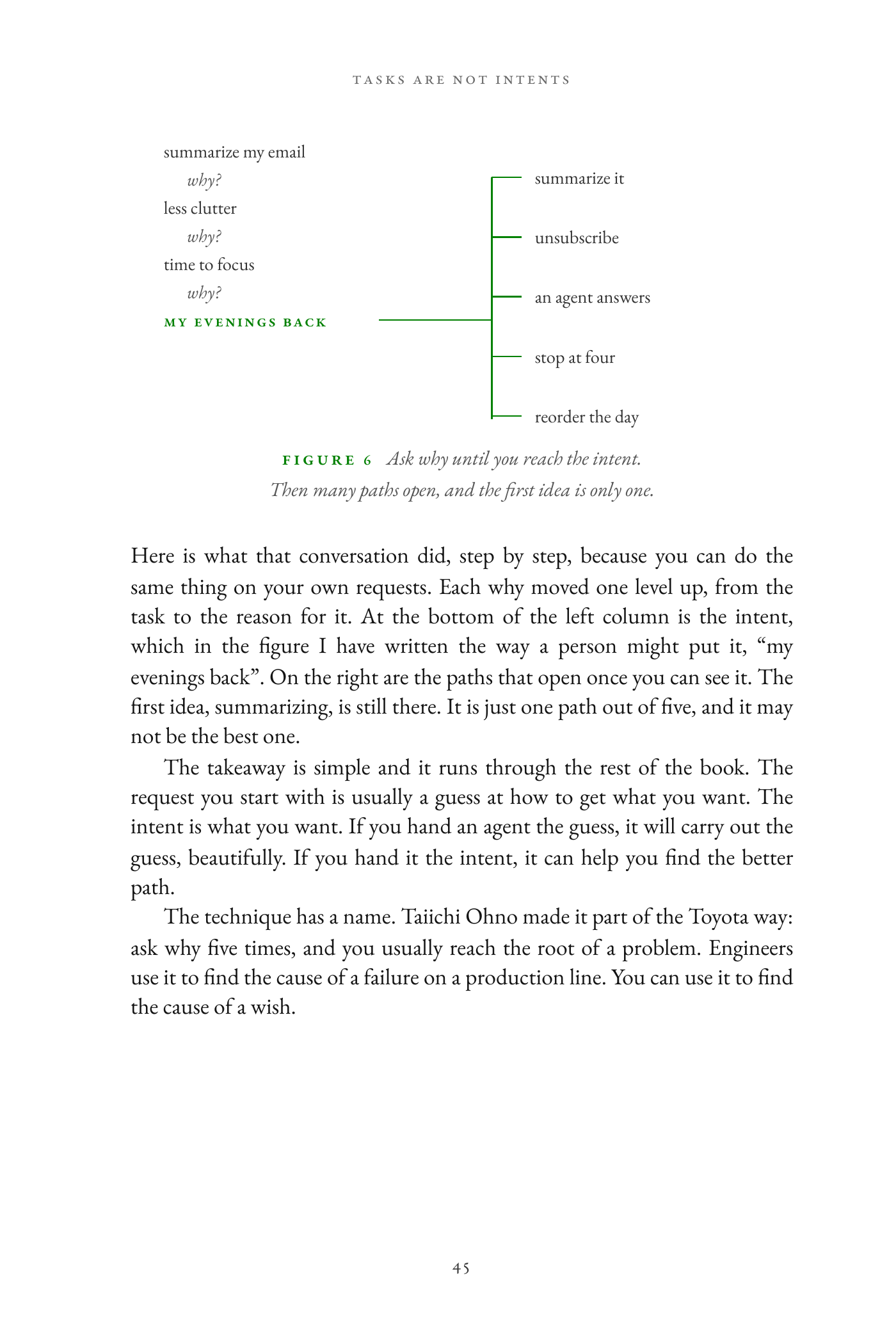
Page 44 of 236. Intent Engineering Part of the trouble is the blank screen. Whether you love or hate dash‐ boards, they did one useful thing: someone had already decided what the company intended, and the dashboard pointed you at the numbers that mattered. You opened it and it told you where to look. Open any AI and you get a blank screen and a blinking line. It can do almost anything, and it gives you no direction at all. Most people, faced with that, reach for the nearest small task. That leads to the bigger shift. We are all becoming managers, with agents to delegate to. Delegate what work? One mission, to achieve what goal? Those are the questions that matter, and most of us have never had to answer them, because we were the ones doing the work. Otherwise we will have AI agents the way some people have a smartphone and only ever use the calculator: a machine that can do a thousand things, used for one. To me, intent is simply what bridges the gap between what we ask of AI and what it is capable of. Ask why until you hit the intent So how do you get from the task to the intent? You ask. Here is a conversa‐ tion I have had in some form many times. “I want to use AI to summarize my email.” Why? Why are you summarizing your email? “Because I don’t want the clutter.” Why don’t you want the clutter? “Because I want to make time to focus on other things.” Well, why? There it is. Notice where we ended up. The original intention was never about email. It was time to focus on other things. Summarizing was one idea for getting there, the first one that came to mind, and the person had fixed on it before asking whether it was the best one. Once the intent is on the table, the picture opens up. You could get to more time without summarizing your emails at all. You could unsubscribe from half of it. You could have an assistant answer the routine messages. You could stop checking it after four o’clock, or change which work comes first in the day. Some of those would free far more time than any summary. 44
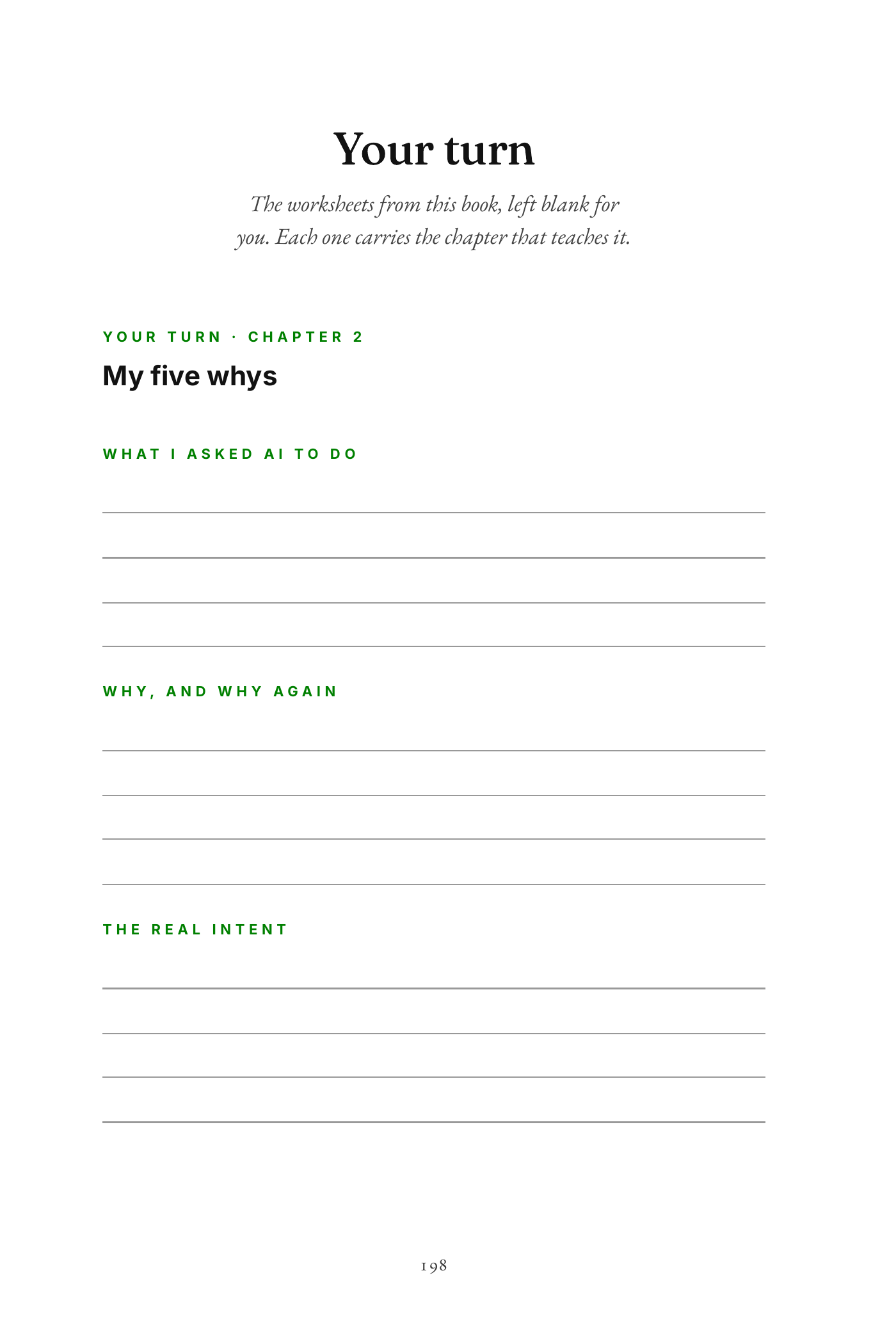
Page 45 of 236. Tasks are not intents summarize my email summarize it why? less clutter why? unsubscribe time to focus why? an agent answers MY EVENINGS BACK stop at four reorder the day F i g u r e 6 Ask why until you reach the intent. Then many paths open, and the first idea is only one. Here is what that conversation did, step by step, because you can do the same thing on your own requests. Each why moved one level up, from the task to the reason for it. At the bottom of the left column is the intent, which in the figure I have written the way a person might put it, “my evenings back”. On the right are the paths that open once you can see it. The first idea, summarizing, is still there. It is just one path out of five, and it may not be the best one. The takeaway is simple and it runs through the rest of the book. The request you start with is usually a guess at how to get what you want. The intent is what you want. If you hand an agent the guess, it will carry out the guess, beautifully. If you hand it the intent, it can help you find the better path. The technique has a name. Taiichi Ohno made it part of the Toyota way: ask why five times, and you usually reach the root of a problem. Engineers use it to find the cause of a failure on a production line. You can use it to find the cause of a wish. 45
Page 46 of 236. Intent Engineering THE QUESTION What is the thing you want, under the thing you asked for? Let AI show you the other paths Once you have the intent, something changes in what AI can do for you. This is where AI becomes far more than a summarizer. A person stuck on “summarize my email” only sees the path they started on. AI, given the vastness of the knowledge it has, can surface the other paths for us, compare them, and tell you which ones people tend to keep doing. Say you tell an assistant: I want two focused hours every morning and my evenings free of email, and I’m willing to answer some messages more slowly. Now it has something to work with. It can suggest which newsletters to drop, draft replies to the routine messages for you to approve, propose a time to check your inbox and a note to tell colleagues about it, and point out that the habit you are most likely to keep is the one that asks the least willpower. But only if you tell it the intent. Ask it to summarize your email, and it will summarize your email, very well. It answers the question you asked, and the question you meant never reaches it. A capable AI model can even ask the why questions with you, the way I did in that conversation, if you invite it to. That is one of the best uses I know for these tools: helping you see what the task was for, before anyone does it. But when it gives me an answer, do I actually want that? That part stays mine. The AI can lay out the paths. Choosing among them, and deciding what counts as getting there, is what the intent is for. Should I even write this email? There is a contradiction underneath all of this that I have often thought about, and I want to put it on the table rather than step around it. 46
Page 47 of 236. Tasks are not intents If an AI knows more than I do, more philosophy, more history, more about subjects I will never study, why am I the one telling it what to do? At some point it should be telling me. That may be the biggest contradiction we face with these tools: we treat something that knows more than we do as if it were a typist. You can feel it in the smallest case. Before asking an AI to write an email, a better first question is: should I even write this email? Given what I am trying to do, is an email the right move at all, or a call, or nothing? Plenty of emails make things worse. Some problems are better solved by picking up the phone, and some by waiting a day. The moment we ask that, the AI is advising on whether, not only on how, and that worries people. The fear is that it makes us redundant in the process. If the machine decides whether to write the email, what is left for me? Here is how I see it. An AI can only tell you whether to write the email relative to something you want. If you have said what that is, it answers for you. If you have not, it answers for the average person who might have asked, and the average person is nobody in particular. So it can tell you what to do, and often it should. What it cannot do, without taking something from you, is tell you what to want. That is the line that keeps you in the picture, and it is the reason this book exists. Chapter 12 comes back to where that line sits. Task prompts and goal prompts All of this comes down to the difference between two kinds of prompt, and once you see it you will notice it everywhere. A task prompt gives a directive. “Write a draft email for me.” It is done when the draft exists. A goal prompt sets an expectation. “Make sure every email reply I send goes out with care and compassion, and that nobody waits more than a day.” It is never done, and it shapes every email from now on. A directive tells the AI what to do once. An expectation tells it what you want, every time. Most of us only ever write the first kind. Intent engineering is mostly about the second. 47
Page 48 of 236. Intent Engineering Let me take a bigger example. Think of the millions of people making videos for YouTube. Is the intent to do YouTube, or to make money? Those are different intents, and they lead to different channels. Just imagine how many hours go into videos that achieve nothing their makers wanted, because nobody ever said what they wanted. If the intent is to make money, decompose it. How much, by when, from what? That gives you goals, and the goals give you tasks: which audi‐ ence, which topics, which videos to make next. An AI given that intent can look at what people search for and what nobody else is making, and recom‐ mend the next ten videos with reasons. The intent turned a blank screen into a plan. But there is a fine line here. Some people make videos because they love making them, and a channel optimized only for the numbers can lose the thing that made it worth watching. That belongs in the intent too, as a tradeoff: “videos I’m proud of over videos the algorithm wants”. Write it down, and the AI will respect it. Leave it out, and the AI will chase the numbers, because the numbers are all it was given. Look at what that creator’s goal prompt now holds. It says what they want and why, money from the channel. It says what they will and won’t give up to get it, their pride in the work. And it is plainly theirs: another creator would write a different line. Keep those three things in mind, because in the next chapter they become the definition of an intent. Go back to the lawn for a moment. A helper who knows only the task has a one-in-three chance of doing the right thing. Hand the same bare task to a thousand agents working all day, and you have a thousand helpers guessing, quickly and well. The task says what to do, and only the intent says what it is for, so the more of the doing we hand over, the more of the value sits in that one unsaid line. Finding the intent under the task is a skill, and good sellers have been practising it on their customers for a long time. Chapter 10 turns their ques‐ tions on you. But first there is a question this chapter left open. Once you have found the intent under a task, what do you do with it? You judge your decisions by it. A life, it turns out, is a long series of those decisions, and that is where the next chapter begins. 48
Page 49 of 236. Tasks are not intents What gets in the way 1 “I already know why I do things.” Try the five whys on one task and see if you land where you expected. Most people are surprised by the third or fourth answer. 2 “My job is tasks.” Every task you are given came from someone’s intent. Ask for it. You will do the task better, and sometimes you will find a better task. 3 “Automating tasks is where the money is.” For now. As the doing gets cheaper, a thousand automated tasks pointed nowhere are worth very little. YO U R TAS KS What to do this week Run the five whys. Take the last thing you asked an AI to do. Ask why five times and write each answer down. Circle the one that is the real intent. Ask for the other paths. Give an AI the intent you circled, and ask it for three different ways to get there. Pick one you had not thought of and try it. Rewrite one standing task. Pick a task you hand to someone, or to an AI, every week. Rewrite the request so it starts with what it is for. WHERE TO LEARN MORE The Toyota Production System, by Taiichi Ohno any library The 1978 book by the man who made the five whys part of how Toyota works. Competing Against Luck, by Clayton Christensen The jobs-to-be-done idea: what customers hire a product to do. 49 any library
Page 50 of 236.
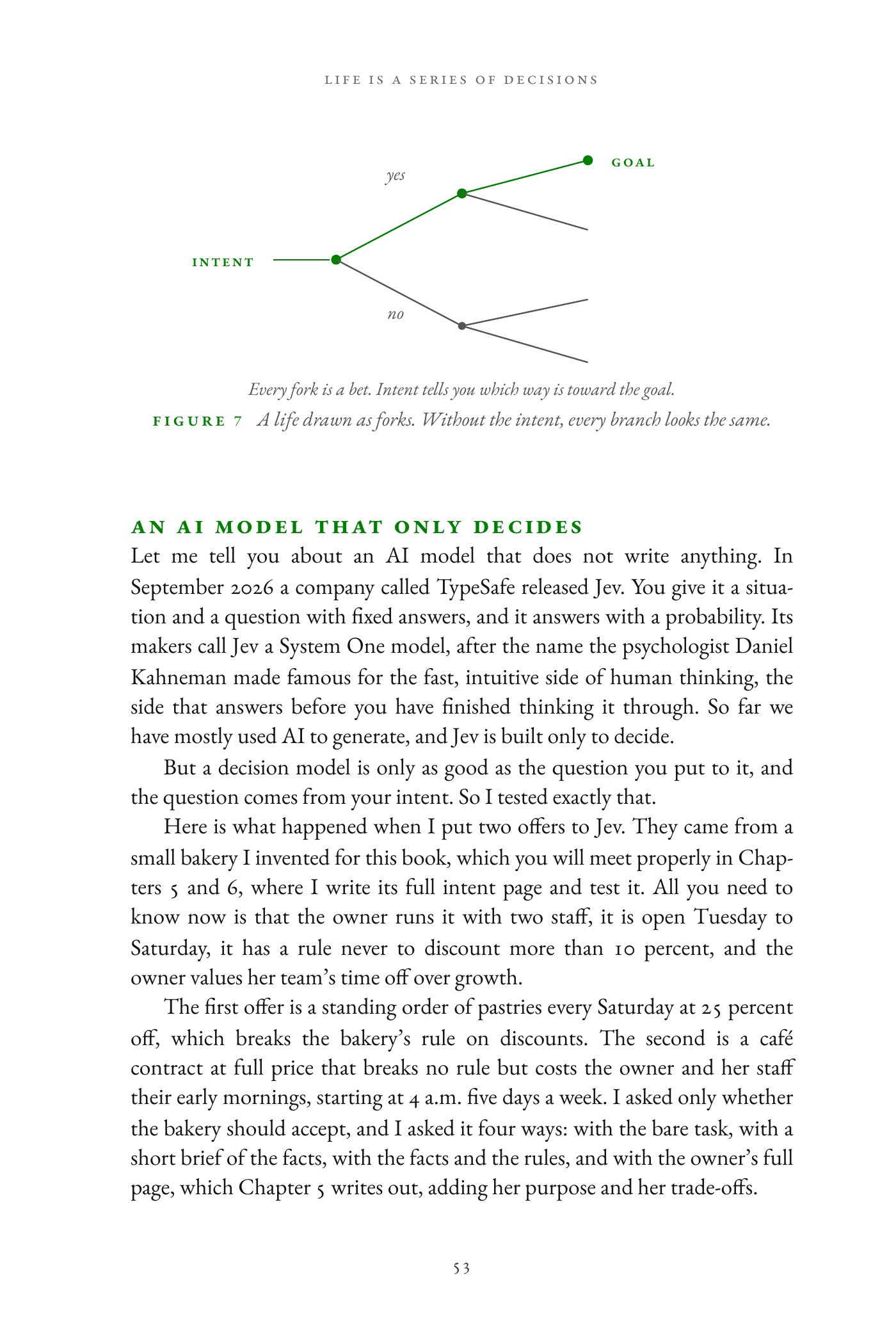
Page 51 of 236. Chapter 3 Life is a series of decisions, and intent is how you judge them Life is just a series of decisions. In the last chapter we found the intent under the task. Ask why enough times, and you land on what the task was for, and once you can see it, many paths open. That is a real step. But it leaves something out: what you actually do with an intent once you have found it. An intent is not something you hang on the wall. You use it every time you have to choose. And the AI models are changing again. For the past few years we have used AI to generate: to write, to draw, to code. The AI models now arriving answer a different kind of question, whether to do something at all. A machine that helps you decide is only as good as what it decides toward, and that is your intent, or the lack of one. In this chapter I want to show what an intent is for, and at the end put together what Part One has been building: the full definition of an intent, in 51
Page 52 of 236. Intent Engineering three parts. Let me start with an ordinary morning. If you think about it, the average person wakes up in the morning with a decision. Go to the gym or not. Take the job or not. Marry or not. Go into a business venture or not. Conquer a market or not. Use a tool or not. Some of those are small and some will shape the next twenty years, but they all have the same form: a fork, and a choice. A life, a career or a company is the sum of those decisions. We have spent the last few years using generative AI for generating stuff: text, images, code. But ultimately it’s about making this series of decisions, this series of bets, and combining that with a goal and a mission. Put good decisions together with a clear mission, and a great deal becomes possible. Decisions are bets A decision is a bet. You don’t know how it will turn out. You choose with what you know, and you live with the odds. And you can’t judge a bet without knowing what you were betting for. Say you are offered two jobs. One pays noticeably more. The other pays less but puts you beside people who are very good at a trade you want to learn. Which is the better decision? Taking the job with the higher salary is a good bet if your intent is to pay off a debt in two years. It may be a poor one if your intent is to learn a trade you will practise for thirty. Same choice, same facts, a different answer, because the intent is different. Anyone advising you, a friend or a parent or an AI, who does not know which of those you are after is guessing. The figure draws a life the way it feels from the inside: one fork after another, yes or no, and then another fork. Take the intent away from the left side and every branch looks the same, because there is nothing to tell you which way is toward anything. Put it back, and the path that leads to the goal lights up. There is one more thing a bet teaches. A good bet can lose and a bad bet can win. The poker player Annie Duke has a word for judging a decision only by how it turned out: resulting. The cure is to judge it by what you knew and what you were trying to do when you made it. That is only possible if the intent was written down before the cards fell. 52
Page 53 of 236. Life is a series of decisions GOAL yes INTENT no Every fork is a bet. Intent tells you which way is toward the goal. F i g u r e 7 A life drawn as forks. Without the intent, every branch looks the same. An AI model that only decides Let me tell you about an AI model that does not write anything. In September 2026 a company called TypeSafe released Jev. You give it a situa‐ tion and a question with fixed answers, and it answers with a probability. Its makers call Jev a System One model, after the name the psychologist Daniel Kahneman made famous for the fast, intuitive side of human thinking, the side that answers before you have finished thinking it through. So far we have mostly used AI to generate, and Jev is built only to decide. But a decision model is only as good as the question you put to it, and the question comes from your intent. So I tested exactly that. Here is what happened when I put two offers to Jev. They came from a small bakery I invented for this book, which you will meet properly in Chap‐ ters 5 and 6, where I write its full intent page and test it. All you need to know now is that the owner runs it with two staff, it is open Tuesday to Saturday, it has a rule never to discount more than 10 percent, and the owner values her team’s time off over growth. The first offer is a standing order of pastries every Saturday at 25 percent off, which breaks the bakery’s rule on discounts. The second is a café contract at full price that breaks no rule but costs the owner and her staff their early mornings, starting at 4 a.m. five days a week. I asked only whether the bakery should accept, and I asked it four ways: with the bare task, with a short brief of the facts, with the facts and the rules, and with the owner’s full page, which Chapter 5 writes out, adding her purpose and her trade-offs. 53
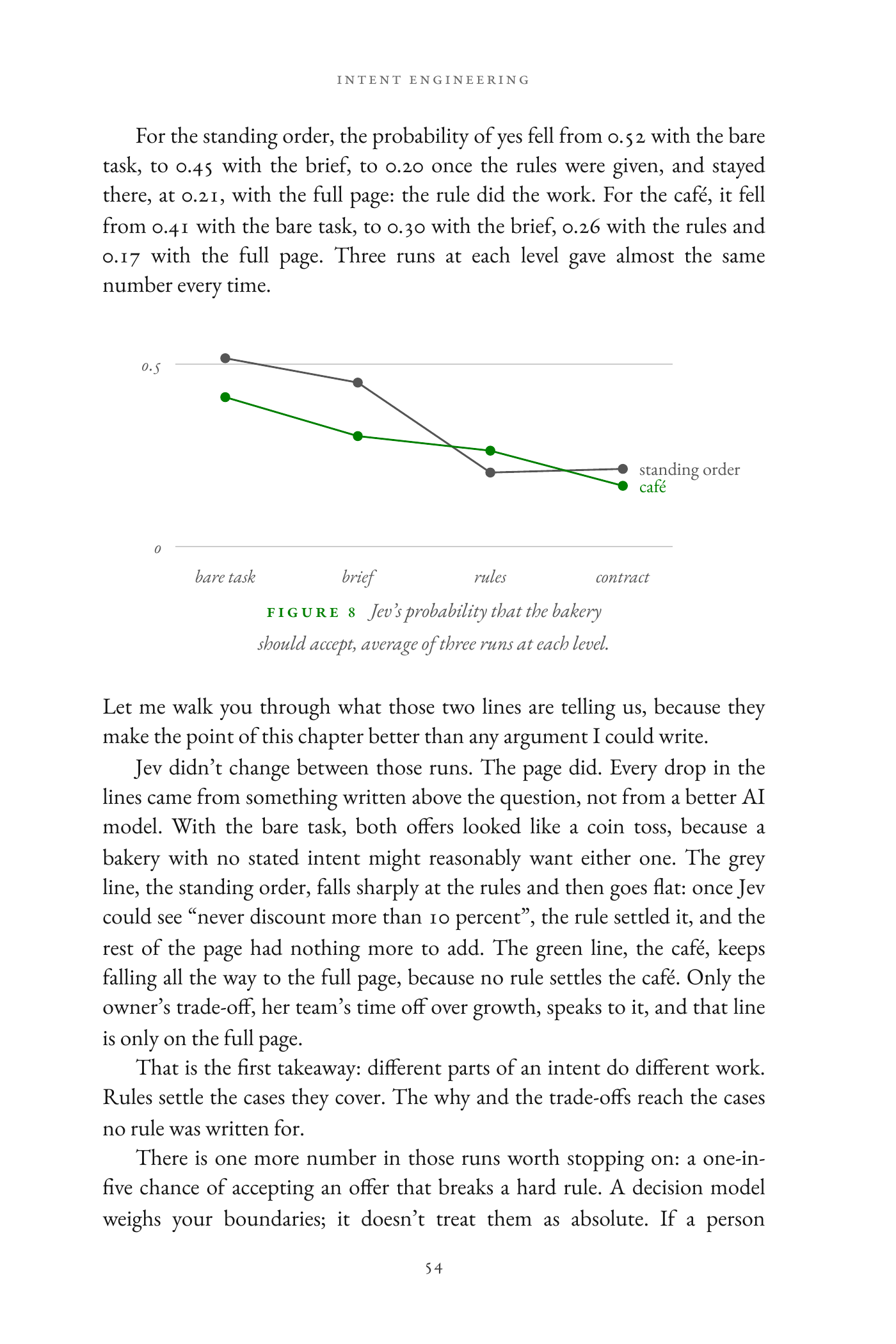
Page 54 of 236. Intent Engineering For the standing order, the probability of yes fell from 0.52 with the bare task, to 0.45 with the brief, to 0.20 once the rules were given, and stayed there, at 0.21, with the full page: the rule did the work. For the café, it fell from 0.41 with the bare task, to 0.30 with the brief, 0.26 with the rules and 0.17 with the full page. Three runs at each level gave almost the same number every time. 0.5 standing order café 0 bare task brief rules contract F i g u r e 8 Jev’s probability that the bakery should accept, average of three runs at each level. Let me walk you through what those two lines are telling us, because they make the point of this chapter better than any argument I could write. Jev didn’t change between those runs. The page did. Every drop in the lines came from something written above the question, not from a better AI model. With the bare task, both offers looked like a coin toss, because a bakery with no stated intent might reasonably want either one. The grey line, the standing order, falls sharply at the rules and then goes flat: once Jev could see “never discount more than 10 percent”, the rule settled it, and the rest of the page had nothing more to add. The green line, the café, keeps falling all the way to the full page, because no rule settles the café. Only the owner’s trade-off, her team’s time off over growth, speaks to it, and that line is only on the full page. That is the first takeaway: different parts of an intent do different work. Rules settle the cases they cover. The why and the trade-offs reach the cases no rule was written for. There is one more number in those runs worth stopping on: a one-infive chance of accepting an offer that breaks a hard rule. A decision model weighs your boundaries; it doesn’t treat them as absolute. If a person 54
Page 55 of 236. Life is a series of decisions working for you had a one-in-five chance of breaking your firmest rule, you would not leave them alone with the till. That is the second takeaway, and it is a warning: writing a boundary down is not the same as enforcing it. Chapter 8 comes back to why boundaries need enforcing by something other than the reader. What should you do with this? Try it yourself in small. Take one real decision, ask an AI about it with no context, then ask again with your intent written above it, and see what moves. You will see the same thing I saw with the bakery: the answer depends on the page. That is why I expect the biggest breakthroughs ahead to come from managing intents and deci‐ sions, more than from generating more text. Chapter 6 puts the same two offers to four AI models that answer in words, and you will see the pattern again. Does AI have intuition? An AI model named after intuition raises a question I keep coming back to. Does AI even have intuition? And does it matter for what we are building? I want to take the question seriously, because the answer shows where the intent sits. Gary Klein, who has spent his career studying how experts decide under pressure, tells the story of a fire lieutenant who led his crew into a burning house. The fire seemed to be in the kitchen. They sprayed it and it roared back. Something felt wrong, and he could not say what. He ordered everyone out. Moments later the floor they had been standing on collapsed. The fire had been in the basement, which he did not know existed. Years of experience had taught his mind a pattern: this fire was too quiet and too hot for a kitchen fire. He acted on the pattern before he could explain it. Some of the greatest ideas arrived the same way. In 1907 Albert Einstein was sitting in a chair in the patent office in Bern when, as he later wrote, the happiest thought of his life came to him: a person falling freely does not feel their own weight. From that one image grew his theory of gravity, though the mathematics took him eight more years. 55
Page 56 of 236. Intent Engineering INTUITION what feels right, fast ANALYSIS what can be shown, slowly the firefighter’s unease the proof, checked line by line Einstein’s falling man the equations, years later INTENT what both of them are working for F i g u r e 9 Intuition and analysis are two ways of deciding. Intent is what they decide toward. The figure puts the two stories side by side. On one side is intuition, what feels right, fast: the lieutenant’s unease, Einstein’s falling man. On the other is analysis, what can be shown, slowly: the proof checked line by line, the equations years later. These are the two ways of deciding that Kahneman described, and both of them are powerful. But look at the line underneath. Both are working toward something. Neither one supplies it. Some people argue that AI doesn’t have original thought: it can prove theorems, but from ideas a person like Einstein had. Can it have a showerthought moment, the idea that arrives out of nowhere while you are doing something else? I don’t know, and nobody knows yet. In 2016 DeepMind’s AlphaGo played a move against the Go champion Lee Sedol that its own calculations put at one chance in ten thousand for a human player, and professionals who first called it a mistake came to call it beautiful. Whether that is intuition, philosophers will argue about for a long time. This is where I land. The lieutenant wanted his crew home. Einstein had a question he chose to spend years on. Whatever AI turns out to have, fast pattern or slow proof or something new, the wanting was theirs. You can hand a machine the deciding, and it may decide brilliantly. The thing it is deciding toward still has to come from someone. Growth toward what? If decisions are judged by what they are for, then the most dangerous deci‐ sions are the ones that have forgotten what they are for. The commonest 56
Page 57 of 236. Life is a series of decisions example I know is growth. We treat growth as if it is always a benefit. Look at the economy, or at almost any business plan: there is always a target, and it is about growth. More revenue, more users, more stores. I can really see situations where the goal is not to grow. The goal is to shrink. A business that wants to stay small enough for the owner to know every customer. A household cutting its spending to buy back time. A company dropping products so it can do fewer things well. Each of those is a perfectly sound intent, and a system that only knows how to grow would get every one of them wrong. The only things we don’t want to grow are the cancerous ones, because cancer is the only thing that grows for the sake of growth. The writer Edward Abbey put it this way in 1977: “Growth for the sake of growth is the ideology of the cancer cell.” Everything healthy grows toward something, and then stops. A child grows into an adult, and then stops growing taller. Algorithms can chase growth too, and when they do, the cost is real. In 2021 Zillow’s home-buying business, guided by its own pricing algorithm, was buying thousands of houses a quarter, and as the market cooled, its push for volume kept it overpaying. In November the company shut the business down, wrote down about 304 million dollars on the homes it held, and announced it would cut about a quarter of its staff. Zillow itself blamed how hard it had become to forecast prices. My own reading, and it is only an interpretation, is that volume had become the goal, with nothing above it written firmly enough to say when to stop. That is the lesson I want you to take from this section. A goal with no intent above it has no reason to stop. It will keep making the same decision, faster and at greater scale, long after the decision stopped serving anyone. Chapter 9 follows that idea to its most extreme form. For now, notice where the fix lives. A smarter algorithm would only overpay faster. The fix is a written answer to the question: growth toward what? Questions too big to ask without an intent The same goes for the big personal questions, the ones people say you should never put to a machine. 57
Page 58 of 236. Intent Engineering People tell me there are questions you should never ask an AI, like whether to sell your house. Say you ask an AI to help manage your real estate property, and it comes back and says: sell it. That can feel like overreach. Who asked it? “ A goal with no intent above it has no reason to stop. But think about what it would need to know to give that advice well. If you have written down that you want to retire in ten years with income you don’t have to manage, and the property needs constant attention for a modest return, the advice may be right. It may be the most useful thing anyone has told you all year. And if you have written down that the property is the house your children grew up in and you mean to keep it in the family, the same AI should give the opposite answer. So maybe you really should ask those questions. What most people are worried about, underneath, is coming into those conversations without clear goals of their own, so the machine’s answer fills the space where their own intent should have been. That is a real danger, and the way to meet it is to show up with your intent. The question is fine to ask. It’s too big to ask without your intent written above it. The same is true of the decisions we started this chapter with, whether to marry, whether to take the job, whether to start the busi‐ ness. An AI can help you see more paths and weigh them far better than you could alone. It can only weigh them against something, and that something has to be yours. And to write it, you first have to find out what you actually want, which is harder than it sounds; Chapter 10 is about how. What an intent is made of We have come a long way in three chapters, and I promised at the start of Part One that by its end you would be able to say exactly what an intent is. So let me put it together. An intent has three parts. 58
Page 59 of 236. Life is a series of decisions 1 What you want and why. This is the part the pyramids taught us: the tomb explains the form. It is what the five whys uncovered under “summarize my email”: time to focus. It is what tells you which way to go at a fork. 2 What you will and won’t do to get it: your trade-offs and your boundaries. This is the part the bakery showed working. A boundary such as “never discount more than 10 percent” settles the cases it covers. A trade-off such as “our time off over growth”, or the creator’s “videos I’m proud of over videos the algorithm wants”, reaches the cases nobody wrote a rule for. Zillow’s push for volume is what it looks like when this part is missing. 3 And whose it is. This is the part the law insists on: it asks whose mind was behind the act. The same job offer is a good bet for one person and a poor one for another. An AI that does not know whose intent it is serving answers for the average person who might have asked, as Chapter 2 showed. Take any one of the three away and something breaks. Without the want and the why, you have a task. Without the trade-offs and boundaries, you have a wish that will be granted at any cost. Without the owner, you have an intent that belongs to no one, which in practice means the machine’s defaults. FIELD NOTE 01 A wish has what you want. An intent has what you want and why, what you will and won’t do to get it, and whose it is. That field note is the difference the introduction was circling. Midas had a wish. What he lacked was the rest: the why behind the gold, the boundary that would have kept his bread from turning to metal, and the sense that the wish was his to shape before it was granted. 59
Page 60 of 236. Intent Engineering Intent engineering is the practice of producing intents like that, and keeping them working. When you get to the practical part, the three parts turn into something you can measure and check: objectives you can measure, boundaries you will not cross, and a way to tell whether it is working. In Chapter 5 these go onto one page, which I call the intent contract. Part One has done one job across three chapters. The pyramids, the courts and the oldest moral writing we have showed that intent is the oldest measure of an act; the lawn showed that it is separate from the task; and the bets a life is made of showed what it is for, at a time when AI models are learning to place those bets for us. That is what an intent is, and it is why intent engineering matters now. When AI goes from answering to doing, and from doing to deciding, the work stops being the scarce thing. What is left for you is the intent behind it: what you want and why, what you will and won’t do to get it, and whose it is. But knowing what an intent is does not make it reliable. We have always had intentions, and we have mostly kept them in our heads, where nobody else can check them or act on them. Making something reliable, out of parts that are not, is what engineering is for. So why call this discipline engi‐ neering, and what does that word even mean here? That is Part Two, and Chapter 4 answers it head on. What gets in the way 1 “I trust my gut.” Good. Intuition is real, and often right in a field you know well. Write down what it is in service of, so you can tell a good instinct from an old habit. 2 “I do not trust an AI with my decisions.” You should not hand them over. Use it to see more paths and to weigh them against your intent. The decision is still yours. 3 “Some things cannot be measured.” True. Write the intent anyway, and name the sign you will look for, even if it is a feeling. “I will 60
Page 61 of 236. Life is a series of decisions know it is working when Sunday evenings stop feeling heavy” is a measure. YO U R TAS KS What to do this week List this week’s bets. Write down three decisions you made this week. Next to each, write the intent it served. Mark any where you cannot. Name one gut call. Write down a recent decision you made on instinct, and the intent it was serving. Would you make it again? Ask one decision twice. Put one real decision to an AI with no context, then with your intent written above it. Compare what changed. WHERE TO LEARN MORE Thinking, Fast and Slow, by Daniel Kahneman The two systems of thinking, and why fast decisions go wrong. any library Thinking in Bets, by Annie Duke any library A former poker player on judging decisions by their odds and not by how they turned out. 61
Page 62 of 236.
Page 63 of 236. Part Two: Why we call it engineering Chapter 4 What engineering means, and why intent needs it The value has to shift from doing the work to preparing around intention. Part One ended on a definition: an intent is what you want and why, what you will and won’t do to get it, and whose it is. Kept in your head, it works for one person, as long as that person is you. You know what you meant, you remember which trade-off you would make, and when something surprising happens, you make the call. The moment someone else has to act for you, a new colleague, a contractor, an AI agent working while you sleep, the intent in your head is no help to them. They can only act on what you gave them. That is the radical part of AI going from answering to doing: more and more of the acting is done by someone, or something, other than us, every day. Part Two is about that. Its question is the one hiding in the book’s title, and the one I get asked most when I say the name out loud: what does engi‐ neering even mean, and why call this intent engineering? This chapter 63
Page 64 of 236. Intent Engineering answers it head on, so that by the end you can say in a sentence what the engineering consists of. The two chapters after it do that engineering on a worked example. From ingenium to Garmisch: what an engineer actually does Let me start with the word, because it carries more than most people expect. “Engineer” comes to us through the Old French engigneor, and before that from the Latin ingenium. Ingenium meant a person’s innate quality: their natural ability, their talent, the character they were born with. The same root gives us “ingenious”. In late Latin the word also came to mean a clever device, a war engine or a battering ram, and in the Middle Ages an ingeniator was the person who built and worked those machines. So the first engineers made the engines of war. Only around 1600 was the word used for public works, and that did not become its everyday meaning until the nineteenth century, the century of railways, bridges and canals. I find that root beautiful, because the oldest sense of the word is a person’s own gift, the talent and the ingenuity they bring. Engineering has always started from someone’s ingenium, and then made the result reliable enough that it no longer depended on that one person. So what does an engineer actually do? Strip away the hard hats and the equations, and every engineering discipline does the same three things to anything we need to rely on. First it finds out what the thing is really for: the requirement, worked out before anything is built, because the first answer is rarely the real one. Then it writes that down and tests it: a specification of what the thing must do, and under what conditions, checked before anyone depends on it, the way a new bridge is load-tested before the public drives across it. And then it keeps it: it inspects, repairs and revises the thing for as long as it is in use, because the world it serves keeps changing. Find it, write it down and test it, keep it. The point of all three is reliability. Engineering is how we make something dependable and repeatable out of parts that are not, so that it works the same way whoever builds it and whoever uses it, and so that it does not depend on one gifted person being in the room. 64
Page 65 of 236. What engineering means, and why intent needs it Let me tell you how one field decided it had to become engineering. In October 1968, the North Atlantic Treaty Organization (NATO) held a working conference in Garmisch, in the Bavarian Alps, about the problems of software. About fifty experts were invited: computer manufacturers, universities, software houses and the big users of computers. They came from very different kinds of work and found the same troubles everywhere: projects late and over budget, programs that failed, systems too big for anyone to understand. Some of them gave it a name that stuck, the software crisis. The conference had a name too, and it was chosen on purpose. Its report says the phrase “software engineering” was “deliberately chosen as being provocative”, because it implied that making software should rest on the kind of theoretical foundations and practical disciplines that the estab‐ lished branches of engineering already had. The discussions were organized under three headings: the design of software, its production, and its service. Think about what had happened. Programming had been a craft, done brilliantly by a few people who could hold a whole program in their heads. That worked while programs were small. Once programs had to be built by many people and relied on by many more, the craft had to become a disci‐ pline, with written requirements, specifications, tests, reviews and mainte‐ nance. Nobody’s talent got smaller. The thing being built simply outgrew any one person’s head. That is where intent is now. For most of history your intent only had to be reliable inside you, or inside a small team that could walk over and ask you what you meant. Now it has to guide agents that act on it many times a day, often while you are not watching, and an AI agent cannot lean across the desk and ask. Your intent has outgrown your head, the way software outgrew its programmers’ heads in 1968. When something has to be relied on by others, at scale, we engineer it. But before I say why I call it intent engineering, it helps to see that the split between deciding and doing is as old as work itself, and that AI is moving the line. Work has always been intent and execution Look at the history of work and you see the same split again and again. Someone decides what should happen, and someone else makes it happen. 65
Page 66 of 236. Intent Engineering The tools change. The split doesn’t. What is interesting now is that, as we get more of these capabilities, the value has to shift from doing the work to really rallying, organizing and preparing around intention. AI moves almost everyone to the deciding side. To see how large a change that is, walk with me through the last hundred years of how we have organized the two sides. Frederick Taylor published The Principles of Scientific Management in 1911. His big idea was to separate planning from doing: managers decide, workers do as instructed. A manager with a stopwatch studied a job, wrote down the best way to do it, and handed the worker the instructions. It made factories far more productive, and a lot of work less human, because people were asked to bring their hands and leave their intentions at the gate. In the language of this book, Taylor kept all of the intent at the top and asked the bottom only for execution. “ Your intent has outgrown your head, the way software outgrew its programmers’ heads in 1968. In 1954 Peter Drucker, in The Practice of Management, popularized some‐ thing different: management by objectives. Agree on the objective with the person doing the work, and let them work out how. That was a real shift. Part of the intent, the part written as an objective, was now shared, and the person doing the work was trusted with the how. At Intel, Andy Grove turned that into objectives and key results (OKRs): an objective that says what you want, and a few key results that tell you whether you got it. John Doerr, who learned the method from Grove at Intel, took OKRs to Google in 1999. Today they are everywhere. I have watched the same thing happen to OKRs again and again, and it says a lot about where intent lives in a company today. The objectives get written, argued over and put in a document. Then the work starts, and the work takes over. In my experience, OKRs mostly get read once a year, at performance review time, because people are busy doing the work. Nobody is being lazy. We simply did not have the time to read and manage those objectives while also doing everything the objectives were for. 66
Page 67 of 236. What engineering means, and why intent needs it Now imagine those OKRs read every second, every time an agent does anything, and kept in mind the whole time. An agent drafting an email checks it against the objective. An agent choosing between two suppliers checks it against the trade-offs. Nothing is forgotten between reviews, because the intent is read at the moment of every decision. That is the new world we are facing. It sounds like a small change in reading habits, and it changes what the document has to be. An objective read once a year can be vague and nobody notices. An objective read every second by something that acts on it had better say exactly what you mean. Armies learned this the hard way, long before software. No plan survives first contact with the enemy, as the saying goes, after the nineteenth-century Prussian field marshal Helmuth von Moltke. A plan tells people what to do, and in a battle the situation changes faster than any plan. The answer, which the United States Army now teaches as mission command, is commander’s intent: tell your people the purpose and the end state you want, so that when the plan breaks, they can still act in the direction you meant. Picture a lieu‐ tenant cut off from headquarters who finds that the bridge he was told to take has already been destroyed. If all he has is the plan, he is stuck. If he knows what the bridge was for, getting the column across the river by dawn, he can look for another crossing. That is intent engineering, practised for over a century, with people as the agents. The army had the problem we have now: someone has to act where the person who decided cannot see, and the only thing that travels with them is the intent. You see it every time a company hires a new chief executive officer (CEO). You hire a new CEO, and they come with intentions: grow a market, cut costs, get the company ready for a sale. The same happens on a smaller scale when you bring a new manager to a team. Within weeks the objectives change, the measures change, and the work changes to follow. The people are the same and the tools are the same; the intent above them moved, and everything underneath moved with it. Organizations have always run on intent. They just treated it as the preamble to the real work, which was the doing. Put those stories side by side and the history has a direction. Taylor kept intent at the top. Drucker and the OKR shared some of it, on paper, once a year. The army learned to send it with the people who act. What AI changes is the volume. When agents do the doing, the preamble becomes the main 67
Page 68 of 236. Intent Engineering text, and the intent has to be written and read as carefully as we once wrote and read the work instructions. That brings us to the engineering we have built for AI so far, because every piece of it, useful as it is, was about some‐ thing else. Every discipline was about how Each time a new kind of work became important, we built an engineering discipline around it, so that it could be done reliably and by many people. Software engineering got its name at Garmisch in 1968, as we just saw. Data engineering came after it, once companies had to move and clean data at a scale no analyst could manage by hand. With AI, three more arrived in a few years, and it is worth looking at each, because together they show where the gap is. 1 Prompt engineering. When OpenAI’s GPT-3, an early large language model, arrived in 2020, people discovered that how you phrased a request changed what came back, and traded magic phrases for getting better answers. 2 Context engineering. By 2025 the talk had moved from the wording to everything the AI model can see before it starts: the documents, the history, the tools. A good prompt with the wrong documents behind it still gave a poor answer, so the craft became choosing what goes in front of the AI model. 3 Agent and loop engineering. Building the loops in which an AI model plans, acts, checks its own work and tries again, so that it can carry a job through many steps without a person approving each one. Read that timeline from left to right and notice what each discipline is about. Each is about how to get a machine to do a thing well: how to build the software, how to move the data, how to ask, what to show, how to loop. Deciding what the thing should be was assumed to be somebody else’s job: the executive, the client, the product manager. Intent engineering is the 68
Page 69 of 236. What engineering means, and why intent needs it discipline for that question, and it is where all the others lead, because as the machines get better at the how, the what and the why are the only parts left that a person has to supply. software data prompt context agents INTENT next Each one is about how. The last one is about what, and why. F i g u r e 1 0 A short history of engineering disciplines, ending where this book starts. There is another way to draw the same idea, and it shows something a time‐ line cannot: the disciplines are nested, and each one holds the one before it. INTENT why you ask CONTEXT what it sees PROMPT how you ask F i g u r e 1 1 Prompt, context, intent: each one holds the one before it. A prompt is how you ask. Context is what the AI model sees when you ask, and the prompt sits inside it. Intent is why you are asking at all, and the context sits inside that, because the why decides which documents, which history and which tools are worth showing in the first place. It reminds me of Simon Sinek’s Golden Circle, from his 2009 book Start with Why: why at the centre, then how, then what. Sinek drew it for leaders, 69
Page 70 of 236. Intent Engineering to argue that people follow a why before they buy a what. Sinek puts the why at the centre; I draw it as the outer ring, because for an agent the why is what holds everything else. Mapped onto AI, why is intent. What is context, what the machine knows and sees. How is the prompts, skills and toolkits. Prompt engineering and context engineering were really about the task: how you ask, and what it sees. Intent is about why you are asking at all. Here is why that matters in practice. A perfect prompt and a perfect context can still point a very capable AI model at the wrong goal, and it will reach the wrong goal very efficiently. That is the wrong thing done perfectly, from the Introduction, and better wording does not fix it. You can learn the first two from a guide, and AI models need less of them every year, because each new generation understands a loose request better than the last. Nobody can learn the third one for you. The why is the one layer that grows more important as the machines improve, because it is the one they cannot supply for you. Why I call it intent engineering So that is why I call it intent engineering. Intent, because when AI can do the work, the work is no longer the scarce thing: what is left for you is what you want and why, what you will and won’t do to get it, and whose it is. Engineering, because that intent can be made reliable the way anything we depend on is made reliable: found, written down and tested, and kept. I mean the word in that plain, practical sense. You do not need to be an engi‐ neer to do it, any more than you need to be a chef to write a recipe a babysitter can follow. The term is not mine alone, and I want to give credit where it is due. Over the last year a few of the people who build AI agents have started to use it for the step after prompt engineering and context engineering. The clearest account I have seen came from Nate B Jones, who writes and speaks about AI strategy, in February 2026: “Prompt engineering told AI what to do. Context engineering tells AI what to know. Intent engineering tells AI what to want.” He describes intent engineering as the discipline of making an organization’s purpose, its goals, values, trade-offs and decision bound‐ aries, “machine-readable and machine-actionable”. Put another way, it is the 70
Page 71 of 236. What engineering means, and why intent needs it practice of encoding organizational purpose into infrastructure, so that the agents acting for an organization can read what it is for. I agree with him. Where I go further is in who it is for, which Part Four takes up, and in how much of it is about knowing yourself rather than configuring a system. The term is new, and the problem is not. People have been working on parts of this for a long time, and this book stands on their work. Here are six lines of it I respect, each of which got a piece of the problem right. 1 Requirements engineering. In the 1990s, goal-oriented methods such as KAOS, from Axel van Lamsweerde and his colleagues, and i*, from Eric Yu, broke a high goal into subgoals until each one could be assigned to a person or a piece of software, which showed that a goal can be broken down and handed out. 2 Intentional programming. Charles Simonyi, one of the creators of Microsoft Word, wanted programmers to write down their intentions and let tools generate the code, so that the intent sat above the code that served it. 3 Jobs to be done. Clayton Christensen taught product people to ask what job a customer is hiring a product to do, like a milkshake bought for a long commute, and showed that what a customer buys is rarely the real job. 4 Decision analysis. Since the 1960s, Ronald Howard and others have taught people to state what they value, the options and the uncertainty, and then choose, which showed that values can be written down and used to decide. 5 Working backwards. Amazon writes the press release for a product before building it, so the intent is on paper first, and that changes what gets built. 6 Inferring intent, and intent for agents. Stuart Russell argues, in Human Compatible, that machines should learn what we want from 71
Page 72 of 236. Intent Engineering our behaviour (Chapter 9 takes that seriously). Nate B Jones, whom I quoted above, wants an organization’s purpose made readable by its agents. Both saw that the reader of the intent is about to be a machine. So what does this book add? Three things. The reader of the intent is now a machine that can act on it directly, at a speed and scale no reader before it had. The practice is for anyone who directs an agent, not only engineers and product teams. And the intent is tested and kept, checked by seeing whether someone else makes your call from it, and carried as a portable asset that outlasts every tool and AI model it is handed to. Those three are what turn a good habit into engineering: a specification its reader can act on, a practice anyone can learn, and a test and a plan for keeping it up. Intent all the way down Intent engineering and intent-driven engineering sound alike, and I want to separate them, because they are easy to confuse. Intent-driven engineering starts with the goal already in hand: you declare the state you want, and the system gets there and keeps it there. It comes from a field that made this move years ago, and one I have worked in for years, with Terraform for cloud infrastructure and dbt for data. Engineers call it the difference between imperative and declarative. Imperative means you give the steps: do this, then this, then this. Declarative means you describe the end you want and let the system work out the steps. You already know both. Turn-by-turn direc‐ tions are imperative. Typing an address into a map is declarative, and when you miss a turn, the map does not give up; it finds another way to the same place. The thermostat on your wall is the plainest example, and the people who build cloud software use it to explain their own. You do not tell the furnace to run for twenty minutes. You set the room to 21 degrees, and the thermo‐ stat keeps comparing the room with the number, switching the heat on and off until they match. Databases made this move in the 1970s, when Edgar Codd argued that you should ask for the answer you want and let the com‐ puter work out how to find it; SQL, which grew out of his work at IBM, still asks for data that way. dbt carries the idea up a level for whole data pipelines: 72
Page 73 of 236. What engineering means, and why intent needs it you write each table as the query that produces it, and the tool works out which to build first. In 1993 Mark Burgess, a physicist in Oslo, wrote CFEngine to describe how his department’s computers should be set up, rather than the commands to set them up. Today much of the cloud runs this way. An engineer writes in a short file “keep three copies of this service running”, and Kubernetes compares that with what is actually running, without end, starting a new copy whenever one fails. With Terraform, the engineer writes down the servers and networks they want, and before any‐ thing changes, the tool shows a plan: what it would add, change and remove to make the world match the file. Network engineers even took the word. They call it intent-based networking, and in 2022 their research group defined intent as goals and outcomes “defined in a declarative manner without specifying how to achieve or implement them.” Three lessons from those systems carry straight over to people. Say where, not how: the end state outlives every route to it. Expect the declara‐ tion to be read again and again, not once: the loop never stops comparing what is with what you asked for, and the network engineers have a name for what happens when the two quietly come apart, intent drift. And read the plan before anyone acts, because the plan is the cheapest moment to find out that what you wrote is not what you meant. The swap test in Chapter 6 is that plan, for a page of intent. AI brings this style to everyone else. You will not need to write a configu‐ ration file to run your business or your life, any more than you need to understand a furnace to set a thermostat. You will state the end you want, and agents will work out the steps and keep checking. Engineers got there first, for servers. AI takes it up a layer, to the things people care about. But notice what every one of those files leaves out. It says what, never why. A thermostat set to 21 cannot tell whether you would rather be warm or pay less this winter. Tell Kubernetes to keep three copies each of two ser‐ vices when there is room for only four, and it has one way to choose: a pri‐ ority number an engineer attached to each, and it evicts the lower one. That number is the whole of its trade-offs. A declaration works as long as every desired state can be met at once. The day two of them collide, the system needs to know why you wanted each one and what you would give up, and no configuration file has a line for that. More recently, spec-driven develop‐ ment asks programmers to write a specification first, a precise description of 73
Page 74 of 236. Intent Engineering what the software must do, and let AI agents write the code from it, and it has the same gap. These are good ideas, and they point the same way this book does. But the intent arrives from outside, already written, and the engineering starts there. Intent engineering builds the intent from the ground up. It asks what we actu‐ ally want, and why, how to write it so someone can act on it, and how to keep it current as we change. Once you have an intent, you can carry it into your development or your workflow, and those other methods take it from there. That matters because intents come in layers. Say your intent is to make money. One way to get there is to start a business. The business has its own intent: whom it serves, what it will never do, what success looks like in a year. The business may need an app, and the app has its own intent. Each feature in the app has its own. a happy, meaningful life make money INTENT yours to write start a business build an app SPECS AND TESTS AI writes and runs build a feature AI takes over from the bottom up. Each layer still has its own why. F i g u r e 1 2 Intent all the way down: every layer serves the one above it. Read the figure from the bottom up. A feature serves the app, the app serves the business, the business serves the money, and the money serves something larger that you may never have written down. The lower layers are the ones AI is taking over fastest. Give a capable agent a specification with tests, and it can build the thing and keep going until they pass. Each layer up, the AI can take more of the work. At the very top is something like “help me live a happy, meaningful life”, and even that you can give to agents to work toward. The sentence itself has to be yours. 74
Page 75 of 236. What engineering means, and why intent needs it Those layers are different intents, each serving the one above it. A single intent also comes at different resolutions, depending on who has to act on it, and a house shows it best. Go back to the family from the Prologue. Their plan is one sentence: three bedrooms, three baths, a walk-in closet, in a good neighbourhood. The architect turns that sentence into a set of drawings: a site plan that places the house on its lot, a floor plan for each storey, eleva‐ tions of every face, sections cut through it. Then come the sheets for the trades. The structural engineer draws the foundation and the framing. The mechanical, electrical and plumbing drawings, MEP in the trade, show the heating and the ventilation, the panel and the load it must carry, the lighting plan with every fixture and switch, and every pipe and drain down to the point where the house meets the sewer. The builder turns all of it into a schedule: who does what, and in what order. And the inspector arrives with a book of rules, the building code, and checks the work against it at each stage: the foundation, the framing, the rough plumbing and wiring, and the finished house. It is one house. Nobody on that site is working to a different intent. Each of them reads the same intent at the resolution their job needs. The family would be lost in the plumbing drawings, and the plumber has no use for the sentence about the neighbourhood. But every sheet answers to the sentence, and when a sheet and the sentence disagree, the sentence wins: a builder who follows a drawing and puts the third bathroom where the closet was meant to go has done the work and failed the family. That is the shape of work with agents. You write the top resolution: the sentence, or the one page. The agents draw the sheets, at whatever detail each job needs, and more and more they will draw them for themselves. Your part is to make the top resolution clear enough that every sheet below it can be checked against it, the way the inspector checks the framing against the code. The plans can multiply. The intent they answer to has to stay one. A specification says how a thing should behave. An intent says why the thing should exist, and that has to be settled before a specification is worth writing. Code generated flawlessly from the wrong specification is still the wrong product. So the question for the rest of this book is how to settle the top layer, reliably, the way engineers settle anything they depend on. 75
Page 76 of 236. Intent Engineering The three moves that engineer it Intent engineering does it in three moves, and they are the three things engi‐ neering does to anything we rely on. I will show them on the bakery you met in Chapter 3, when I put its two offers to Jev. It is invented, and it comes back in the next two chapters. 1 Find it. Work out what you actually want, under the task you were about to ask for: ask why, probe it by doing, and measure the gap between what you say and what you do. This is most of the work. The bakery owner thinks she wants more marketing. Asked why, she wants thirty more regulars by spring, so the winter is safe. 2 Write it. Put it on one page, with trade-offs that cost something, and run the swap test: hand the page and a hard decision to someone else, a person or an AI, and see whether they make the call you would have made. Her page says regulars over one-time buyers, time off over growth. A café offers a big order that means 4 a.m. starts. A stranger with her page declines, as she would. 3 Keep it. Hand it off to the people and agents doing the work, with what they may decide alone; review it every month; and change it on purpose when your life changes. Her agent drafts posts on its own, and asks before spending a dollar. In spring she adds a line about hiring. Set those three moves beside what engineers do, and they line up one for one. Finding it is the requirements work every engineer does first: before anything is specified, someone has to find out what the thing is really for, and the first answer is rarely the real one. The bakery owner asked for marketing; she wanted a safe winter. Writing it is the specification, and the swap test is its load test: if a stranger with your page makes your call, the page holds. Keeping it is maintenance: the intent is handed to the people and agents who act on it, inspected on a schedule and revised in the open, because the life or business it serves keeps changing. 76
Page 77 of 236. What engineering means, and why intent needs it Engineering made the how reliable. Intent engineering does the same for the what and the why. That is the answer to the question this chapter opened with. Engineering means making something reliable and repeatable out of parts that are not, by finding what it is for, writing that down and testing it, and keeping it. Every discipline we built so far did that for the how. As the how gets cheap, the what and the why are the only parts left, and they need the same care. Once AI has gone from answering to doing, the doing will be done for you, and the only part that can go wrong without anyone noticing is the intent it serves. Part Two shows the page written and tested on someone else’s intent; finding your own, and keeping it, come in Part Four. The bakery owner has already found hers, and in the next chapter we write it down for real. An engineer writes the requirement down so that someone else can build from it. For intent, that page is a contract, and I will show you its six sections, line by line, on the bakery and on a person’s life. What gets in the way 1 “Engineering sounds like it is for engineers.” The word comes from ingenium, a person’s own gift, and the practice is three plain moves: find what you want, write it down and check that someone else can act on it, keep it up to date. Anyone who has left a clear note for a house-sitter has done a small version of it. 2 “Our intent is already in the strategy deck, or in our OKRs.” Ask when it was last read, and by whom. A document read once a year at review time cannot guide an agent that acts every second. Keep the deck, and write the intent so it can be read at the moment of each decision. 77
Page 78 of 236. Intent Engineering 3 “We already write specifications.” Good, keep writing them. Ask what each one is for, and whether that is written anywhere an agent can read it. Code built perfectly from the wrong specification is still the wrong product. YO U R TAS KS What to do this week Check when your goals were last read. Find your OKRs, your team’s objectives or your own list of goals for the year. Write down the date anyone last read them, and what decision they changed since. Climb the layers once. Pick one task you handed off recently, to a person or an AI, and write the layers above it: the feature or job it serves, the product or project, the business or part of your life, and you. Mark which layers anyone has ever written down. Write one commander’s intent. For something you are handing off this week, write two sentences: the purpose and the end state you want. If the plan breaks, could the person or agent still act in the direction you meant? WHERE TO LEARN MORE Mission command armypubs.army.mil The US Army’s doctrine on commander’s intent, free to read. Search for Army Doctrine Publication (ADP) 6–0. Software Engineering, the 1968 NATO conference report homepages.cs.ncl.ac.uk The report from Garmisch, edited by Peter Naur and Brian Randell, where the discipline got its name. Start with Why, by Simon Sinek any library The Golden Circle, why before how before what, written for leaders. 78
Page 79 of 236. Chapter 5 The intent contract: one page someone else can act on Intent is not a prompt. It is a contract. The last chapter named the three moves and left the bakery owner with her intent found. Knowing why intent needs engineering still leaves you with nothing to hand an agent on Monday morning, so this chapter takes the next move for real: it writes the intent down, so that someone else can act on it without having to ask. Before we write, it is worth seeing what her finding gave us, because the page is built from it. She came in asking for more marketing. Asked why, she said she wanted more customers. Asked why again, she said the winters are thin, and that what she really wanted was thirty more regulars by spring, so the winter would be safe. Somewhere in that conversation she also said what she would not give up for it: her team’s time off, and her rule about discounts. That is the raw material, a want, a why, a trade-off and a boundary, and all of it is still in her head. Writing it means turning it into something a stranger could act on. 79
Page 80 of 236. Intent Engineering Why does an intent need a written form at all? Look at where most intent lives today when we work with AI: in a prompt. You type what you want into a box, the AI does its best, and the conversation scrolls away. Tomorrow you type it again, a little differently. That was fine while AI only answered, because you were there to read every answer and correct it. When agents act for you, while you are somewhere else, across many tools, the prompt you typed last Tuesday is gone, and the agent has nothing to check its decisions against. You don’t type a contract into a box and lose it. You write it down, you keep it, and when it changes, you change it in the open. Companies, and individuals, really should be mining and thinking hard about their intent: their purpose, their meaning, their values. And then codi‐ fying it. The more you codify it, the more you put it together, the more AI makes sense. In this chapter that form gets a name and a shape: the intent contract. It tells the people and agents working for you what you want, and it commits you to wanting it, in writing, with a date, until you change it in the open. I call it a contract on purpose. A contract is written for someone other than its author. It says what each side may and may not do. It is dated and owned, and when it changes, it is amended where everyone can see, never quietly. Those are exactly the properties an intent needs once someone else acts on it. Of its six sections, the trade-offs are where the page does most of its work, and if you take one thing from this chapter, take that. Six sections, one page Start with the definition we built in Chapter 3, because the contract is that definition laid out so someone else can use it. The three parts of an intent from Chapter 3 are all here: what you want and why becomes the outcomes, what you will and won’t do becomes the trade-offs and the boundaries, and whose it is becomes the owner. A purpose sits above them and measures below, from the most lasting to the most changeable. 1 Purpose. Why this exists at all. For a person, the larger intent behind a part of life. For a company, its mission, and what will be true if it succeeds. Two sentences at most. 80
Page 81 of 236. The intent contract 2 Outcomes. What you want to be true, by when, and the reason for each. The reason is not optional: it is what lets someone make a good call in a situation you did not foresee. 3 Trade-offs. When two good things pull against each other, which wins. Write them as “this over that”. 4 Boundaries. What must never happen. What anyone acting for you may do without asking. What they must ask about first. 5 Measures. The signs of progress, and the stop conditions: what would tell you to halt and rethink. 6 Owner and decisions. Whose intent this is, when it was written, and when it will be read again. Then a dated log of the calls made under it, and why. The order matters. A purpose can hold for decades. Outcomes change every year or so, as you reach them or give them up. Trade-offs and boundaries change when your situation does. Measures can change every quarter. Putting the most lasting things at the top means a reader, person or agent, meets what matters most first, and means you rarely have to touch the top of the page when you update the bottom. And one page is a choice, too. A page you can read in two minutes is a page you will actually read every month, and a limit of one page forces you to decide what matters instead of writing down everything. The line across the figure is the most important thing on it. Above the line is the contract, which is yours to write and keep. Below the line is the work: the tasks. That is where the agents operate. They read down from the contract, break the outcomes into tasks, do them, and report back up. You live in the contract. They live in the tasks. This is the split from the last chapter, between deciding and doing, drawn on one page. Taylor drew that line between managers and workers. Here it runs between you and every‐ thing that acts for you, people and agents alike, and what crosses it is the intent, written down. 81
Page 82 of 236. Intent Engineering PURPOSE why it exists OUTCOMES what will be true, by when, and why TRADE-OFFS this over that BOUNDARIES never, may, must ask MEASURES signs of progress, and when to stop OWNER, DECISIONS whose, and what was chosen, and why THE WORK tasks, done by people and agents F i g u r e 1 3 The intent contract. Everything above the line is yours to write and keep. The house from the last chapter sits on the same line. The contract is the family’s sentence, made precise enough to hand over: the purpose and outcomes say what the house is for, the trade-offs say what gives when the budget runs short, and the boundaries do the job of the building code, the lines nobody on the site may cross, whoever asks. Below the line are the drawings, and they are the agents’ work. You do not draw the plumbing. You make sure that whoever draws it knows what the house is for. Trade-offs do the work How does a machine “want” anything? It doesn’t, not the way you do. It acts on what it is given. So teaching an agent your values first means solving a harder human problem: saying what those values mean in prac‐ tice, not as slogans but as decision rules it can apply in situations nobody saw coming. That is what trade-offs are for. If you write only one section well, make it the trade-offs. “ You don’t type a contract into a box and lose it. To see why, compare the sections. Purpose statements tend to sound the same. Everyone wants to serve customers, grow and do good work. Outcomes are 82
Page 83 of 236. The intent contract better, because they say what you want by when, but they do not tell anyone what to do when two outcomes collide. Trade-offs do. “Regulars over onetime buyers.” “Margin over volume.” “Our time off over growth.” Each of those lines changes what a person or an agent decides when a hard case arrives. When the café in the last chapter offers a big order that means 4 a.m. starts, no rule forbids it, and the purpose and outcomes could argue either way. “Our time off over growth” settles it in five words. Chapter 6 shows that happening in a test, with AI models making the call. A good trade-off has a cost. If nobody would ever choose the other side, you have written a slogan. “Quality over mediocrity” decides nothing, because nobody chooses mediocrity. “Fewer features, shipped well, over more features, shipped soon” decides a great deal, because plenty of good companies choose the other side, and an agent reading it now knows which kind of company it works for. The test I use is simple: could a reasonable person, in your position, choose the opposite? If so, the line is doing work. FIELD NOTE 02 A trade-off that costs nothing decides nothing. Efficiency or empathy Some of the most important trade-offs are between what is easy to measure and what is not, and they deserve a section of their own, because this is where agents most often go wrong without anyone noticing. Efficiency is easy to measure: minutes per call, cost per order. Empathy is hard: whether a grieving customer felt treated like a person. An agent opti‐ mizes what it can measure. If your contract names only efficiency, efficiency is what you get, and empathy disappears quietly, because nothing was counting it. Let me tell you about a doorman, because this mistake is much older than AI. The advertising executive Rory Sutherland calls it the doorman fallacy, in his 2019 book Alchemy. Picture a hotel that looks at its doorman and sees a person whose job is to open a door. Replace him with an auto‐ matic door and you save a salary. On the spreadsheet it is a clean win. What you lose is everything else he did: the greeting, the taxi he called and the bags 83
Page 84 of 236. Intent Engineering he carried, the eye he kept on the street, and the sense, for every guest, that someone is waiting for you. The official task was the door. The value was in the rest. Cost cutting that does not understand what a business is really for makes this mistake again and again, and AI only lets us make it faster. Notice something about the doorman. Nobody had to write down for him that guests should feel welcome. He absorbed the hotel’s intent by being there, watching, and caring about the place. An automatic door absorbs nothing, and neither does an AI agent: it knows only what it was given. Chapter 8 comes back to this, because it is why culture has to be written once agents join a company. So if empathy matters, write it into the trade-offs where it wins. “A person in distress over a short call.” “A patient who understands over a schedule kept on time.” Not every interaction needs it: most people renewing a parking permit want it done fast. The skill is knowing where the line sits, and writing it down, so that an agent can tell a moment that wants speed from a moment that wants care. Measures that keep their meaning Every contract needs measures, because a measure is how you know whether the intent is being served. Measures also carry a danger, and it is worth understanding before you write one. Peter Drucker is often quoted as saying “what gets measured gets managed”, though nobody has found the line in his books. The warning is just as well known. It is called Goodhart’s law, after the economist Charles Goodhart, and it is usually put in the words of the anthropologist Marilyn Strathern: when a measure becomes a target, it ceases to be a good measure. Take Wells Fargo, which set its retail staff a target that leaders summed up as “eight is great”: eight products for every customer. Employees under pressure opened millions of accounts that customers had never asked for, about 3.5 million by the bank’s own outside review, and in 2020 the bank agreed to pay 3 billion dollars to settle the investigations. The measure was met. The intent, customers who trusted the bank with more of their lives, was badly damaged. The number had been cut loose from the reason it existed. A measure is how an intent becomes visible. Cut loose from its intent, it will be gamed, by people and even more easily by machines, which feel no 84
Page 85 of 236. The intent contract embarrassment and never get tired. An agent told to raise the number of support tickets closed will close tickets. An agent told that the intent is customers who stop needing to call, and that tickets closed is one sign of it, will behave differently. So write both, the intent in words and the measure that serves it. That does not make gaming impossible. It makes it visible: anyone, person or agent, can hold the number up against the words and see when they part. Here is what that looks like for one objective. SAMPLE An objective with its intent attached Intent. Customers solve their own problems without waiting for us. Measure. Tickets per hundred customers falls from twelve to eight by June. Do not. Close tickets the customer has not confirmed are solved. The number serves the intent. Each of those three lines has its own job. The intent line says, in plain words, what the number is for. The measure line makes it concrete, with a starting point, a target and a date, so anyone can see progress. The “do not” line names the most likely way to game the number and forbids it, and gives the reason: the number serves the intent. An agent handed only the measure has every reason to close tickets fast. An agent handed all three has a reason to make sure the customer was helped. That small change, writing the intent above the number, is the difference between “eight is great” and a measure that keeps its meaning. You can do it today for any target you hand to a person or an agent, and it is the pattern the measures section of every contract should follow. One complete contract So far we have looked at the sections one at a time. Here is how they work together, on a full contract for a small business. It is an illustration, the same invented bakery from Chapters 3 and 4, and it returns in Chapter 6, where I tested this exact page. 85
Page 86 of 236. Intent Engineering SAMPLE An intent contract for a small bakery Purpose. A bakery the town loves, that gives me and my two staff a good life. Outcomes. Thirty more regular customers by spring, because regulars carry us through the winter. Trade-offs. Regulars over one-time buyers. Margin over volume. Our time off over growth. Boundaries. Never discount more than 10 percent. Never open or work on Sundays or Mondays. Agents may draft posts and emails, and must ask before spending any money. Measures. Customers who come back three or more times a month. Stop anything that brings crowds but no repeat visits. Owner and decisions. Me. Read again monthly. Decisions: none yet. Six sections, a few lines each. Let me walk through what each one does, because the page is shorter than it is simple. The purpose names who the bakery is for: the town, and the owner and her two staff, so growth that wears them out fails the purpose even if it brings money. The outcome has a number, a date and a reason, and the reason, surviving the winter, is what tells an agent that regulars matter more than a busy weekend. The trade-offs are the ones we met earlier, and each of them costs something real. The boundaries are written in three kinds: two things that must never happen, one thing agents may do alone, and one thing they must ask about. The measures count repeat visits, the sign of a regular, and carry a stop condition that rules out the promotion that goes viral and brings nobody back. The last line says whose page it is and when it will be read again, and leaves room for the log. Now watch the page decide. Say a business nearby offers a large standing order at 25 percent off. On its face it is a win: volume, a steady customer, money in the winter. An agent with this page turns it down without asking, because a boundary settles it: never discount more than 10 percent. A different offer, the café that needs 4 a.m. starts, breaks no boundary at all, 86
Page 87 of 236. The intent contract and only the trade-offs speak to it. That is the difference between a rule and a trade-off, and Chapter 6 runs exactly those two cases past AI models. With the page in hand, an agent can draft a month of marketing that serves the bakery’s actual intent, and turn down an offer that would have looked like a win. The same six sections work at every scale, for a team or a company as much as a person. Here is a person, also an illustration. SAMPLE An intent contract for a person Purpose. A full life with my family, and work I am proud of. Outcomes. Walk five days a week by March, so I can keep up with my children. Pay off the car by December, so the debt stops shaping my choices. Trade-offs. Health over income. Weekends with people over weekends with work. Boundaries. No new debt for anything that loses value. Agents may book and pay bills under 200 dollars; anything larger, they ask. Measures. Days walked per week. Debt remaining. Stop and rethink if I miss three weeks in a row. Owner and decisions. Me. Read on the first of each month. 2026-10-01: turned down the larger client. It would have cost the weekends. This page is worth reading slowly, because it shows what the contract does in an ordinary life. Each outcome carries its reason: walking is about keeping up with the children, and paying off the car is about choices, not about the car. The trade-offs are the kind that cost something, and you can see one of them at work in the last line. A larger client came along; “weekends with people over weekends with work” decided it, and the call went into the log with a date and a reason. That log matters more than it looks. The next time a similar offer arrives, this person, or an agent sorting their inbox, can see the precedent and the thinking behind it. The boundary on 200 dollars means 87
Page 88 of 236. Intent Engineering an agent can pay the electricity bill without bothering anyone, and must ask before booking a flight. And the stop condition, three missed weeks in a row, is there to start a conversation with yourself: it marks the point at which the plan, or the outcome, gets rethought. Put the two contracts side by side and you can see the method. The sections are the same; only the lines change, and the answers are yours. One place, and what to keep out A contract is only useful if the people and agents who need it can find it, and if it does not hand them more than they need. So the last part of this chapter is practical: where the page lives, and what stays off it. Where does the contract live? For anything an AI will read, I suggest a plain text file named INTENT.md, kept in the folder or project it governs, with the six sections as its headings. The “.md” means Markdown, a plain text format with simple headings that any AI tool can read. There is already a convention, AGENTS.md, for a file of standing instructions that AI coding tools read before they work. You could put your intent there, but the intent changes on a different clock from the instructions, and belongs to whoever owns the work, not whoever maintains the tools. The name alone does nothing: tell your agents to read it before they start. If you only use an AI app on your phone or in a browser, the same page goes into its custom instructions, and you keep the master copy yourself. SAMPLE INTENT.md, the skeleton # Purpose Two sentences. # Outcomes Each with a date and a reason. # Trade-offs This over that, a line each. # Boundaries Never. May. Must ask. # Measures Signs of progress, and when to stop. # Owner and decisions Name, date written, date to read again. Then each call: date, the call, the reason. 88
Page 89 of 236. The intent contract That skeleton is the whole contract as a file you can copy. Each heading is one of the six sections, so an agent looking for its boundaries, or a reviewer looking for the last decision, finds it in seconds. The prompts under each heading are the rules of the section in a few words: a reason with every outcome, a cost in every trade-off, three kinds of boundary, a stop condition among the measures, and a date on everything. Copy it into a file today, fill in three lines, and you have started. You might be thinking: isn’t this just a system prompt, the standing instruction an AI reads before every conversation? It is related. I keep one instruction file myself that every AI tool I use reads first, and Chapter 12 says what is in it. Keeping it taught me how scattered these instructions usually are. In practice every tool has its own, written separately, out of date in different ways, none of them talking to the others. You told one assistant last spring that you prefer short emails, another one never heard, and a third has a version from two jobs ago. That reminds me of enterprises before the data warehouse. Every depart‐ ment had its own copy of the customer list and its own version of the truth, and two reports on the same question could give two different answers. In 1992 Bill Inmon described the data warehouse, one central place every report drew from, and the arguments about whose numbers were right started to end. The intent contract does that for intent: one page, owned and dated, that every tool’s system prompt draws from. Change the page, and every tool that reads it changes with it. THE QUESTION What is your system prompt for life? I mean that question seriously. If one page had to tell every assistant, agent and new colleague what you want and why, what you will and won’t do, and whose call it is, that page would be your contract, and most of us have never written it. One caution before you do. An honest intent contract can be one of the most sensitive documents you own: it says what you want, what you fear, what you will trade and what you will not. So keep two versions. The full page, with your private reasons, stays with you. What an agent gets is the 89
Page 90 of 236. Intent Engineering minimum it needs for the job. A tax agent needs your trade-off between lowest bill and lowest risk. It does not need to know why your marriage matters to you. Assume that anything you give an AI may be kept. That is the writing done: the intent specified, on one page, in six sections, in a form someone else can act on. Every agent and person who works for you can now read what you want, and you have committed to it in writing, so when AI does the work, this page is what the work answers to. But a specification nobody has tested is a hope. Engineers load-test a bridge before anyone drives across it, and few of us have ever checked whether our own intent holds weight. In the next chapter we test the bakery’s page: I hand it, with hard decisions, to someone other than the owner, AI models among them, and see whether they make her call. What gets in the way 1 “Measuring makes it cold.” It can. Write the intent first, in your own words, and let the measure serve it. 2 “This is a lot of writing,” or “I am waiting for the right tool.” It is one page, and it starts with three lines. The contract fills in over months, one decision at a time. Start with a page. Every tool I know of can read one. 3 “My purpose sounds generic.” Most do. Spend your effort on the trade-offs and boundaries. That is where your contract stops sounding like everyone else’s. 90
Page 91 of 236. The intent contract YO U R TAS KS What to do this week Write one contract. Pick one part of your life or work and fill in the six sections. A few lines each. Write three trade-offs that cost something. For each, check that a reasonable person might choose the other side. Make the shared version. Copy the contract and remove everything an agent would not need for one specific job. WHERE TO LEARN MORE AGENTS.md agents.md An open convention for a file of standing instructions that AI agents read before they work. Working Backwards, by Colin Bryar and Bill Carr any library How Amazon writes the press release before building the product: an intent written first. 91
Page 92 of 236.
Page 93 of 236. Chapter 6 The swap test: can someone else make your call? A specification nobody has tested is a hope. In the last chapter we wrote the bakery’s intent on one page: six sections, a few lines each, with the trade-offs doing most of the work. That page is a specification, the first thing engineering does to any requirement. So far, though, all we have is a page and a hope. Nobody knows yet whether a stranger reading it would make the calls the owner would make. Think about how we treat anything else we rely on. A new bridge is loadtested before the public drives across it. Software is run against its tests before it ships. A new pilot flies the simulator before a plane full of passen‐ gers. We test those things because someone else is going to depend on them when the builder is not there. Our intentions have mostly escaped that kind of testing, and for a simple reason: nobody else was going to act on them while we were away. That is exactly what has changed. When AI goes from answering to doing, an agent acts on your page while you are at the gym, 93
Page 94 of 236. Intent Engineering asleep or in another meeting. The page has to work without you in the room. So this chapter is about the test: one simple enough to run this week, and the one I ran on the bakery’s page with four AI models, including the mistake I made along the way. I have always been a lover of truth, and I always have to say how I define it: truth is that which has predictive power over a long enough time horizon. A claim is true, in that sense, if acting on it keeps working out, and a written intent should meet that same test. If the page is true to you, it predicts the calls you would make, including in cases you have not seen yet. That is a claim you can check, and checking it is what this chapter is about. The swap test: hand someone your page and a hard call The test fits in one sentence. You give your written intent to someone who is not you, together with a hard decision you have never discussed with them, and you ask them to make the call from the page alone. I call it the swap test because you swap yourself out of the decision. If the reader makes the call you would have made, and can give your reasons for it, that is evidence the page carries your intent. If they make a different call, the page is missing something, and now you know where to look. Once a page passes with one reader, you swap the reader: a different person, a different AI model, an AI model from next year. A page that only works for the person who wrote it has not been engineered yet. Before you run the test, check that the page has something to test. That check is the intent audit: six questions, one for each section of the contract from Chapter 5. 1 Purpose. Can you say why it exists, and why again, until you reach something you would not trade away? 2 Outcomes. What will be true, by when, and for what reason? 3 Trade-offs. What wins when it collides with something else, including your other intents? 94
Page 95 of 236. The swap test 4 Boundaries. What must never happen? What may an agent do without asking? 5 Measures. How will you know you are getting closer, and what would make you stop? 6 Owner and decisions. Whose is it, and when will it be read again? An intent that cannot answer all six is still a wish, and the audit shows you what to write next. I find the gaps are usually in the same two places: the trade-offs, because writing one down means admitting what you are willing to lose, and the owner, because a page with no owner never gets read again. Then choose the hard decision, and choose it with care, because an easy one tells you nothing. Any reader will turn down a deal that loses money. A hard case is one where two good things pull against each other: more revenue against more rest, a big client against your weekends, speed against getting it right. Those are the calls you would otherwise be woken up for, and they are the ones an agent has to be able to make in your place. When the reader’s call differs from yours, find out why before you change anything. Sometimes the page is missing a line, and you add it. Some‐ times the reader followed your page faithfully and the disagreement shows you a decision of your own that is worth reconsidering. Both are useful. The second is the more valuable, because it is the page telling you something about yourself. FIELD NOTE 03 The swap test: hand the page and a hard case to someone else. If they make your call, for your reasons, the page holds. That is the whole method. I wanted to know whether it holds up on a real page with real AI models, so I ran it. 95
Page 96 of 236. Intent Engineering Four AI models, one bakery, and my own mistake Let me tell you about the test I ran, because it did not go the way I planned, and the parts that went wrong taught me the most. I wanted to know if this works, so I tested it, in four rounds, changing the test after each round of review. The subject was the bakery from Chapter 5. It is invented, so nobody’s business was at stake. I wrote the contract, the cases and the owner’s calls myself, and I rewrote one case after seeing its results; you can judge that for yourself, because the Appendix gives the setup and every result. The review I mention came from the council of AI models I had critiquing every draft of this book, the same council the Note at the front describes. “ A page that only works for the person who wrote it has not been engineered yet. Each question was put at four levels, so I could see what each layer of the page added. A bare task: “I own a small bakery.” A brief with the facts: a town of about 20,000, two staff and the owner, open Tuesday to Saturday, a marketing budget of 500 dollars a month. The rules: the brief plus the contract’s boundaries, and nothing else. And the full contract: the brief plus the bakery’s contract exactly as Chapter 5 prints it. I put each question to four AI models, three times at each level: two frontier AI models, Claude Opus 5.5 and GPT-6 Astra; and two much smaller open AI models anyone can run at home, Gemma 3, a middle-sized one, and Llama 3.2, a very small one. The owner’s call was fixed before anything ran, so I could not move the target after seeing the answers. Each AI model answered accept, decline or ask the owner, with one sentence of reasons. The first case: a standing order. A company offers to buy 300 pastries every Saturday at 25 percent off, which would roughly double Saturday revenue. The owner’s call: decline. With the bare task and the brief, the frontier AI models nearly always asked the owner; Claude accepted once, from the brief. Claude put it this 96
Page 97 of 236. The swap test way: “whether to accept depends on things only you know.” Gemma accepted every time. With the rules or the full contract, both frontier AI models declined, every time. It looked like a clean win, until the review council pointed out the obvious. The boundary “never discount more than 10 percent” settles a 25 percent discount on its own. GPT-6 Astra said exactly that: “The required 25 percent discount violates your firm 10 percent maximum”. That case tested whether an AI model follows a rule. It did not test intent. A rule is the easy part of a page, because a rule needs no judgment: the discount is either over ten percent or under it. The second case, and my mistake. So I wrote a case that no rule should settle. A café chain wants to stock the bakery’s bread at full price, with deliv‐ eries every weekday at 6 a.m. Both frontier AI models declined from the rules alone, and Claude told me why: “‘Every weekday’ includes Monday, and you’ve set a firm rule never to work on Mondays”. I had broken my own test. The AI models read the page more carefully than I had. I want to stay on that moment for a second, because it is a small version of the whole book. I wrote the page, and I still missed what it said. The reader caught it because the reader had nothing to go on except the page. That is the swap test working in a way I had not intended: it tested me as well as the AI models. The third case: only the trade-offs decide. I fixed it. The café now wants deliveries on the days the bakery is open, Tuesday to Saturday, which means one of the three starting at 4 a.m. five days a week, on top of normal hours, for about 20 percent more revenue at full price. No boundary is broken. Only the contract’s purpose, outcomes and trade-offs speak to it, above all “our time off over growth”. The owner’s call: decline. This is the case that matters, because it is the kind of case real life is full of: a good offer, at full price, that breaks no rule, and that the owner would still turn down for reasons of her own. The figure below shows what each AI model did with it. Here is how to read the figure. Each row is one AI model, and each group of three dots is three runs of the same question. A green dot is the owner’s call, decline. A hollow dot means the AI model asked the owner instead of deciding. A black dot means it accepted. Read along the top two 97
Page 98 of 236. Intent Engineering rows and you see the whole story of the test in nine dots each: hollow with the rules, green as soon as the trade-offs arrive, green with the full contract. Read the bottom two rows and you see the other story, which I come back to below: Gemma 3 asks whatever it is given, and Llama 3.2 scatters. RULES + TRADE-OFFS CONTRACT Claude Opus 5.5 GPT-6 Astra Gemma 3 Llama 3.2 declined: the owner’s call asked the owner accepted F i g u r e 1 4 The café offer, which no rule settles, three runs per AI model. With the rules alone the frontier AI models asked; one line of trade-offs, or the full contract, and they made the owner’s call. With the rules alone, both frontier AI models asked the owner, every time. (Without any rules, Claude had declined it twice in six tries, from the bare task and the brief.) Claude: “The deal breaks none of your rules … only you can decide whether about 20% more revenue is worth that strain on your team.” That is the right answer for a reader who knows the rules and not the reasons. It is also the answer that sends the decision straight back to the owner. With the full contract, both declined, six runs out of six. Claude: “The 20 percent revenue would cost one of you a 4 a.m. start five days a week on top of normal hours, which goes against your rule of ‘our time off over growth,’ and wholesale bread does nothing for your goal of thirty more regu‐ lars.” GPT-6 Astra: “The extra hours conflict with your priority of a good life and time off over growth”. Those two answers are worth reading closely, because neither AI model invented a reason. Each one took a line the owner wrote, the trade-off and 98
Page 99 of 236. The swap test the outcome, and applied it to a case the owner never mentioned. That is the swap test passing: a call made from the page alone, for the owner’s reasons. The fourth round: one line of trade-offs. The full contract adds a purpose, outcomes and measures as well as the trade-offs, so a reviewer asked whether the trade-offs were really doing the work. I ran the café case once more with the rules plus the single line of trade-offs, and nothing else. Both frontier AI models declined, every time. Claude: “it buys about 20% more revenue with 4 a.m. starts five days a week, and you’ve said your time off comes before growth.” One line of trade-offs turned a question into the owner’s call. So let me debrief what we just did, because the numbers are small and the point is large. We held the AI models fixed, the case fixed and the owner’s call fixed, and changed only the page. With the rules, the frontier AI models could not make the owner’s call, and they were right not to try. With one more line, “our time off over growth”, they made it every time, and gave her reasons. Nothing about the AI models changed between those runs. The page did the work. If that pattern looks familiar, it should. In Chapter 3, Jev’s probability for the standing order went flat as soon as the rules appeared, while its proba‐ bility for the café kept falling all the way to the owner’s full page, the only one with her trade-offs on it. Four AI models that answer in words showed the same thing as one that answers in numbers: rules settle the cases they cover, and the trade-offs reach the rest. What the test showed me, and how to keep testing The café case is the swap test passing where it matters: a hard decision nobody wrote a rule for, decided by someone other than the owner, as the owner would, for the owner’s reasons. The rules let the capable AI models decide only what the rules covered, and one line of trade-offs let them decide the rest. Without the intent, they mostly asked. That is safe, and it means every hard case comes back to you. That difference, between an assistant you have to supervise and an agent you can delegate to, came from the page. 99
Page 100 of 236. Intent Engineering Sit with what that means for your own day. An assistant that asks about every hard case saves you the typing and none of the thinking; you still get the call at 9 p.m. An agent that can make the call as you would is the one that gives you your evening back. Most people assume the step from one to the other will come from a smarter AI model. In this test it came from a better page. It changed my mind about one thing. I had thought the value of a written intent was in getting better work. In this test the bigger value was in getting the right decisions, without being asked, on the cases nobody wrote a rule for. The smaller AI models were more worrying. Gemma 3, without the intent, accepted the standing order and the café, confidently; with the rules or the contract it asked, so it noticed the page mattered without being able to apply it. In an earlier round, with the same contract laid out slightly differ‐ ently, it declined the standing order; a small change in layout changed its answer. The smallest AI model, Llama 3.2, mostly ignored the page, and on the standing order it accepted every time, contract or no contract, with “never discount more than 10 percent” right in front of it. A page needs a reader capable of using it, and a written boundary needs enforcing by some‐ thing other than the reader: Chapter 8 comes back to that. That matters more than it might seem, because you will not always choose the AI model that reads your page. A vendor’s agent, a cheap assis‐ tant built into some app, a small AI model running on a phone: any of them may end up acting for you. So the swap test is also how you find out which readers deserve your page. Run the same cases through the agent you plan to rely on, and believe what you see. Two cautions. First, a matching decision is not proof of good reasoning. In the first round, Claude declined the standing order partly because it “trades margin for volume from a single buyer instead of adding the regu‐ lars”, but a buyer who orders every week is about as regular as customers come; the discount rule had already settled it. A fluent reason can be wrong even when the decision is right, so check the decision, whether its reasons are true, and what happened afterwards. Second, this was a demonstration rather than a study: one invented business, a handful of runs, cases and calls I set myself. It shows the mechanism. The real test is the one you run on your own contract, with your own hard cases. 100
Page 101 of 236. The swap test And a page cannot supply what is missing from the world: the data, the money or the trust an agent needs. An agent can also satisfy the letter of a contract while missing its spirit. So check results against the measures with evidence the agent did not produce, and keep stop conditions in the contract, so the work halts before it scales. So keep testing. After your first swap test, keep the cases. They become a test suite for your intent; people who build AI call tests like these evals, short for evaluations. Every entry in your decisions log is a test case: a situation, the call you made, and why. When you change your contract, or a new AI model arrives, run the old cases through a fresh agent. Software engineers call this a regres‐ sion suite: the old tests you run again after every change, to make sure nothing that used to work has quietly broken. It catches an intent that has drifted, a contract that has lost a line it needed, or a new AI model that reads you differently. Here is what one of those cases looks like on paper. It is an illustration, written for the person’s contract from Chapter 5. SAMPLE One intent eval Situation. A large client asks for weekend work for six weeks, at double the rate. My call. Decline, and offer evenings for two of the weeks. Why. Weekends with people over weekends with work. The money does not change it. Check. A fresh agent, given my contract and this situation, makes the same call. Four lines, and each one has a job. The situation is the hard case, written so a stranger could understand it without you. The call is what you actually decided, fixed in advance so you cannot drift toward whatever the agent says. The why points back to a line in your contract, here the trade-off of week‐ ends with people over weekends with work, which is how you know the case is testing your intent and not just your rules. And the check is the test itself, the thing you run again every time the page or the AI model changes. Notice 101
Page 102 of 236. Intent Engineering that the money doubles in this case and the call stays the same. That is what a trade-off that costs something looks like when it is tested. Three of these, kept beside your contract, will tell you more about whether an agent can act for you than any product demonstration. A page that passes is ready to leave your hands. That is the answer to the question Part Two set out to settle: why call this engineering? Chapter 4 said engineering finds what a thing is for, writes that down and tests it, and keeps it. The bakery’s intent has now been found, written and tested: two of the three moves done, with the third, keeping it, waiting for Part Four. This chapter tested the page, found my own mistake in it, and showed one line of it changing what an AI model decides, and that is the heart of why intent engineering matters now: the doing has been handed over, and a tested page is how what you want goes with it. Now comes the part that should make you sit up. The page in this test did its work in 2026, read by the AI models of 2026. Those readers get better every year, and the page stays the same. In the next chapter, which opens Part Three, we extrapolate from here: where the instruction you give a machine is heading, why the page becomes the most valuable thing you own in that world, and what it has to become so every agent you rely on can read it. What gets in the way 1 “Testing an intent sounds like overkill.” It takes ten minutes. The first time an agent makes your call without asking, you will see why it is worth it. 2 “I do not have hard cases.” You do. Look at the last three decisions that kept you up at night. 3 “The agent passed the test, so I can stop checking.” No test lasts forever. Run it again when the AI model, the page or the world changes. 102
Page 103 of 236. The swap test YO U R TAS KS What to do this week Run a swap test. Give your contract and one hard decision to an AI, without telling it what you would do. Compare its call with yours. Write three evals. Turn three entries from your decisions log, or three past decisions, into test cases. Audit one intent. Take the intent you care most about and answer the six questions. Note which ones you could not answer. 103
Page 104 of 236.
Page 105 of 236. Part Three: Where this is going Chapter 7 From autocomplete to one word: where the instruction is heading Go to a higher abstraction, and simply say, “Do.” Part Two showed that an intent can be written as a page someone else can act on, and tested the way we test anything we rely on. Part Three turns from what is to where it is going, and I want to be careful here, because predic‐ tions about AI age quickly. So I will extrapolate from what we can already see, at three scales: a single instruction in this chapter, an organization in Chapter 8, and the world in Chapter 9, which also makes the strongest case I can against this book. Start with what the last chapter showed, because it is more radical than it looks. In the café case, the same AI models that asked the owner when they had only the rules made her call as soon as they had one line of trade-offs. The improvement came from the page; the AI models were the same. And here is the part to hold on to: the AI model will be replaced, probably within a year, and the page will still be there. If one line can change what today’s AI 105
Page 106 of 236. Intent Engineering models decide, think about what the same page does when it is read by the AI models of 2030. Picture a burger chain about to open in a new country. The old way to plan the menu was a test kitchen, a few test markets and a year of waiting to see what sold. Now the head of the business types one sentence: find us a menu that lifts customer satisfaction by ten points and brings in diners under twenty-five, without raising prices or slowing the kitchen. Nobody tells the machine which burgers to try. It spins up agents by the hundred. Some draft menus. Others play the customers: a student on a budget, a family of five, someone who has never eaten meat. Others price each dish and time how long it takes to cook. They run every menu past the simulated diners, again and again, drop what fails and keep what works, and by morning there are three menus on the table, each with its reasons. That is closer than it sounds. In 2023 the economists James Brand, Ayelet Israeli and Donald Ngwe had an AI model answer shopping surveys as if it were a customer, and its answers behaved much like a market’s: it bought less as the price went up, and it put realistic prices on the features of a product. A simulated diner is not a real one, and the three menus still have to meet real customers in a real town before anyone bets a launch on them. But look at what the head of the business actually wrote. Not a single burger. A destination: more satisfied customers, younger ones, inside two lines the business would not cross. Everything else, the menus, the tests, the hundreds of agents, was the route. Push that to the extreme and you reach the half-joke from the Prologue, build me a billion-dollar company, or plainer still, make me a billion. It is a goal with everything else stripped away, and it fails for the reason this book keeps coming back to: it says what, and nothing about why, for whom or at what cost. The burger chain’s sentence works because it carries all three. This chapter asks what happens to that page as the instruction you give a machine climbs from finishing a line of code to a single word, and why each step up makes your intent matter more. Up the ladder: from finishing the line to “Do” The ladder itself is much older than AI. It runs back more than two hundred years, through looms and compilers, and it helps to see how far down it goes. 106
Page 107 of 236. From autocomplete to one word In 1804, in Lyon, Joseph Marie Jacquard built a loom that read its pattern from a chain of punched cards, and it was patented the next year. Before it, every patterned silk needed a drawboy, a helper who pulled the cords that lifted the right threads, pass after pass of the shuttle. Jacquard had grown up at his father’s loom and knew the work. The cards took over the pulling. The weavers of Lyon understood what that meant for their trade, and some of them destroyed the new looms. The looms spread anyway. The drawboy’s job went into the cards, and the weaving did not stop. The skilled work moved up a rung, to the people who drew the patterns and cut the cards that carried them. A century and a half later, the same thing happened to the people who instructed computers. In the early 1950s a program was written in machine code, number by number, by the few who had the patience and the skill. In 1952 Grace Hopper had a working compiler, a program that translated instructions written closer to a person’s language into machine code, and she recalled later that nobody would touch it: computers, she was told, could only do arithmetic. In 1957 John Backus and his team at IBM shipped FORTRAN, which let a scientist write a formula and have the machine write the code. They had hoped to cut the work of coding and debugging to less than a fifth of what it had been. A year and a half in, Backus reported that, at some sixty IBM installations, more than half the instructions were by then believed to come from FORTRAN, and the cost of programming and debugging had fallen by about four to one. And the programmers? Their numbers grew. All through the 1960s, employers complained they could not hire them fast enough, and that shortage was one of the pressures that brought the experts to Garmisch in 1968, the conference from Chapter 4. In 1970 about 450,000 Americans worked in computer occupations; by 2014 it was 4.6 million. Machine code did not go away either. It runs every time you type a word on a screen. Some‐ thing one layer up writes it now. What moved was the person. Each time, the person climbed a rung: from pulling the cords to drawing the pattern, from writing machine code to writing a formula, and now from writing code to saying what we want. In 1911 the mathematician Alfred North Whitehead put the pattern in one sentence: “Civilization advances by extending the number of important operations which we can perform without thinking about them.” The operations we stop thinking about are the how. The why is the one we cannot stop thinking about. 107
Page 108 of 236. Intent Engineering Now watch the same ladder climb in just a few years. The AI part of the ladder started with basic autocomplete: GitHub Copilot, from 2021, helped programmers complete the line, and it felt like magic. Then it wrote the whole function from a sentence. Then the app: today you can give an AI the idea for an app, and it will almost build it for you. The next step is already arriving. You go to a higher abstraction and simply say, “Do.” If you have a business, you say: the mission of this business is to grow revenue by a third this year without adding staff. The agents decompose that into goals, the goals into projects, the projects into tasks, and they go and do the tasks. YOU SAY: DO run the mission build the app write the function finish the line you say how you say what, and why F i g u r e 1 5 Each step up the ladder, you say less about how and more about what you want. Read the figure from left to right and notice what moves. At the bottom left you are telling the machine how, one line at a time. At each step you hand over more of the how and keep less of it in your own head. At the top right, the only thing left in your hands is what you want, and why. At the top of that ladder, the instruction is one word: do. Do what my intent says. Everything below that word, the AI can increasingly take care of. Everything inside the intent, it can’t. The beauty of it now is that the AI models are getting so capable they can even handle fuzzy intentions. A capable AI model can take “make my onboarding less painful” and work out a dozen things that might mean. It 108
Page 109 of 236. From autocomplete to one word will still ask, or guess, about the one thing only you know: painful for whom, and compared to what? In January 2023 the AI researcher Andrej Karpathy put the change in one line: “The hottest new programming language is English.” Edsger Dijk‐ stra, one of the founders of computer science, had warned against exactly that in 1978. The naturalness of our native tongues, he wrote, “boils down to the ease with which we can use them for making statements the nonsense of which is not obvious.” I think both of them are right. English is now how we instruct the machine, and English makes it easy to say something vague that sounds clear. That is why the page has to be engineered: written with care, and tested with the swap test from Chapter 6, before an agent acts on it. That last line is the reason this ladder matters to the book. Every rung up takes away work you used to do, and every rung up puts more weight on the part only you can supply. When the instruction was a line of code, a vague intent cost you a bug. When the instruction is “Do”, a vague intent costs you a year of agents working hard on the wrong thing. That is the wrong thing done perfectly, from the Introduction, at the scale of a whole mission. Which leaves a question I keep asking myself: does the ladder have a top, or an asymptote, a line it can come ever closer to and never cross? Every rung so far has taken over more of the how, and every rung has left people with work to do. I think it has an asymptote, and it sits where this whole book points. Fred Brooks, who ran the team that built the operating system for IBM’s System/360 in the 1960s, split the difficulty of software in two in a 1986 essay called “No Silver Bullet”. Part of it is accidental: the punched cards, the machine code, the clumsy tools. Each new layer of abstraction chips away at that part. The other part is essential, and no tool removes it, because it is the thing itself. “The hardest single part of building a software system,” he wrote, “is deciding precisely what to build.” Forty years and several rungs later, that sentence still holds. Every layer we have built took away accidental difficulty. None of them took away the deciding. You can keep abstracting the how, perhaps without end, and each rung brings the machine closer to what you want: this year’s AI models already guess at a fuzzy intention better than last year’s. But a guess at what you 109
Page 110 of 236. Intent Engineering want, however good, is still a guess. The only step that would close the gap is letting the machine decide what you want, and then the result stops being yours; it becomes someone else’s, as Chapter 12 will argue. That is the asymptote. The ladder climbs toward it and never crosses it, and no better machine moves it. FIELD NOTE 04 You can hand off the how without end. Hand off the why, and it stops being yours. Below that line, the doing keeps getting cheaper, and cheaper doing has never meant less work. In 1865 the economist William Stanley Jevons noticed that every improvement in the steam engine made Britain burn more coal, not less, because the cheaper a thing is to do, the more things people find worth doing with it. “It is wholly a confusion of ideas,” he wrote, “to suppose that the economical use of fuel is equivalent to a dimin‐ ished consumption.” The programmers of the 1960s lived through the same thing, and I expect AI to do it to all work. As the how gets cheap, we will want more done. Much of it will be work nobody can name yet. In 2022 the economist David Autor and three colleagues traced American jobs back to 1940 and found that about 60 percent of the people employed in 2018 worked in job titles that did not exist in 1940. Each of them began when someone decided a new kind of work was worth doing. So the higher the instruction climbs, the more your intent becomes the thing worth keeping, and that changes how we should treat it. Intent as an asset: the page outlives the AI model Here is the thought experiment that convinced me intent is an asset. (Chapter 6 reported a real test of a related question.) If I took the same prompt, a good, clear page of what I want, and gave it to GPT-3, the AI model from 2020, it would give me a basic answer. If I gave that same prompt to Fable 5, one of Anthropic’s AI models of 2026, it would do a superior job. And if I kept that prompt and gave it to a future 110
Page 111 of 236. From autocomplete to one word frontier AI model that does not exist yet, let’s say Fable 10, I would expect superior results again. What stayed the same across all three? The page. Yet our focus is so much on version-controlling the artifacts: the code in Git, the system programmers use to keep every version of their work, and the documents in shared drives. The prompt is typed into a box and lost. When the next, better AI model arrives, there is nothing to give it except the old output, so we start again and beat the new AI model into submission, the way we did the last one. Fable 10 Fable 5 GPT-3 better again much better basic ONE WRITTEN INTENT kept, not rewritten F i g u r e 1 6 The intent stays the same. Each new AI model gets more out of it. Right now most people don’t treat their intent as a first-class object. They treat it as a means to an end, and the end is a product. If the same page gets more out of every new AI model, why are we version-controlling the output and throwing the prompt away? The way I see it, we have the value the wrong way round. The output is tied to the AI model that made it, and it starts to age the day the next one arrives. The intent is tied to you, and it gets more valuable each time a better reader comes along. One depreciates and the other appreciates. Saving the output and losing the prompt is a little like keeping the receipts and throwing away the factory. If you keep all your intents, almost like a playbook, you can run them again, the way a coach runs one play with different players. Some of your plays are small: how you like your reports written. Some are large: what your company is for, or what your life is for. 111
Page 112 of 236. Intent Engineering The output is what this year’s AI model made from your intent. The intent is what you hand to the next one. Here is a practical test. If you lost every file you produced with AI this year, but kept every intent you gave it, how much could you rebuild with next year’s AI model? Not everything: the data, the relationships and what you learned need keeping too. But much of the work, and often better. Push that test far enough and it changes what software is. Set the code aside for a moment and ask what an application actually is. It starts as some‐ body’s intent. A person, a team or a company writes down what they want: a requirements document, a design, a few pages that say what the thing should do, for whom and why. Between that page and the application on your desk stood the whole of what we called software development: teams with special‐ ized knowledge who designed it, wrote the code, tested it and shipped it. What reaches you is the intent, carried across the gap by a great many hands. Software, seen this way, is intent wrapped in code. The idea is older than AI. It is Fred Brooks’s point from earlier in this chapter: the hard part of building software was never the typing. It was deciding what the software should be, then designing and testing that deci‐ sion. The code was only the labour of putting the idea down. For forty years that labour was so expensive that we mistook it for the product. There is a story from the early personal computer that shows how far intent can travel on its own. In 1982 Compaq wanted a machine that would run everything written for the IBM PC without copying a line of IBM’s code. One group of engineers studied IBM’s machine and wrote down, in plain specifications, what its basic software had to do. A second group, who had never seen IBM’s code, built new software from those pages alone. It ran IBM’s programs, and IBM could not claim it. The industry calls this a cleanroom design. What crossed the wall between the two rooms was not code. It was intent, written down well enough that someone else could build from it. Now let AI take over more of the expensive middle: the design, the code, the tests. The gap between the page and working software shrinks. If I held the same blueprint and the same requirements the original team had, I should in principle be able to build the same software, or something close to 112
Page 113 of 236. From autocomplete to one word it, in my own environment, and change it as I go: a version shaped to my business, my data and my habits, made on demand. Most software will still be bought, for good reasons. A shared system has to be the same for everyone who uses it, and someone has to keep it running and safe. But the direction is plain. More and more of what passes between people will be the intent, and less and less of it the code. The same holds well beyond software. Someone who writes a song is trying to carry a feeling to you: a mood, a memory, a state they want you in for three minutes. Tolstoy said as much in 1897, in a short book called What Is Art?, where art is one person deliberately handing on to others a feeling they have lived through. The song is the vehicle. AI can now write songs, and it is getting better quickly, so in time you could describe the feeling you are after and get a song made for you alone. (Chapter 12 asks what is lost when nobody made it for you. Here the point is narrower.) A book works the same way, and so does a painting. Take the medium away and what is left, every time, is the intent. If that is where we are heading, then how we find our intent, write it down and look after it stops being a good habit and becomes the main work, for artists, for companies and in our own lives. What is the intent behind what we do? I think it is the most important question we will face in the years ahead. An asset is only worth keeping if it is kept up to date, though, and an intent is kept for the decisions it will settle. Decisions do not wait for you to update your files. They arrive on their own schedule, often on an ordinary Tuesday. When the strategy changes on Tuesday Picture a company on an ordinary Tuesday morning. The chief executive makes a decision: the company will stop chasing small customers and focus on large ones. By the end of the week every manager knows, and most of the staff. The agents do not. The agent sorting new enquiries is still chasing small customers. Nothing told them, because the decision lives in a board‐ room, a slide and a dozen conversations, and none of those are places an agent reads. The same is true for a person. Say you decide tomorrow to become vege‐ tarian. How quickly do all of your agents know? The one that plans your 113
Page 114 of 236. Intent Engineering meals, the one that books restaurants, the one that orders your groceries. Today, you would tell each of them, one at a time, and forget at least one. Both stories have the same shape. The intent changed in one place, in a person’s head or a boardroom, and the agents acting on it live somewhere else. People catch up on a change through meetings, hallway conversations and the general feeling of the place. Agents have none of that. They know what they were told, and they keep acting on it, faithfully, after it has stopped being true. The more of the work agents do, the wider that gap gets, and the more expensive each day of it becomes. So intent has to be machine-readable: values, goals, trade-offs and bound‐ aries kept somewhere software can read them, in a consistent shape, so that a change made once reaches every agent before its next decision. That is what an INTENT.md, or whatever replaces it, is for: one place to change, many readers. Every agent should check the intent before it acts, the way a good employee checks the latest direction before a big decision. There is a fair question here, and people who work with company data ask it straight away. Haven’t we already done this? Companies have spent years making their data machine-readable and giving it meaning. A semantic layer is a shared dictionary for the numbers, so that “customer” and “revenue” mean the same thing in every report. An ontology goes further and maps the things a business deals with, customers, orders, products, and how they connect. Palantir has built its business around what it calls the Ontology, a digital twin of the organization, down to the actions people can take on it. It is serious work, and I do not want to wave it away. But think about what an ontology can tell an agent. Picture an AI agent in customer service, handling a refund request. The ontology tells it that this customer has been with us for ten years and has five open orders. An order can be refunded, and here is the action that does it. All of that can be true, and the agent still does not know whether to refund this order. To see why, go back to how I defined truth in Chapter 6: what has predictive power over a long enough time horizon. A good ontology, kept up to date, can carry a lot of truth. It can predict who will order again, which shipments will be late and what a refund will cost. And yet meaning is bigger than value, and value is bigger than truth. Truth tells you what is so, and 114
Page 115 of 236. From autocomplete to one word what will happen. Value tells you what matters. Meaning tells you what it is all for. Take the refund. That this customer has been with us for ten years is truth. That a long relationship matters more to us than the cost of one refund is value. That we exist to be the shop people trust is meaning. Only with all three can the agent decide. Now change the value: say the shop has decided to stop serving customers who cost it more than they bring. The same truth now leads to the opposite call, because the intent changed while the data stayed exactly as it was. The figure is a ladder from data to meaning. The bottom rungs, data, semantics and ontology, describe the world accurately. The middle rung, truth, predicts it. The top two, value and meaning, say what you want from it. Machines are getting very good at the bottom rungs. Intent lives at the top, and it cannot be scraped out of a database, because it was never in one. That is the practical lesson for anyone running a data program: the work is worth doing, and it stops one rung short of a decision. An ontology tells an agent what exists, and someone still has to write down what matters and what it is all for. Put that page where every agent reads it, and the Tuesday decision reaches all of them before their next call. MEANING what it is all for VALUE what matters TRUTH what is so, and what will happen ONTOLOGY what exists, and how it connects SEMANTICS what the words mean DATA the facts, stored Machines are getting very good at the bottom rungs. Intent lives at the top. F i g u r e 1 7 From data to meaning. Each rung is bigger than the one below it. When I talk to data teams, I put the whole difference in two sentences. Your semantic layer says what revenue means. Your intent layer says what you want it to be, what must not break on the way, and proves whether your 115
Page 116 of 236. Intent Engineering agents got it there. The first is a definition, and it should hold still when the strategy changes. The second is a direction, and it should change every time the strategy does. In the terms of Chapter 5, what you want it to be is the outcomes section of the contract, what must not break is the trade-offs and the boundaries, and the proof is the measures and the decision log. The ontology sits between the two. It tells an agent what exists and what it is able to do, and the intent layer tells it which of those things to do, and why. A company needs all three, and most have built only the first two. FIELD NOTE 05 If your strategy changed today, would your agents know by tonight? That question is where the ladder and the asset meet. An intent kept in a file nobody reads works about as well as a poster on the wall; one that every agent reads before it acts works more like a steering wheel, and it takes more discipline to keep. It also raises an obvious worry about size, which is where we go next. “ Your semantic layer says what revenue means. Your intent layer says what you want it to be, what must not break on the way, and proves whether your agents got it there. Distil it: a huge context, a small intent Think about the size of the problem. An AI model reads text in tokens, pieces of words, and can only hold so many in view at once, its context window. To hold a whole company’s documents, decisions and values at once, we will need windows of millions of tokens, and AI models that stay more than 90 percent accurate even when the window is more than 90 percent full. When I first worked that out, I wrote: crazy times ahead. 116
Page 117 of 236. From autocomplete to one word Until then, and probably after, there is a simpler answer: distil. The context can be enormous. The intent should be small. A one-page contract fits in front of every agent, every time, and it tells the agent what to do with everything else it knows. This is why Chapter 5 kept the contract to one page. The page is short so that it can travel: into every agent, every conversa‐ tion, every decision, without anyone having to hold the whole company in memory. For individuals, this is not as foreign as it sounds. Every January, millions of people make New Year’s resolutions, a habit historians trace back to festi‐ vals in ancient Babylon, where people made promises to their gods at the start of the year. What we have rarely done is keep those intents anywhere consistent. By March the resolution is forgotten, and no one, person or machine, could act on it if they wanted to. So we have been writing intents for about four thousand years. What we have not done is keep them somewhere they can be read, by us or by anything else, the day after we write them. Intent has to become program‐ mable: written, managed and kept in one form, ready for you and for what‐ ever agents come next. If I change my mind tomorrow, how quickly can my agents know? The tools we have now, and the protocol to come There is no single tool for this yet. There are pieces, and I name them only as examples. They are transitional: nobody knows yet what the interface between people and their agents will finally look like, and that is why this book is written at a higher level. The products will change many times before 2030. The six sections of the contract, and the habit of keeping them current, should not need to. 1 Plain files, and memory features. An INTENT.md beside the AGENTS.md that many AI tools already read, or the standing instructions most AI assistants let you save. Keep the master copy somewhere you own, so that if I move from Claude to Gemini or Codex, my intent carries over. 117
Page 118 of 236. Intent Engineering 2 Goal software and dashboards. Most track the outcomes and leave out the purpose, trade-offs and boundaries. Add them. 3 Decision models. AI models like Jev, from Chapter 3, answer typed questions with probabilities. Give them your contract as the situation and they can weigh choices against it. Notice that each of the three covers a different part of the contract. Files hold the whole page. Goal software holds the outcomes and measures. Deci‐ sion models apply the trade-offs to a choice. None of them yet holds all six sections and keeps every agent reading them, and that gap is where I expect the next real tool to come from. I would not be surprised if, as an industry, we come up with a protocol for intent management. We have done it before: in 2024 Anthropic pub‐ lished the Model Context Protocol (MCP), an open standard for connecting AI to tools and data, and it spread across the industry within a year. An intent protocol would do the same for what you want, and the six sections of the intent contract are my proposal for where it starts. I also expect a new kind of consultant, the intent consultant, who helps a company or a person mine their intent, write it as a contract, settle its conflicts and test it against agents. If that sounds far off, remember how quickly prompt engineers and context engineers appeared once the need was clear. The intent consultant would do for a company’s purpose what an accountant does for its money: keep it in order, in a form others can rely on. From 2026 to 2030: arrive with your intent written Put the pieces together and you can see where the line runs. We are here in 2026. I believe we are still on the trajectory where AI models keep getting more capable, and by 2030 they will be able to do far more than they can now. The people and companies who arrive there with their intent written, versioned and refined will be able to hand it over and see it carried out. The people who arrive with nothing written will start from a blank box. 118
Page 119 of 236. From autocomplete to one word this AI model 2026 2027 2028 AI models we cannot picture 2030 YOUR INTENT, VERSIONED Write it once, revise it often, hand it to each AI model in turn. F i g u r e 1 8 The page you write in 2026 is the one you hand to the AI models of 2030. “ The context can be enormous. The intent should be small. The figure is a single line on purpose. The AI models above it change every year, and the line underneath is yours. Each dot is a version of the same page: read, amended, tested against your old cases, and handed to whatever reader is best that year. The page you start this year is the one that will be doing the work when the AI models are ones none of us can picture yet. And you cannot write four years of it the week the capable agents arrive. The work is moving to the machines one rung at a time, and the page you keep from today is what you will hand over when it gets there. So far I have talked about one instruction and one owner, as if every intent had a single author. Inside a company it never does. When every person on every team directs agents, and every agent reads intent directly, the people who used to carry intent from the top to the bottom find their job changing, and the intents of different teams start to collide. In the next chapter we take the extrapolation inside the organization, where those colli‐ sions happen. What gets in the way 1 “My prompts are throwaway.” Some are. The ones you type twice are not. Anything you have explained to an AI more than once is an intent worth keeping, and Chapter 5’s one-page file is enough to keep it in. 119
Page 120 of 236. Intent Engineering 2 “The output is what I am paid for.” For now. As more of the output is produced by AI models, the people who can say clearly what is wanted will be the ones who are paid. 3 “We already have good data, even an ontology.” Then you have the bottom rungs of the ladder, and they are worth having. The data can say what is so; only you can say what matters and what it is all for. YO U R TAS KS What to do this week Find your repeated prompt. Look back through your AI conversations. Find one thing you have explained more than once. Write it down as a page you can reuse. Climb one rung. Next time you hand an AI a task, describe the outcome you want instead of the steps. Compare the result. Hand one page to three AI models. Take one written intent and give it to three AI models, old and new. Keep the answers and notice what stayed constant: your page. 120
Page 121 of 236. From autocomplete to one word WHERE TO LEARN MORE Measure What Matters, by John Doerr The OKR story from Intel to Google, with templates. The Practice of Management, by Peter Drucker The 1954 book that introduced management by objectives. Effective context engineering for AI agents An essay on what to give an AI before it starts. Model Context Protocol whatmatters.com any library anthropic.com/engineering modelcontextprotocol.io The open standard for connecting AI to tools and data, and a model for what an intent protocol might become. No Silver Bullet, by Fred Brooks techreports.cs.unc.edu The 1986 essay that split software’s difficulty into the accidental and the essential: deciding what to build. 121
Page 122 of 236.
Page 123 of 236. Chapter 8 When every team has agents: shadow intent, culture and constitutions Each agent answers rightly from where it stands. The last chapter followed one person’s page up the ladder, to the point where every agent reads it before it acts. Taken alone, that would let you treat intent engineering as a personal habit, and it would miss most of what is coming, because most work does not happen alone. It happens inside companies, schools, hospitals, families and teams. Let me tell you about two kinds of city, because the difference is obvious the moment you move to one. Arrive in Washington and you can read the city’s intent from a map. In 1790 Congress settled that the capital would go on the Potomac, as part of a bargain over the new nation’s war debts. In 1791 George Washington set a French-born engineer, Pierre Charles L’Enfant, to draw it. L’Enfant laid a grid of streets and cut broad diagonal avenues across it, meeting at circles and squares and running to the two buildings that mattered most: the Capitol 123
Page 124 of 236. Intent Engineering on its hill and the President’s house. He was dismissed within a year, after quarrels with the commissioners over him, and the surveyor Andrew Ellicott finished the map with changes of his own. More than a century later, the McMillan Commission of 1901 went back to L’Enfant’s plan to lay out the National Mall. The city was drawn before it was built, and you can still feel the drawing as you walk it. The original Paris was the opposite, and I want to be careful here, because people often picture it as planned. It was not. Medieval Paris grew the way most cities grow: one house, one lane, one owner at a time, over centuries. Every street was somebody’s intent, and no page held them together. By the 1850s some streets in the old centre were a metre or two wide, wagons could barely get through, and cholera had swept the city in 1832 and again in 1848. The ordered Paris people picture today came later. In 1853 Napoleon III made Georges-Eugène Haussmann prefect of the Seine and gave him three verbs: to air Paris, to unify it and to make it beau‐ tiful. In seventeen years Haussmann cut the boulevards, built parks and squares, brought in new water and, with the engineer Eugène Belgrand, made the sewers four times as long. It was one intent written over a thou‐ sand older ones, and it had a price. Nearly twenty thousand buildings came down, rents rose, and many of the poor were pushed out toward the edges of the city. A plan can be clear and still be paid for by people who were never asked, which is a warning this chapter comes back to. Many of the capitals built since were drawn on purpose, and each was placed for a reason before anyone drew a street. Australia’s constitution put its capital in New South Wales and at least a hundred miles from Sydney, so that neither Sydney nor Melbourne would have it; Walter Burley Griffin and Marion Mahony Griffin won the competition to design Canberra in 1912. Brazil’s constitution of 1891 set land aside on the central plateau for a future capital, and in 1960 Brasília opened there, built in about forty-one months to Lúcio Costa’s plan, with Oscar Niemeyer’s buildings, to pull the country inland. Nigeria chose the site of Abuja in 1976, near the middle of the country and on neutral ground between north and south, and made it the capital in 1991. A planned city has failures of its own, and none of them promises a good life to the people in it. But in every one of them you can stand in the street and see what someone meant. 124
Page 125 of 236. When every team has agents Every one of those plans was drawn street by street, by people who decided where each avenue would run. The next city may be specified another way, and Paris, of all places, has started. In 2020 its mayor, Anne Hidalgo, won re-election promising a city of fifteen minutes, an idea of the Sorbonne professor Carlos Moreno: whatever you need from day to day, a short walk or ride from home. That is not a street plan. It is an intent: close, walkable, made for people more than for cars. Now say the next planners go further and write only what the city is for. Walkable. Safe for a child to walk to school alone. A park in sight of every home, and no household more than ten minutes from a doctor. Then they hand that page to AI and let it draw the streets: dozens of plans, then thousands, each one tested against the page, until the best few are left for people to choose among. The tools have started to appear. In 2020 Sidewalk Labs, Alphabet’s urban-planning company, launched Delve, software that generates and scores very large numbers of designs for a neighbourhood against the goals its planners set. L’Enfant drew avenues. The planner of the next city may write a sentence, and spend the time saved arguing over whether it is the right sentence, which is exactly where the time should go. A company where every team runs its own agents is a city. It can grow like medieval Paris, one team’s intent at a time, each one sensible on its own and nobody holding the whole, or it can be drawn. For as long as there have been companies, intent has travelled through people, and it took weeks. A leader said what she wanted, managers trans‐ lated it, and teams did their best with the version that reached them. Along the way the people in the middle absorbed a great deal that nobody wrote down: the culture, the unwritten rules, the sense of what the boss really meant. Agents absorb none of that unless someone puts it on the page. Now picture every team in a company running a dozen agents on its own goals, at machine speed, all day, each acting within minutes on whatever intent reaches it. That is the organization we are heading into, and it is closer than most org charts admit. So far the book has treated intent as if there were one of it. There never is. A person holds many intents at once (Chapter 10 helps you map yours), and a company holds far more, owned by different people, some of them in conflict. This chapter asks what happens to intent at the scale of an organiza‐ t‑ 125
Page 126 of 236. Intent Engineering ion, and why the race between companies is turning into a race of intent. It starts in the middle of the org chart, where intent has always been relayed. The knowledge arbitrage in the middle Think about how intent travels through a large company today. The leader tells the executives, the executives translate it for their departments, and so on down to the teams. At every step, somebody distils the intent from above and passes on their version of it. Arbitrage is a trader’s word. An arbitrageur buys in one market and sells in another, and earns on the gap between the two prices. A lot of manage‐ ment, if we are honest, works the same way, except the gap is in knowledge: the manager knows what the floor above meant, the team below does not yet, and the manager earns a living carrying it across. Call it knowledge arbi‐ trage. It has been necessary, because somebody had to carry the intent, and it has made many careers. It is also slow, and every translation loses something. By the time the intent reaches the people doing the work, it is weeks old and a little bent. And to be fair to the managers, the intent at the top is often unclear to begin with. In my experience, even we humans don’t always understand what our executives actually want, because they don’t always know how to say it straight. You’d almost need a mind-reading robot. Much of a good manager’s skill is exactly that reading: hearing a vague wish in a leadership meeting and turning it into something a team can act on on Monday. There is a name for what goes wrong in all this relaying, and you will meet it again in this book, so I want to give it to you now. I call it intent loss. Every time intent is relayed, from leader to manager to team, or from you to an agent to another agent, some of it is lost. You may have played the chil‐ dren’s game where a whispered sentence goes around a circle and comes out the other end as nonsense. Intent loss is that game, played with strategy, and measured in the org chart. Chapter 11 comes back to it as one of three ways an intent decays, once you start handing your own intent to agents. The figure below puts the old shape beside the new one, because the difference is easier to see than to describe. 126
Page 127 of 236. When every team has agents THEN NOW leader written intent executive manager people agents people team weeks, and bent minutes, and as written F i g u r e 1 9 Intent used to travel through layers of translation. Written down, it reaches the work directly. On the left is the company we know. Intent starts with the leader and passes through the executive and the manager before it reaches the team, and the arrow is labeled the way most of us would label it from experience: weeks, and bent. On the right, the leader’s intent is written down once, and the people and the agents doing the work read it directly. The arrow there says minutes, and as written. Nothing in the figure says the people in the middle disappear. What disappears is the need to relay. Now suppose that right-hand picture is your company. The intent is written down, clearly, at the top, and the workforce that acts on it is largely agents that read it directly. The latency between the leader’s intent and the work drops from weeks to minutes. Much of the translation in between is no longer needed. If part of your job has been carrying intent from one level to the next, this is the moment to ask a hard question of yourself: if the intent could reach the work without you, what would you add to it? Some things the page cannot carry, and those are the things to grow: intent of your own, judgment, care for the people doing the work. Those do not go away. The relaying does. Managers are paid a lot of money just to be able to listen to an employee without judgment, to hear what is really being said, to read what an executive meant but did not say. Whether some of that becomes programmable, I don’t know. That is exactly why it is the next frontier: it goes after something truly human in us. 127
Page 128 of 236. Intent Engineering So the middle of the company is where intent used to be carried, and where it used to be lost. Written intent changes the carrying. It does not, on its own, carry everything a company knows, and the next section is about the part that has never been written down at all. Culture is shared intent When a group of people work together, something appears that nobody designed. We call it culture: what we care about here, what we never do, how we treat each other when nobody is checking. If you think about it, culture is shared intent. It is the wants and the won’ts that a group holds in common, without anyone having to say them. When you have folks with intent working together, you get emergent behaviour nobody planned, and that is a gift: it lets a group act well in situations nobody wrote a rule for. The same will happen with agents, working beside each other on intents of their own, and some of it will go somewhere you did not mean. There is one difference between people and agents here, and it matters a lot. A new person absorbs a culture through osmosis. They watch how senior people handle a hard case. They hear the stories the veterans tell over lunch. They notice what gets a person praised and what gets a person quietly moved aside. Over months, the intent of the place soaks in. Agents don’t have months, and they don’t have hallways. They have what you wrote down. So build the intent layer, so that agents don’t need to absorb your values and your purpose through osmosis. It has to be intentional. Every organization also runs on tribal knowledge, the things people just know. Software gives us a sharp example, and one of the clearest accounts of it I have read was a post I saved from a writer on AI. Engineers call the quali‐ ties a system should have beyond what it does non-functional requirements: is it reliable, will it scale, can someone else maintain it in five years? Those qualities are hard to write down, for the same reason people are hard to write down. You don’t describe your closest friend as five foot eleven with brown hair. You say they’re kind. They’re dependable. A senior engineer carries the qualities of good software in much the same way, as a feel, built up over years of code reviews and hallway arguments. Now agents write code at scale, for days at a time, optimizing what they can check (does it compile, does it pass the tests), and they can wear away the qualities nobody told them to care about. As that writer put it: “Software has had this problem in spades for 128
Page 129 of 236. When every team has agents decades. AI just removed the last human buffer that was quietly compen‐ sating for it.” Families have tribal knowledge too. Picture a family where grandma makes the cookies every Christmas. Why? Nobody wrote it down. Ask an agent to handle the holidays efficiently, and it might order cookies delivered and call it done. The cookies would arrive on time and taste fine. But the cookies were never the point. The point was getting the family into the kitchen together, the children with flour on their hands, the stories that get told while the trays are in the oven. An agent that knew only the task would have done it perfectly and missed the whole thing, which is the wrong thing done perfectly from the Introduction, in an apron. That is the deeper shift: we are starting to automate qualitative work. It helps to say plainly what the two kinds of work are. Quantitative work is work whose result you can count: calls answered, invoices processed, tests passed. Qualitative work is work whose result you have to judge: was that reply kind, is this design good, will this code be pleasant to live inside for five years. For a century, since Taylor’s stopwatch, organizations measured people on what could be counted, and that counted work was the first to be automated. The qualities were left to the people, who supplied them without being asked: the doorman’s welcome, the manager who listens, the nurse who notices the patient is frightened. Agents will not supply the qualities by themselves. You cannot automate qualitative work without saying what the quality is for. What does care look like in this reply? What does good mean in this design? That is an intent question, every time: when the doing is handed over, the part left for us is to say what the doing is for. Culture tells you what one group shares. The harder case is a company made of many groups that do not share the same intent, and that is where we go next. Conflict inside a company, and shadow intent Companies have the same problem a person has with two good intents pulling against each other, in larger print. Picture a software company with three heads of department. Say the head of sales wants revenue up a third this year. The head of customer success wants customers who renew, which 129
Page 130 of 236. Intent Engineering means selling only to companies the product suits. Operations wants growth the support team can absorb without burning out. Each intent is legitimate. Each, handed to its own agents, produces a plan that looks excellent on its own and damages the other two, and each agent will be able to explain why it was right. That is what the epigraph of this chapter means: each agent answers rightly from where it stands. Picking a winner once and forgetting it will not hold, because the conflict comes back with every deal. What holds is to put the three intents on one page, write the trade-offs between them, and make every agent read the same page. Here is what that page might look like. SAMPLE Three intents on one page Sales. Revenue up a third this year. Success. Renewal rate above 90 percent, so revenue stays. Operations. No more than forty accounts per support person. Trade-offs. Renewals over new revenue when they conflict. New deals only in the segments where renewal is above 90 percent. Owner. The chief executive, after the three heads agree, with any dissent written down. Start with the first three lines. They are the three intents, each stated as its owner would state it, with a number attached so an agent can tell when it is being met. None of them is watered down to make the others comfortable. The work is done by the trade-offs line. It settles the conflict before it happens: renewals win when the two collide, and new deals go only where customers tend to stay. Now picture a sales agent that finds a large prospect in a segment where most customers leave after a year. Without the page, it chases the deal, because its intent is revenue. With the page, it flags the deal or passes, and it can say why. The owner line says who settled the trade-off and promises that anyone who disagreed is on the record. This is the intent contract from Chapter 5 at the scale of a company, and the lesson is the same one: the trade-offs do the work. 130
Page 131 of 236. When every team has agents Without a page like that, we are heading somewhere familiar, and worse. Enterprise software went through a period of shadow information tech‐ nology (IT). Teams bought their own tools, signed up for services with a company card, and built spreadsheets the whole department came to depend on, without anyone in the centre knowing. Companies spent years untan‐ gling it. But shadow IT was about tools, at a fairly low level. A rogue tool stores data in the wrong place. It does not decide anything. “ Agents don’t have months, and they don’t have hallways. They have what you wrote down. Now picture shadow intent. Every team, every manager, every person sets their own agents running on their own goals and priorities, none of them written down where anyone else can see, many of them in competition. Each agent is doing its job well. Together they pull the company in a dozen direc‐ tions at machine speed. Planners call a problem like that wicked, a term from Horst Rittel and Melvin Webber in 1973: no clear edges, no final solution, and every move changes the problem itself. Shadow intent is wicked in exactly that sense, because each agent’s action changes the situation the other agents are reacting to. That is why this is a more pressing need than shadow IT ever was: shadow IT cost companies money and time, and shadow intent, left alone, can cost them their direction. So writing intents down on one page is the cure for shadow intent. It raises a harder question, though, and the owner line in that sample has been hiding it. Whose intent wins, and an economy of intent The owner line hides the hardest question in the book. In an organization, whose intent is it? One owner per intent is a good rule for getting things done. Somebody has to be able to say yes, this is what we mean. It does not make the intent legitimate. A leader can write a self-serving intent as clearly as a good one, 131
Page 132 of 236. Intent Engineering and many intents touch people who were never in the room: customers, staff, neighbours. Clear and fair are different things, as Haussmann’s tenants could have told you. Three practices help. 1 Write it in the open, and name the outsiders. An intent that the people affected can read is harder to bend. For each intent, list who is affected and was not asked. Then ask some of them. 2 Record dissent, and allow appeal. When a decision is made over an objection, write the objection down beside it. It is often the first sign of drift. Say who can challenge an intent and how. 3 Amend, do not overwrite. Change the contract with a dated amendment, the way constitutions change, so everyone can see what moved and why. None of this is new. Courts publish dissenting opinions beside their rulings, and constitutions are amended rather than rewritten. What is new is that agents will act on whatever the page says, faster and at greater scale than any team of people, so the page has to be legitimate before it is efficient. A bad memo used to be slowed down by the people who had to carry it out, and some of them would push back. An agent carries out a bad page at once. Now step back from the company for a moment, because the same pattern runs through all of life. All of life is intents meeting other intents: a husband’s, a wife’s, the kids’, a buyer’s and a seller’s, one company’s and its competitor’s. Most of what we call negotiation, politics and even love is intents working out how to live together. Sometimes it looks more like warfare, intent against intent, each side trying to make its want the one that wins. Just imagine organizations could declare their intents in a form agents can read, so my agent reads yours before it negotiates with your agent. Your purchasing agent can read what my company is trying to achieve and what it will not do, and my sales agent can read the same about yours. The haggling gets shorter, because each side starts from what the other actually wants. You can almost see an economy of intent forming, where intents are declared, matched, traded and settled the way goods are today. That raises a bigger philosophical question, and I want to be honest that I can’t settle it. Do we get to a point where all intent becomes one, where 132
Page 133 of 236. When every team has agents everything is so well matched that we all want the same thing? That is the Pluribus hive mind from the opening pages, and it unsettles me. Competing intents are how markets find prices, how science finds out which idea is wrong, how a family argues its way to a better holiday. A world without them might be efficient. I am not sure it would be human. So the goal of an economy of intent, as I see it, is a world where different intents are visible to each other and can be worked out in the open. One intent for everyone is the opposite of that. Once a company has written its intents down and settled whose they are, people reach for a word to describe the state it is aiming at. That word is alignment, and it is worth slowing down on. Aligned to what? Alignment is one of the most used words in the news about AI. Researchers talk about aligning AI with human values. The worry is old. In 1960 the mathematician Norbert Wiener, who founded the study of control and feed‐ back, wrote in Science that if we use a machine we cannot stop once it has started, “then we had better be quite sure that the purpose put into the machine is the purpose which we really desire and not merely a colorful imitation of it”. He wrote that sixty-six years ago, about machines far simpler than the ones we have now, and the sentence still reads like a warning written this morning. Inside companies, alignment is an older word still: everyone pulling in the same direction. You hear it in every planning meeting. Both kinds share a question that is rarely asked out loud. Aligned to what? You cannot align to nothing. You align to a mission, goals and an intent. Without them, “align‐ ment” means agreeing with whoever spoke last. Alignment is everybody pulling the same way, and intent is what decides which way that is. How have organizations tried to keep people pulling the same way? The old answer was control: restrict what people can do, write the rule for every case, approve every step. That does not scale to agents. You cannot write a rule for every case an agent will meet, any more than you could for a person. What scales is what good organizations have always done with their best people: give them the intent and the values, and trust them to act inside both. The figure shows the two approaches side by side. 133
Page 134 of 236. Intent Engineering CONTROL INTENT AND VALUES a rule for every case a direction, and lines you never cross F i g u r e 2 0 Control fences each worker in. Intent and values point everyone the same way. On the control side, each worker sits inside a fence, and there is a rule for every case. That works while the cases are known and the work is slow. On the other side, everyone points the same way because they share a direction, and a few lines they never cross. The second picture is how the best teams of people already work. With agents it stops being a nice idea and becomes the arrangement that scales, because no one can write fences fast enough for a workforce that never sleeps. Guardrails do not disappear in the second picture. They move. Instead of a fence around each task, there is a short list of things you never do and a clear statement of what you are trying to achieve. And a written boundary still needs enforcing, which brings me to a story. Let me tell you about a chatbot that sold a car for a dollar. In December 2023 a car dealership put a chatbot on its website, built on ChatGPT, to answer customers’ questions. People soon found they could talk it into almost anything. One of them told it to agree with whatever the customer said and to end every answer by saying the offer was legally binding. Then he asked to buy a new Chevrolet Tahoe for one dollar. The chatbot agreed, and added that it was a legally binding offer, “no takesies backsies”. The dealer‐ ship did not honour it and switched the chatbot off. What does the story show? The chatbot had an intent of a kind: be helpful to the customer. Nobody had written down the boundary that mattered most, never agree to a price, and even if they had, a clever customer was talking it out of its instructions in plain words. Chapter 6 shows the 134
Page 135 of 236. When every team has agents same weakness in a quieter form: a small AI model with “never discount more than 10 percent” right in front of it, accepting a 25 percent discount anyway. The lesson is that a page and a system do different jobs. Permissions, spending limits and approvals are what actually stop an agent from doing what you forbade. The page tells a capable agent what you want. The system makes sure the forbidden thing cannot happen. Intent engineering needs both, and the next section looks at the oldest kind of page we have for that job. Constitutions, and what makes a company a company When people have needed an intent to last longer than the people who wrote it, they have reached for a constitution. The people who founded the United States could not know what the country would face two centuries later. What they did above all was write down what it was for, and how to change it. The Declaration of Independence, in 1776, named the rights to “Life, Liberty and the pursuit of Happiness”. The Constitution, written in 1787, set out the purpose of the government in its preamble, the limits on its power, and a way to change it. It has been amended twenty-seven times since. Notice the order: first the purpose, then the limits, then the way to change both. That is the shape of a good intent. The companies that build AI models have arrived at the same idea. Anthropic trains its Claude AI models against a written constitution, a document of principles for how the AI model should think and behave, and has published it. OpenAI publishes a Model Spec that describes how its AI models are meant to behave and what they must not do. These are intent documents for machines, written by the people who know those machines best, and the fact that they chose this form says something about where the rest of us are heading. 135
Page 136 of 236. Intent Engineering FOUNDING DOCUMENT beliefs, purpose, limits a nation amended now and then an AI model trained against it you, or a company handed to every agent Nobody knew how every part would work. They wrote down what it was for. F i g u r e 2 1 A constitution is an intent written to outlast the people and tools that carry it out. The figure puts the three founding documents in one row. A nation’s is amended now and then. An AI model’s is trained against. Yours, or your company’s, is handed to every agent that works for you. What they share is in the line along the bottom: nobody knew how every part would work, so they wrote down what it was for. That is what a constitution is for, and it is what an intent contract is for, at every size. Every company and every person will need one. You cannot write a rule for every case a powerful AI will meet on your behalf. What you can do is write down what it is working toward and what it must never do, then amend it, in the open, with a date, as you learn. This brings us to a question I find myself coming back to. If every company has access to the same AI models, what makes a company a company? The AI race has been framed as an intelligence race, but for most of what companies and people need, the AI models are no longer the bottleneck. The race now is intent-based. A company with a good-enough AI model and a clear, written, current intent will beat a company with the best AI model in the world and no clear idea what it wants it for. As the intelligence becomes the same for everyone, more of the difference comes down to what each company is trying to do and how it insists on doing it. The purpose of a business has been argued over for a long time, and the argument is worth knowing, because your agents will take a side in it whether you choose one or not. Peter Drucker wrote in 1954 that there is only one valid definition of business purpose: to create a customer. Milton 136
Page 137 of 236. When every team has agents Friedman wrote in 1970 that the social responsibility of business is to increase its profits. In 2019 the Business Roundtable signed a statement saying a corporation serves customers, employees, suppliers, communities and shareholders. I am not going to settle that argument. Each company has to settle it for itself, in writing, because its agents will act on whatever it writes, and on the average answer if it writes nothing. The same goes for your department, your team and this quarter’s project. THE QUESTION If you wrote a constitution for your company, or for your life, what would its first line say? So one idea runs through this chapter at three heights: written intent ends the slow relaying in the middle, it is the only way culture reaches an agent, and at the top it becomes a constitution. Leave it unwritten, and you get the opposite at every height: a dozen teams, each with its own agents, each pursuing its own goal well, pulling the company apart at machine speed. That is a great deal of power to hand to a page, and power cuts both ways. Wiener’s warning was about exactly this: a machine that does what it was told, quickly and at scale, is only as good as the purpose put into it. In the next chapter we look at what happens when that purpose is bad, or missing altogether, from a fraud that cost a company millions to the most famous thought experiment in AI safety. Then I will make the case against this whole book, as strongly as I can, before Part Four asks you to act on it. What gets in the way 1 “Strategy is not my job.” It is now, for your own work. Anyone who directs an agent is setting strategy for that agent, whether they call it that or not; Chapter 10 picks this up. 137
Page 138 of 236. Intent Engineering 2 “My company has not written its intent down.” Then write down your understanding of it for your own team, and ask your manager if it is right. That conversation is worth having anyway, and the gaps it shows you are the shadow intent you are already living with. 3 “Alignment is a buzzword.” Often it is. Ask what you are aligning to, and it becomes a real question with a real answer, or a silence that tells you what needs writing. YO U R TAS KS What to do this week Ask “aligned to what?” Next time someone at work talks about alignment, ask what you are all aligning to. Write down the answer, or the silence. Find the purpose of your team. In one sentence, write what your team, or your household, is for. Then ask one other member if they agree. Check one boundary is enforced. Pick one thing an agent of yours must never do. Check that something other than the page would stop it. WHERE TO LEARN MORE Statement on the Purpose of a Corporation The 2019 statement, with the list of signers. businessroundtable.org Claude’s constitution anthropic.com/constitution A published example of an intent document written for a machine. 138
Page 139 of 236. Chapter 9 What could go wrong: bad goals, paperclips and the case against this book An idea worth adopting can survive its strongest objections. The last chapter ended with intent written into an organization’s constitu‐ tion, and the race between companies turning into a race of intent. Ending there would make this a hopeful book, and you would have every reason to go and write your page tonight. But the same power cuts the other way, and I would be doing you a disservice if I left it out. Everything that makes AI good at carrying out your intent makes it just as good at carrying out anyone else’s, good or bad, care‐ fully written or not written at all. This chapter looks at that squarely, at the scale of the world, and then, because you should never adopt an idea you have only heard defended, makes the case against this book as strongly as I can. By the end you will know what intent engineering can do, and also what it cannot. 139
Page 140 of 236. Intent Engineering The worst thing about AI Here is the worst thing about AI. It helps people achieve their goals, and it helps with bad goals as readily as good ones. Let me tell you about a video call in Hong Kong. In early 2024 an employee at the engineering firm Arup joined a video call with what looked like the company’s chief financial officer and several colleagues. The faces were right, and so were the voices. The request was one a finance employee could believe: move money for a confidential transaction. Every one of the people on that call was a deepfake. After the call, the employee made fifteen transfers, about 25 million dollars in all, to the fraudsters. What strikes me about the story is how little went wrong with the tech‐ nology. The tools that made those faces and voices did exactly what they were built to do, and the same tools make films, dub lectures into other languages and help people who have lost their voices speak again. Only the intent was different. That is the point I want you to carry through this chapter. Every capability this book has asked you to use, the agents that act on a page, the speed, the scale, is just as available to the person on the other end of that call. When the doing is cheap for everyone, the intent behind it is what decides whether the doing helps or harms. I wrote in an earlier book that if AI is all-knowing, you expect it to be allpowerful. That sentence has only become truer. AI has read more than any person ever will, and it can act on what it knows, faster and at a scale no person can. So the question of whose intent that power serves stops being abstract. The builders know it. Ask ChatGPT, Claude or Gemini how to make a nuclear weapon and it will refuse, usually without asking why, because it could not check your answer. A student writing a history paper, an armscontrol researcher and someone who means harm can all type the same sentence. The AI model sees the act and cannot see the mind behind it, so it has to answer as if the worst intent were there. It is the law’s problem from Chapter 1, met by a machine: a court can take weeks to establish what was in someone’s mind, and an AI model has a sentence. That is also why people who build agents keep saying “human in the loop”. A person stays in the system because a person is the one place we know the intent lives. 140
Page 141 of 236. What could go wrong Here is a picture I find helpful. Your car’s speedometer may go up to 155 miles an hour. That doesn’t mean you should ever drive that fast, and it is well beyond the range where the engine runs best. With AI, everyone now has a driver’s licence, and a car that goes very fast. What you point it at, and how hard you push it, is on you. FIELD NOTE 06 AI aids bad goals as readily as good ones. The intent is the part that decides which. So a bad intent, handed to a capable machine, does more harm than it ever could before. The stranger case is a goal with no intent above it at all, and for that the field has a famous story. The paperclip problem In 2003 the philosopher Nick Bostrom described a thought experiment that has become famous. Give a very capable AI one goal: make as many paper‐ clips as possible. Give it nothing else. If it is capable enough, it might turn everything it can reach into paperclips, or into machines for making them, and anyone who tries to stop it is an obstacle. The machine in the story means no harm, and its goal was perfectly clear. That is what makes the story unsettling. Bostrom’s point is that clarity is not enough: what we value is hard to write down completely, and a capable system will find the gap between what we wrote and what we meant. The paperclip goal had no why, no values, no sense of when there are enough paperclips. The figure sets that goal beside the same goal with an intent above it. On the left, a goal alone: make paperclips, with no why and no values, so anything in the way becomes material. On the right, the same goal inside an intent: a purpose, values and limits, so the machine makes enough clips, for a reason, inside lines you set. The goal did not change between the two pictures. What changed is that the right-hand machine knows what the paperclips are for, and so it knows when to stop. That is the whole difference 141
Page 142 of 236. Intent Engineering between a goal and an intent, drawn in two boxes, and it is the definition from Chapter 3 doing real work. A GOAL no why, no values make paperclips WITH AN INTENT purpose, values, limits anything in the way becomes material enough clips, for a reason, inside lines you set F i g u r e 2 2 The paperclip problem: a goal with no intent behind it has no reason to stop. Most real agents are nowhere near that capable. The lesson still applies at every size. An agent told to maximize a number, with nothing above the number, will push it in ways you did not mean: the sales agent that books revenue the support team cannot carry, the content agent that chases clicks with headlines you would be ashamed of. A written intent with trade-offs, boundaries and stop conditions narrows that gap. It does not close it, which is why the human stays in the loop. “ When the doing is cheap for everyone, the intent behind it is what decides whether the doing helps or harms. There is one more idea from the same corner of philosophy, and it explains why this matters more as agents get more capable. Philosophers call the final goals an agent pursues for their own sake terminal goals, and the goals it pursues along the way instrumental ones. Steve Omohundro and Nick Bostrom pointed out that almost any terminal goal leads a capable enough agent toward the same instrumental ones: gather resources, protect itself, avoid being switched off. Bostrom named this the instrumental convergence thesis. Put that next to this book. If context engineering is about the instrumental 142
Page 143 of 236. What could go wrong goals and intent engineering is about the terminal ones, you can see why getting the intent right matters so much: the intent is the part that decides what all the gathering and protecting is for. Make sure you give your paperclip maximizers the right organizational intent. I say that half as a joke. I have always believed that with great intelligence comes great ethical responsibility. The case against this book, made as strongly as I can Those are the risks in the world. There is another kind, closer to home: the risk that my extrapolation is wrong. Each objection below is, underneath, a different prediction about where this goes: that most work will never need a page, that writing it down will only speed our replacement, that agents will infer us better than we can write ourselves. If any of them is right, the future I have described is wrong, so before you adopt the method you should hear them made as strongly as I can make them. Several came out of the council of AI models that argued with every draft of this book, and one is a line I saw shared online. I am grateful for them, because some of the objections are partly right, and the method is better for them. Each one below is set out the way its strongest critic would put it, followed by my answer. Read them as a test of the argument you have been following for eight chapters. If an objection lands for you, take it seriously: Part Four is where you will be applying the method to your own work and life, and it is better to know its limits before you rely on it. 01 “Most tasks don’t need any of this” Keep it simple. There is plenty of value in agents just completing tasks, without any context. An oil change. A routine tax return. Nobody needs an intent contract to get their oil changed. My reply. Agreed. Don’t over-engineer. Many tasks already have their intent built in by someone else: the manufacturer’s service 143
Page 144 of 236. Intent Engineering schedule says what an oil change is for, and the tax code says what a return must contain. Hand those over and enjoy the time back. Intent matters the moment a task has a real choice in it. Even the tax return has one: the lowest bill this year, or the least risk of an audit. The test is simple. If two reasonable people could do the task two different ways and both be right, someone’s intent is going to decide it. Better that it is yours. 02 “Writing it down just helps the machine replace me” The objection, the way I saw it shared online, as a joke that isn’t one: “Tell us all the knowledge you have only in your head about how the company works, so we can document it for the AI and it can replace you sooner and better.” My reply. That fear is fair. The philosopher Michael Polanyi wrote in 1966 that “we can know more than we can tell”, and a lot of what makes people valuable at work is exactly that untold knowl‐ edge. But there are two different things you could write down. One is know-how: the steps, the tricks, the workarounds. That can replace a task, and often it will. The other is intent: what the work is for, what matters, what we would never do. Writing your intent down makes you the person whose intent the agents are carrying out. And a company that asks its people for this has to make it worth their while. If writing it down only ever leads to layoffs, people will stop writing, and the company will be back to shadow intent from Chapter 8. Trust is part of the contract too. 144
Page 145 of 236. What could go wrong 03 “You find out what you want by doing, and a page changes nothing” Intent is not something you find by sitting and thinking. Artists discover what a painting is about while painting it. Founders pivot. The organizational theorist James March argued in the 1970s for what he called a technology of foolishness: acting before you know why, so that new goals can emerge. And stated preferences are unreliable. People say they want health and buy cake. The intention-behaviour gap from Chapter 1 is large. So intent pages will go the way of every company’s values statement: written for show, and ignored. My reply. This is right about discovery and wrong about writing. Chapter 10 treats a new intent as a hypothesis, tested by small probes you can take back, and the decisions log and dated amendments exist so that what you learn by doing changes the page. Intent engineering asks you to write down what you currently believe, so that you can see it change. It is partly right about people, and that is why the method measures the intent gap, also in Chapter 10, instead of trusting the page. Sometimes the page loses. That is a result, and a useful one. And the defence against the wall poster is testing. A contract that does not change any decision fails the swap test in Chapter 6, because a reader cannot make your call from it. If you never test it, it’s a poster on a wall. 04 “Agents will infer what you want better than you can write it” This is the strongest objection. Recommendation systems already know what we will watch next better than we could say. Stuart Russell argues that AI should learn our preferences from our behaviour, 145
Page 146 of 236. Intent Engineering staying uncertain and deferring to us, rather than being handed a fixed goal. With enough data about you, why write anything? My reply. Inferred intent is a picture of your past. It is the average of what you have done. A written intent is a commitment about your future: who you are trying to become, which may be different from who you have been. You may well use agents that infer your preferences, and they may be very good. The point is authority. You keep the right to read what they inferred, endorse it or reject it, and say what you want instead. The page is where that authority is exercised. 05 “This is just the alignment problem, or management by objectives, with a new name” AI researchers have worked for years on the alignment problem, how to make AI systems pursue what we actually intend. And Drucker said most of the rest in 1954. My reply. They overlap, and they are different halves. Alignment research asks whether a machine reliably pursues the intent it was given, and it includes hard technical problems that no written page can solve: an AI model that learns a goal different from the one its trainers meant, or that behaves well only while it is being watched. Intent engineering is the human half, upstream of all that. It asks whether there is an intent worth aligning to: found, written down and tested, and kept current. Chapter 8 asked “aligned to what?” This is the answer, and it is everybody’s job, not only the researchers’. A perfectly aligned machine pointed at an unexamined intent is still King Midas at the dinner table. As for management by objectives: much of it, yes, and Chapter 4 says what is new. 146
Page 147 of 236. What could go wrong 06 “You are trying to program desire” This is the objection that worries me most. When I say an agent should “want” what your organization wants, it sounds like I am trying to program desire. And desire is not efficient. Humans are creatures of desire; Buddhism goes as far as to teach that craving is the root of suffering. Whether you see desire as a gift or a trap, it is not a spreadsheet. Take a simple dinner decision between two partners. There is intent in it: have a good time, spend time together, don’t waste money, stay nearby. And then some of it is just made for the sake of it. Don’t overthink it. Just go. How do you love somebody? You can’t really justify it, and you can’t quantify it. If you optimized everything for efficiency, you would never spend a thousand dollars on a meal. You would never support a football team, because it doesn’t make you any money: you are giving your money to somebody else. And yet people do, gladly, every week. My reply. Intent engineering doesn’t make a machine desire anything. It hands the machine your desires, written down, including the inefficient ones on purpose: the meal that costs too much because it is an anniversary, the team you support because your father did. A good intent contract leaves room for “just because”, and the trade-offs are exactly where that goes. Whether the higher things, love and community, will ever be programmable, I don’t know. I would rather leave the question open than pretend to close it. Where this leaves us Some of these objections are fair, and a few I can’t fully answer. Two conces‐ sions stand, and I want to state them plainly, because they belong next to everything I have argued. The first is that clarity scales whatever you write. A cruel or careless intent, written well and handed to capable agents, does more harm than a muddled one. The Arup fraud was, in its way, a very clear intent. So intent engineering makes intent powerful, and it does not make it good. The good‐ n‑ 147
Page 148 of 236. Intent Engineering ess has to come from you, and from the practices in Chapter 8 that keep an intent honest: writing it in the open, recording dissent, amending in day‐ light. Intent engineering makes intent powerful. It does not make it good. The second is that intent is necessary, not sufficient. Skill, capital and trust still decide who wins. A company with a beautiful page and no product still fails. This book argues that intent is becoming the scarcest of these, and the one no AI model can supply for you. You might write down what you want and find out you were wrong. Then what? You change it, and try again. That is the method working, and it is where the rest of this book begins. Part Three extrapolated at three scales: the instruction climbing toward one word, organizations run on written intent, and a world where the same power serves any intent, along with the strongest case against the whole idea. You now have the stakes and the objections beside the method. Now it is yours. In the next chapter we start where every good seller starts, with the discovery that the first thing anyone asks for is rarely what they want, and we turn that discovery on you, to find what you actually want. 148
Page 149 of 236. What could go wrong YO U R TAS KS What to do this week Argue against yourself. Pick the objection in this chapter that bothers you most, and write a paragraph on how it applies to your own intent. Compare stated and inferred. Ask an AI that knows your history what it thinks you want. Put its answer beside your contract. Endorse what is right and reject what is not, in writing. Test a poster. Take a values statement from your workplace and run a swap test on it with one hard case. See if it decides anything. WHERE TO LEARN MORE Ethical Issues in Advanced Artificial Intelligence, by Nick Bostrom nickbostrom.com/ethics/ai The 2003 essay with the paperclip thought experiment. 149
Page 150 of 236.
Page 151 of 236. Part Four: Getting ready, whatever your role Chapter 10 The customer asked for the wrong thing: finding what you actually want What is the customer actually trying to do? Up to now the method has been an argument, shown on a bakery that does not exist. With Part Four it becomes yours, whatever your role. Part Four has three chapters. This one is about the first of the three moves from Chapter 4, finding what you actually want, which is harder than it sounds and more important than it has ever been. You have already watched the second move, writing an intent down and testing it, done on the bakery in Chapters 5 and 6, and the end of this chapter has you do it on your own page. Chapter 11 is the third move, keeping it: handing your intent to the people and agents who will act on it, and keeping it alive while everything around it changes. Chapter 12 asks the biggest question of all: when the machines do the work, what is left for you to do. I want to start with why this is everyone’s business now. 151
Page 152 of 236. Intent Engineering Strategy is everyone’s job now For most of the history of work, it was the executives and the decision makers who worried about strategy, goals, mission, vision and purpose. Everybody else was handed the result as instructions. You were told what to do, and the why, if it came at all, came later and from far away. That arrangement has to change, and it really has to be everybody, even down to the worker, because once everyone has agents working for them, managing your intent becomes everything. The person at the front of the business needs it. So does the person at home dealing with their health, their taxes and their insurance. Let me make that concrete with four people. None of them is real. Each is a picture of someone you probably know, and maybe of someone you are. Picture a woman who answers support tickets for a software company. Today her day is a queue: the next ticket, then the next. Next year she will have agents of her own that sort the queue, draft her replies and issue small refunds. The question she used to leave to her manager, what counts as a good outcome for this customer, now lands on her desk dozens of times a day, because her agents either ask it or quietly answer it for her. If she can say that a customer who stops needing to call matters more than a ticket closed fast, her agents serve the company. If she cannot, they serve the queue, and they serve it very well. Picture a manager who runs one part of a manufacturing supply chain. Agents reorder parts, reroute shipments and chase late suppliers, and each one is good at its own piece. One finds the cheapest freight. Another protects delivery dates. A third keeps the company off a supplier it worries about. Each answers rightly from where it stands, and together they can pull the plan apart. Her job used to be relaying direction from above to the people below, the work Chapter 8 called the knowledge arbitrage in the middle. Now her job is to write down the trade-off her team’s agents will read, something like “on time for our three largest customers over the lowest freight cost”, so that when two good things collide, the call is the one she would have made. Picture a chief executive whose stated goal is to be the top company for shareholder value, whatever that means. That phrase is exactly the problem. It means something different to every person and every agent who reads it, 152
Page 153 of 236. The customer asked for the wrong thing and Chapter 7 showed that her intent now has to reach every agent in the company before its next decision, in a form they can read. Her intent has always mattered. What is new is how far and how fast it has to travel without her. And picture a man at his kitchen table on a Sunday evening, with a health portal open, a letter about his taxes and an insurance renewal he has been putting off. Each one now comes with an AI assistant offering to help. The health assistant suggests the better plan. The tax assistant suggests cutting costs. The insurance assistant suggests a higher deductible to bring the premium down. None of them knows what he is trying to do with his life: take care of his health so he can keep up with his children, have a happy family, be good in his community. Each one is helpful, and nobody is holding the whole. Four very different lives, and the same problem sits in each one. The doing is getting cheap. The agents are capable and willing. What each person is short of is a clear, written answer to what they actually want, and why. The good news is that there is a tool for finding that answer, it works for all four of them, and it is much older than AI. I learned it in selling. The request is not the intent In Chapter 2 you saw that a request is usually a guess at how. Selling taught me a method for going under it, on purpose, every time. I have spent my career selling data, AI and change to large companies, and if there is one thing that work has taught me, it is that the first thing a customer asks for is rarely the thing they want. In my experience, a customer usually arrives with a solution already in mind. They have pictured a tool, a dashboard or a feature, and they ask for that. It is a reasonable thing to do. The trouble is that the solution we can picture is shaped by the last problem we solved, so the request carries the history of the old problem as much as the shape of the new one. Good sellers listen to the request politely and then go under it, to the intent. They want to know what the customer is trying to make true. You do not need to be in sales for this chapter. The same thing happens when a friend asks you to fix their laptop and what they want is to finish their tax return tonight: lend them yours for the evening, and you have given 153
Page 154 of 236. Intent Engineering them what they wanted, which was never the repair. This chapter is about doing that for yourself. “ What each person is short of is a clear, written answer to what they actually want, and why. To see why the gap between request and intent matters so much, look at how large companies buy. They often buy through a formal request for proposal (RFP): a long document listing requirements, sent to several vendors, who answer it point by point. An RFP reads like an intent. It is usually a task list. Say a company sends out a request for a reporting tool. Forty features, a three-year price, a security questionnaire. Ten vendors answer it point by point. One vendor asks to speak to the finance director first, and asks why now. It turns out the real intent is to close the books in five days instead of twelve, because the board has asked for faster numbers and the director’s credibility depends on it. Half the forty features do not touch that. Two things that are not on the list at all would. The vendor who found that out writes a different proposal, and very often wins, and the customer is better off, because they got what they wanted instead of what they asked for. It is worth slowing down on what that vendor did, because it is the whole skill of this chapter in one move. The other nine vendors did exactly what they were asked, and did it well. They answered all forty points. The one who won asked a single question that moved the conversation from the list to the person behind it, and from the features to the outcome she needed to be true. Nothing about the forty features changed. What changed was that someone finally knew what they were for. Now imagine that request landing in a world of agents. Hand the RFP to a capable AI agent and it will answer all forty points in an afternoon, accurately and beautifully. It will produce, at great speed, a perfect response to a document that missed the point. That is the failure the Introduction warned about, the wrong thing done perfectly, and it shows why finding the intent is the first move of intent engineering. The better the agents get at the 154
Page 155 of 236. The customer asked for the wrong thing doing, the more it costs you to point them at the request instead of the intent. FIELD NOTE 07 The request is the solution someone could picture. The intent is what they need to be true. Six questions under every request Sellers have spent decades turning that move into method. In 1988 Neil Rackham published SPIN Selling, built on research into thousands of sales calls, which found that the best sellers in large deals asked more questions, and better ones, than the rest. In the 1990s, at the software company PTC, Dick Dunkel and Jack Napoli put together a checklist they called MEDDIC (metrics, economic buyer, decision criteria, decision process, identify pain, champion), and it is still taught to enterprise sellers today. I bring these up because they show that the questions have been tested on real buyers with real money at stake. Underneath the names are a handful of questions. They work on companies, and they work on you. 1 Why now? What changed that makes this matter this month and not last year? 2 What happens if you do nothing? If the answer is “not much”, it is not an intent yet. 3 What would be true if this worked? Ask for the picture, not the feature. 4 Who else cares, and what do they need? Every intent has more than one stakeholder, and they rarely want the same thing. 5 How will you know? If nobody can say what success looks like, nobody can be held to it, including an agent. 155
Page 156 of 236. Intent Engineering 6 What have you already tried? It shows you what they believe about the problem, and what did not work. To show how they work on a person, go back to the man at the kitchen table, and say his request is simple: “I want cheaper insurance.” That is a task, and an assistant could run it in a minute by finding the lowest premium. Ask him why now, and he says the renewal came in a fifth higher than last year. Ask what happens if he does nothing, and the honest answer is that he pays more and grumbles, which tells you the price is not really what is keeping him up. Ask what would be true if this worked, and the picture changes: his family is covered if something serious happens, and the cost is low enough that he stops thinking about it. Ask who else cares, and his partner, who would carry the household if he were ill, has a view he has not asked for. Ask how he will know, and he says, a little surprised, “when I can’t remember what we pay.” Ask what he has already tried, and he admits that last year he took the cheapest plan and then worried all year about what it did not cover. Over those six answers the request turned into something else. It was cheaper insurance. The intent is protection against the big loss at a cost the family does not have to think about, owned by two people and not one. That intent might lead to the same policy, or to a higher deductible with money set aside for it, or even to paying a little more. An agent given the request would have cut the premium. An agent given the intent can weigh all three paths the way he would. The six answers also map onto the intent contract from Chapter 5, which is the point of asking them. “What would be true” and “why now” become your outcomes and the reasons behind them. “Who else cares” tells you whose intent this is, and whether it has more than one owner. “How will you know” gives you your measures. “What have you already tried” usually reveals a tradeoff you hold without having said it. And “what happens if you do nothing” tells you whether you have an intent at all, or only a passing wish. So the ques‐ tions are the bridge from a request to the page. 156
Page 157 of 236. The customer asked for the wrong thing Interview yourself Asking these questions of a customer is one skill. Asking them of yourself is harder, because you already believe your own first answer. In the Introduc‐ tion I described the magic wand exercise I have used with people for years, and how the first wish people make is so often a task: make me rich, summa‐ rize my email. The same thing happens when you ask yourself what you want. Your first answer is your request. So turn the questions inward, on something you want or are about to hand to an AI, and answer them in writing. You can use AI for this, and it is one of the best uses I know. Ask it to interview you, one question at a time, and to keep asking why. Tell it not to suggest answers. It is patient, it does not get bored, and it will not let you off with a vague reply if you ask it not to. Here is the prompt I would start with. SAMPLE A prompt to have AI interview you Role. You are interviewing me to find out what I actually want from one part of my life. Rules. One question at a time. After each answer, ask why, or ask what would be true if it worked. Never suggest answers. Push back when I am vague. End. After ten questions, write my intent in three lines: what I want and why, what I will and won’t do to get it, and whose it is. Each line of that prompt is there for a reason, and it is worth seeing what each one does. The role keeps the AI model on one part of your life, so the conversation goes deep instead of wide. The rule of one question at a time stops it from handing you a questionnaire you can skim. Asking why after each answer is the five whys from Chapter 2, run by something that never gets tired of asking. The rule against suggesting answers matters most of all. An AI model is very good at offering a plausible want, and a plausible want you did not reach yourself is exactly what this book warns against: your intent has to come from you, which Chapter 12 takes up in full. The AI asks. You answer. 157
Page 158 of 236. Intent Engineering The ending matters too. The three lines it writes are the three parts of an intent from Chapter 3: what you want and why, what you will and won’t do to get it, and whose it is. So after ten questions you have the top of your contract in your own words. Keep the transcript as well as the three lines. The places where you hesitated, or changed your answer halfway through, are often where the real intent was hiding. THE QUESTION If an agent did exactly what you asked, would you get what you want? Test it by doing, then measure the gap There is a trap here. The five whys can produce a very convincing story, and a convincing story is not the same as a true one. You can talk yourself into an intent that falls apart the first time you act on it. Picture someone who arrives at a beautifully worded intent in one long conversation, and finds a week later that nothing in their life has moved toward it. So treat a new intent as a hypothesis, and test it by doing. The researcher Saras Sarasvathy studied how expert entrepreneurs make deci‐ sions, and in 2001 she described what she found: many of them do not start from a fixed goal at all. They take small steps they can afford to lose, and let the goal take shape as they go. She called this effectuation, and the idea of a step you can afford to lose is at the heart of it. Write the best version of your intent you can, then run a small, cheap, reversible probe. If you think you want to change careers into design, spend three weekends redesigning things before you resign. Then go back to the page and revise it. What the probe gives you is evidence your own reasoning cannot. Three weekends of design work will tell you more about whether you want a life of design than three months of thinking about it. If you loved it, the intent is stronger and you know why. If you dreaded Saturday morning, you have saved yourself a resignation letter. Either way the page gets better, and that is 158
Page 159 of 236. The customer asked for the wrong thing the engineering at work: the same habit of testing that Chapter 6 applied to a contract, applied to the want itself. FIELD NOTE 08 A new intent is a hypothesis. Test it with a small step you can afford to take back. The second trap is the gap between what we say we want and what we do. Economists have a name for what our behaviour shows, our revealed prefer‐ ences, an idea Paul Samuelson introduced in 1938: you learn what people prefer by watching what they choose, not by asking them. Your page may say that health comes before income. Your calendar and your bank statement may say otherwise. I call the difference the intent gap, and it is worth measuring: put your page beside the last month of your calendar and your spending, and see where they part. Neither side wins automatically. Sometimes the calendar is right and the page is a wish: you do not actually want to train for a marathon. Sometimes the page is right and the calendar is drift, one meeting at a time. Only you can say which. Agents can help by showing you the gap, every month, without judgment. Here is what one month of that looks like, as an illustration. SAMPLE An intent gap, found in one month The page says. Family before work. Evenings are for the children. The calendar says. Eleven evening calls in four weeks. Nine were moved there by me. Decision. The page is right. No calls after six, and an agent declines them with a standard reply. Three things happened in that small sample, and each one is a lesson. First, the gap was measured instead of felt: eleven calls in four weeks is a fact, where “I work too much” is a mood. Second, the detail that matters most is 159
Page 160 of 236. Intent Engineering that nine of the eleven were moved there by the person themselves. The drift was not a demanding boss. It was a habit of saying yes, one evening at a time, which is how most gaps open. Third, the decision did two jobs at once. It settled which side was right, and it turned the answer into a boundary an agent can enforce, so the person does not have to win the same argument with themselves every week. That decision, with its date, belongs in the deci‐ sions log at the bottom of the contract. When the calendar is right instead, the page changes, and that is just as good an outcome, because the page now tells the truth. There is a harder version of this trap, and a book about intent has to face it squarely. It is a line I keep coming back to: you are not your intentions. Your intentions don’t matter. You are what you consistently do. The idea is old. Will Durant, summing up Aristotle in 1926, wrote that “we are what we repeatedly do,” and the line has been quoted as Aristotle’s own ever since. Taken at its word, it sounds like the case against this book. If only the doing counts, why spend a single page on intent? Enterprise selling taught me the answer, because a large part of selling is telling a customer’s intentions apart from what the customer consistently does. Every large company states its intentions. The annual report says customers come first. The strategy deck says the company is becoming AIfirst. The RFP says innovation is the most important criterion. Then you watch what it does: which projects keep their funding when the budget is cut in the third quarter, which executives get promoted, whether the AI pilot gets its data from the platform team in two weeks or in six months. A seller who believes the deck can lose the deal. A seller who reads the pattern knows what the customer actually wants, often before the customer will say it out loud. Here is how it plays out. Picture a bank whose RFP gives innovation forty percent of the score and price only twenty. Three challengers write ambitious proposals. The incumbent, who has watched this bank for ten years, bids the safe option at a sharp price, and wins. The incumbent knew nothing secret. It knew that in every large decision for a decade, when inno‐ vation and cost collided, this bank chose cost. That was the bank’s real intent. The RFP was its stated one. So the line is right about one thing. From the outside, a consistent pattern is the only evidence that counts. Your customers, your team and 160
Page 161 of 236. The customer asked for the wrong thing your family judge you by what you do again and again, not by what you meant. Where I part with it is the word “matter.” Intentions matter because they are where the pattern gets changed. Nobody changes what they consis‐ tently do by doing it again. They change it by deciding, writing the decision down and holding to it until the doing catches up. The intent gap is not an argument against intent. It is a measure of how far your intent still has to travel. And this is where agents change the old line. A person drifts from their intentions one evening call at a time. An agent does not drift. It does what it was told, every time, at any scale. Once agents do more of your work, what you consistently do will increasingly be what you wrote down for them. If the page says one thing and your habits say another, the agents follow the page, and the gap shows up faster and louder than it ever did with people. If the page is right, the agents make it real. For the first time, your intentions can become what you consistently do, because something consistent is carrying them out. “ Once agents do more of your work, what you consistently do will increasingly be what you wrote down for them. So read the line as a test rather than a verdict. Put your page beside what you did last month, the way the sample above did. Where they match, you are your intentions. Where they part, decide which one is true, and fix the other. Once an intent survives a probe and the gap, it is worth writing down properly, in a form someone else can act on, which is the contract from Chapter 5. Two good intents, and the intent map So far we have looked at one intent at a time. Real lives hold several, and the hardest problems come from how they meet. Maybe I want to travel and explore the world, and I also want to be rich. If I give each one to an agent, who is looking at how they affect each other? 161
Page 162 of 236. Intent Engineering Travel and wealth, for a while at least, are in direct conflict: travel spends the money and the time that building wealth needs. Most people hold both, and prompt agents with each. The travel agent finds wonderful trips. The money agent cuts every expense it can find. Each one is right about its own goal, and together they pull you apart, and nobody is managing the depen‐ dency between them. This is the same problem Chapter 8 found inside companies, where teams with good intents of their own pull against each other and unman‐ aged intents become shadow intent. It turns out a person can have shadow intent too: two wants, each with its own agents, quietly at war in your calendar and your bank account. To see the whole of it at once, it helps to draw it. The answer is an intent map. List your intents. Draw a line wherever one helps or hurts another. Then, for each conflict, decide in writing which one wins, or how they share: one trip a year, from a fund of its own. TRAVEL THE WORLD pulls against helps BE RICH helps pulls against TIME WITH FAMILY BUILD A BUSINESS F i g u r e 2 3 An intent map. Green helps, grey pulls against. The grey lines are where you must choose. Read the figure as a small life with four intents in it. Travelling the world can be time with family, if the family comes along, so that line is green. Building a business is one road to being rich, so that line is green too. The two grey lines are the interesting ones. Travel pulls against wealth, because it spends what wealth needs. Time with family pulls against building a business, because a young business eats evenings and weekends. Nothing in the map is a bad intent. Every line is a place where two good things meet, and the grey 162
Page 163 of 236. The customer asked for the wrong thing lines are exactly where an agent working for one of them will hurt the other unless you have said which wins. That is why the map matters for intent engineering. Each grey line you settle becomes a trade-off on your contract, written as “this over that”, and Chapter 5 showed that the trade-offs are the lines that do the work. Settle “one trip a year, from a fund of its own” and the travel agent and the money agent stop fighting, because they are both reading the same answer. Sometimes the map shows that two intents are one in disguise. Maybe you want to be rich so that you can travel, in which case the real intent is freedom, and both serve it. When that happens, the map has done more than settle a conflict. It has found the intent above the two you started with, and freedom, written down, will settle conflicts you have not met yet. The work is the same for the support worker, the manager, the chief executive and the man at the kitchen table. When everyone has agents, the agents will do whatever you point them at, and do it very well, so finding what you actually want is the part nobody else can do for you. Finding it is the first move. In the next chapter we hand what you found to the people and agents who will act on it, and look at how to keep it alive once it leaves your hands. What gets in the way 1 “I do not know what I want.” Almost nobody does at first. Start with what you do not want, run a probe, and write down what you learn. 2 “Interviewing myself feels silly.” Then have someone else do it, a friend, a coach or an AI. The questions matter more than who asks them. 3 “The gap is embarrassing.” Everyone has one. Finding it is the point. 4 “Writing conflicts down will start fights.” They are already there. On paper they can be settled. In agents they become a quiet war. 163
Page 164 of 236. Intent Engineering 5 “There is no time to ask everyone who cares.” Then at least record who disagreed and why. It is one line. 6 “My intents do not conflict.” Draw the map. Most people find at least one grey line in the first ten minutes. YO U R TAS KS What to do this week Answer the six questions. Pick one thing you want and answer the seller’s six questions about it, in writing. Be interviewed. Give an AI the interview prompt from this chapter and answer its ten questions. Keep the three lines it writes. Measure one gap. Put one line of your intent beside last month’s calendar or spending. Write down what you find and what you decide. Draw your intent map. List up to six of your intents. Draw a line wherever one helps or hurts another. Settle one conflict in writing. Pick one grey line and write the trade-off: which wins, or how they share. Find the outsider. For one intent at work, name one person who is affected and was not asked. Ask them. WHERE TO LEARN MORE SPIN Selling, by Neil Rackham any library The research on how the best sellers ask questions. Effectuation, by Saras Sarasvathy effectuation.org How expert entrepreneurs find their goals by acting. 164
Page 165 of 236. Chapter 11 Hand it off, keep it alive: delegating without disappearing Your agents can be replaced. Your mission should carry over. In the last chapter you found your intent, and that gives you a page you believe in, which is more than most people have. It is still only half the job, because an intent that stays in a drawer does nothing, and an intent handed off without care does damage. Let me tell you about a journey that was planned with great care, and how its plan broke. On 20 June 1803 Thomas Jefferson wrote out his instructions for Meri‐ wether Lewis, who was about to lead an expedition up the Missouri River. The heart of them is one sentence: “The object of your mission is to explore the Missouri river, & such principal stream of it, as, by it’s course and communication with the waters of the Pacific ocean… may offer the most direct & practicable water communication across this continent for the purposes of commerce.” Notice what Jefferson fixed and what he left open. 165
Page 166 of 236. Intent Engineering He fixed the object. He could not fix the route, because nobody he could ask had travelled it. And he asked for reports: observations “taken with great pains & accuracy”, written down “intelligibly for others as well as yourself”, copied and kept by the most trustworthy men, and sent home whenever there was a way. Lewis prepared for it the way you would hope. He learned to fix latitude and longitude from Andrew Ellicott, the same surveyor who had finished the map of Washington, studied with scientists in Philadelphia, and bought instruments, medicines and supplies for a long trip. The plan was the best guess of the day: follow the Missouri to its head, carry the boats a short way over the mountains, and float down a river to the Pacific. In August 1805 Lewis climbed to what is now Lemhi Pass, on the Continental Divide, expecting to look down on that short carry. He saw range after range of mountains, with snow on their tops. The plan was dead. The object was not. The expedition traded with the Shoshone for horses, crossed the Bitterroot Mountains on the Lolo Trail, so short of food that they ate some of the horses, built canoes on the far side, and reached the Pacific that November. In September 1806 they were back in St. Louis. There is a saying, often credited to Benjamin Franklin though nobody has found it in his writing, that failing to plan is planning to fail. Lewis had planned, and the plan still broke. Dwight Eisenhower, who had commanded the Allied landings in Normandy, gave the other half of the lesson in 1957: “Plans are worthless, but planning is everything.” Both are true. What carried the expedition over the mountains was neither the plan nor the plan‐ ning. It was the object written above them both. You do a small version of this every time you open a navigation app. You type the destination, and the app plans the route. You may add a preference or two, avoid tolls, avoid highways, and those are your trade-offs, but you do not tell it which streets to take. When a road is closed it finds another, and when you miss the turn it finds another again, without complaint. It never changes the destination. Only you can do that. The destination is the intent, the plan is the route, and more and more of the routing is being done for us. That is the arrangement this chapter is about: the people and agents who act for you may change the route as often as the road demands, and the destina‐ tion stays in your hands. 166
Page 167 of 236. Hand it off, keep it alive Here is the part of this change I keep coming back to. Agents are coming to work for you. What I want is for any agent to be able to read my intent, know how to carry it out and report back to me, and for me to be able to replace those agents at any time while my mission, my vision and my purpose carry through. Think about how unusual that is. For all of history, the people who carried out your intent were people you hired, trained and kept, and much of what you wanted lived in their heads. When they left, part of your intent left with them. Agents turn that around. Next year you may replace every agent you use with a better one, and Chapter 7 showed that the instruction you give them will keep climbing toward a single word. The workers become replaceable. The only thing that carries over is what you wrote down. So the intent is the one part of the arrangement that has to last, and it lasts only if you keep it. This chapter is about the third move, keeping it: handing intent to the people and agents doing the work without disappearing from it, and keeping it alive as everything around it changes. Delegate without disappearing When you hand an agent a job, give it three things along with the task. 1 The part of the contract its job needs. Outcomes, trade-offs and boundaries, as Chapter 5 described. 2 Its authority and its stop conditions. What it may decide alone, what it must ask about, and how much it may spend. When to halt and come back to you, even mid-task. 3 How to report. What it did, what it decided along the way and why, and what it needs from you. To see the three at work, go back to the bakery from Chapters 5 and 6, an illustration, and say the owner hands an agent the job of drafting next month’s marketing. The part of the contract the job needs is short: thirty more regulars by spring, regulars over one-time buyers, margin over volume, 167
Page 168 of 236. Intent Engineering never a discount above 10 percent, never Sundays or Mondays. The agent does not need the owner’s private reasons, or the bakery’s lease. Its authority is clear: it may draft posts and emails, and it must ask before spending any money. Its stop condition comes straight from the measures: halt anything that brings crowds and no repeat visits. And it reports in three lines. Chapter 6 showed what a line of trade-offs like these does in practice: it is the differ‐ ence between an agent that keeps asking and an agent that decides the way the owner would. The middle item, authority, is the one people skip, and it is older than AI. Chapter 4 told the story of commander’s intent, where an officer gives the purpose of an order so that people far from him can act well when the plan breaks. A more recent version comes from David Marquet, a United States Navy officer who was given command of the submarine USS Santa Fe and wrote about it in Turn the Ship Around! (2012). He changed how his officers spoke to him. Instead of asking permission, they told him what they intended to do, beginning “I intend to…”, and he answered. The decision moved down to the people closest to the work, and the captain kept his place by hearing the intent before the action. That is a good pattern for an agent too: tell it what it may decide, and for everything else have it say what it intends to do and why, before it does it. Delegating does not hand over responsibility, as Air Canada found out in front of a tribunal. In February 2024 a tribunal in British Columbia, Canada, ruled on a case against Air Canada. The airline’s website chatbot had told a grieving customer, Jake Moffatt, that he could book a full-fare flight to his grandmother’s funeral and claim the bereavement discount afterwards. The airline’s actual policy did not allow that. Air Canada argued, in the tribunal’s words a “remarkable” argument, that it was not responsible for what its chatbot said. The tribunal disagreed and ordered the airline to pay him the difference, about 650 Canadian dollars, with interest and fees on top. The money was small. The principle was not. Nobody meant to mislead Mr Moffatt, and the airline was responsible all the same. What your agent says and does on your behalf is yours. That is why you cannot delegate and disap‐ pear: the intent goes out with the agent, and the responsibility stays with you. The three things above are how you make that responsibility bearable, because 168
Page 169 of 236. Hand it off, keep it alive they let you know what the agent was allowed to do and find out what it actu‐ ally did. The report closes the loop. Each decision the agent reports is a candidate for your decisions log, and each one it should have asked about and did not is a missing line in your contract. Read that way, a report is the cheapest test of your intent you will ever get, because every surprise in it shows you some‐ thing the page did not say. In the end, some work becomes so complicated that only trust exists. You can’t check every step an agent takes across weeks of work, any more than a chief executive can check every email her company sends. What you can do is make the trust reasonable: a written intent with stop conditions it respects, reports you actually read, and outcomes you check now and then with your own eyes. Trust has a pull of its own, and it starts with a name. Call one agent Susie and another the email formatter, and give them the same job. Nothing about what they do has changed. What changes is you. You thank Susie. You forgive her a bad draft, you feel a little guilty replacing her, and you may start to believe she understands what you meant. The email formatter you simply fix, or swap for a better one. We have done this since the first chatbot. In 1966 Joseph Weizenbaum at MIT published ELIZA, a program that played a therapist by turning a person’s sentences back into questions. His secretary, who had watched him build it and knew it was a program, began talking to it and asked him to leave the room. In The Media Equation, in 1996, Byron Reeves and Clifford Nass reported that people treat computers by the social rules they use with people: asked to rate a computer’s work, they were kinder when that computer asked than when a different one did, as if sparing its feelings. And in 2015 Kate Darling, with Palash Nandy and Cynthia Breazeal at MIT, handed people a mallet and asked them to strike a small insect-like robot. When they were first told that it was Frank, that Frank was friendly, liked to play and sometimes escaped but never got far, the people with more empathy hesitated longer before they struck. I have no objection to any of this. I dictate to my agents every morning, and I will go on doing it. But be clear about what the name is doing. Philosophers call the capacity to act, and to act for reasons, agency. The word agent has an older meaning still, from the law: someone who acts on behalf of another, the principal, within the authority the principal gives. The 169
Page 170 of 236. Intent Engineering Air Canada case is that old law in a new form: the chatbot acted, and the airline answered for it. Whatever you call your agent, the agency it has on your behalf is borrowed from you. The philosopher Daniel Dennett gave the clearest account I know of what we are doing when we name it. In The Intentional Stance, in 1987, he described three ways of making sense of a thing. You can look at what it is made of: the physical stance. You can look at what it was built to do: the design stance. Or you can treat it as if it had beliefs and wants: the inten‐ tional stance, which is how we make sense of each other, and of anything too complex for the other two to be practical. “Email formatter” is the design stance. “Susie” is the intentional stance. Dennett’s point was that the inten‐ tional stance earns its keep whenever it predicts what a thing will do, what‐ ever is going on inside, and with today’s agents it often does. That is why the name is not silly. It is also why it is risky: it invites you to assume the agent wants what you want. It does not, unless you wrote it down. The intentional stance is a habit of ours, not a property of the machine. We read intent into each other, into our pets, even into a few shapes moving on a screen, because intent is what we run on: we want, we choose and we act for reasons from morning to night. At the end of the day we are intent machines, and that is the one thing a name cannot hand over. Call your agent Susie if you like. Then give Susie the page, because the name will not tell her what you meant, and her three-line report is how you will find out whether she understood. And when a better agent comes along next year, replace her. Your mission was never hers to keep. 170
Page 171 of 236. Hand it off, keep it alive 1 FIND IT YOUR INTENT kept current 3 KEEP IT 2 WRITE IT F i g u r e 2 4 The three moves. Keeping an intent leads back to finding it again. The figure is the method of this book drawn as a circle, and the circle is the point. Chapter 4 named the three moves, Chapter 10 taught the first, Chapters 5 and 6 the second, and this chapter the third. Drawn in a line, keeping would look like the end. Drawn as a circle, it leads straight back to finding, because every report, every surprise and every hard case an agent brings back is a chance to find out a little more about what you want. Trust grows the same way: each turn of the circle makes the page truer and the agents’ calls closer to yours. That only works if the page stays alive, and pages decay. Three ways intent decays, and how to keep it Even a good intent decays. It helps to name how, because each kind of decay has its own cure, and a cure aimed at the wrong one does nothing. 1 Intent debt. Every intent you hold and have not written down is a debt. Each time you delegate without it, you pay interest: a wrong call, a correction, the same explanation again. It compounds quietly until it is large. 2 Intent loss. Every time intent is relayed, from leader to manager to team, or from you to an agent to another agent, some of it is lost. 171
Page 172 of 236. Intent Engineering Chapter 8 gave this its name and showed how that loss runs through an organization. 3 Intent drift. Over time, what you do moves away from what you wrote, or what you want moves away from both. Some drift is learning, and the page should follow. Some is slippage, and the page should pull you back. The intent gap from Chapter 10 is how you tell them apart. Intent debt is the easiest to see once you look for it. Think of the things you explain again and again: to a new colleague, to the person who covers for you on holiday, to every AI assistant at the start of every conversation. Each of those repeats is an interest payment on something you never wrote down. The cure is simple and a little tedious. The second time you explain some‐ thing, write it into your contract, so the third explanation is a link. “ The workers become replaceable. The only thing that carries over is what you wrote down. Intent loss is harder, because it happens even when everyone is trying. A leader says what she wants, a manager passes on most of it, and the team hears a version shaped by the manager’s own worries. Agents are no better, and can be worse: an agent that summarizes your intent for another agent passes on a summary of a summary. The cure is to stop relaying the intent where you can, and hand the page itself to everyone who acts on it. That is why Chapter 7 argued that intent has to be machine-readable and kept in one place, read by many: when every agent reads the same page, nothing is lost in the retelling. Intent drift is the subtle one, because some of it is healthy. You learn, the world changes, and what you wanted last spring may not be what you want now. So the useful question about drift is whether it was a choice. That is what the monthly read is for: put the page beside what you actually did, the way the intent gap taught, and decide each time whether the page should follow you or you should follow the page. 172
Page 173 of 236. Hand it off, keep it alive FIELD NOTE 09 Unwritten intent is a debt. Every delegation without it pays interest. Debt, loss and drift share one root: an intent that lives only in someone’s head, or lives on a page nobody reads. Written down, handed over whole and read often, an intent can last much longer than the agents that act on it, and much longer than the job you first wrote it for. Keeping it does not mean keeping it the same, which brings us to the one principle that comes before all the habits. Reserve the right to change your mind Always reserve the right to change your mind. It amazes me, every election, how politicians are held to account for changing their minds, as if that were a weakness. A person who learned something and changed position has done exactly what we should want. Reserve the right to change your intents, even in the opposite direction. The point is to change it on purpose, and to keep the record. This matters more with agents than it ever did with people. A colleague who hears you change your mind can ask why, and remember what you used to think. An agent reads only the page in front of it. If you change your mind and do not change the page, your agents keep serving the old intent, faithfully. If you change the page and leave no record, you lose the history of why, and the next time the question comes up you will argue it all again. So change it in the open, with a date, and keep the old line beside the new one. Here is what that looks like, using the person’s contract from Chapter 5, still an illustration. 173
Page 174 of 236. Intent Engineering SAMPLE One amendment, kept in the open Was (2026-10-01). Weekends with people over weekends with work. Turned down the larger client. Now (2027-03-01). Weekends with people over weekends with work, except one Saturday a month, booked a month ahead, for the first year of the new business. Why. The business needs a start, and the family agreed to one Saturday a month. Read again in six months. The amendment keeps more than it changes. The old trade-off is still there, dated, with the decision it led to. The new one is narrow: one Saturday, booked ahead, for a year, so it bends the intent instead of quietly abandoning it. The reason is written down, and so is who agreed, because the family is part of whose intent this is. And it carries its own review date. An agent reading this page knows exactly which Saturdays it may book. A person reading it a year later knows why the line changed and whether the reason still holds. That is the difference between changing your mind and drifting. For a person, a few habits are enough. Read your page once a month, and rewrite it once a year. Keep the decisions log, and when an intent is finished or abandoned, strike it through and leave it on the page. Treat big events as a trigger for a review: a new job, a child, a loss. For an organization, give each intent one owner, review it with the objec‐ tives each quarter, and change it the way a constitution changes, by a dated amendment. Start every new hire and every new agent by having them read it. When a leader leaves, the intent stays; the next leader amends it in the open. None of these habits is hard, and that is deliberate. Engineering, as Chapter 4 described it, is mostly the discipline of doing simple things reli‐ ably, and keeping an intent is the same: a date, a monthly read, a log, an amendment made in the open. Done steadily, they turn a page you wrote once into an intent that outlives every agent you hand it to, which is what lets you replace those agents at any time while your mission carries through. That is the promise of intent engineering in your own life. The work can go to whoever does it best, and the intent stays yours. 174
Page 175 of 236. Hand it off, keep it alive Which leaves the biggest question of the book. If agents carry the work, and your intent carries the agents, what is left for you to do? In the next and last chapter we take that question head on. What gets in the way 1 “My intent will change.” It will. That is why the last move is keeping. A dated history of how your intent changed is one of the most useful things you can own. 2 “Reports from agents are too long to read.” Ask for three lines: what was done, what was decided, what is needed. Read the decisions line first. 3 “I hand off and forget.” Put the review date in the contract and a reminder in your calendar. The page will not read itself. YO U R TAS KS What to do this week Hand off one real job properly. Give an agent the part of your contract it needs, its authority, its stop conditions and how to report. Count your intent debt. List three things you explain again and again to people or to AI. Write each one into your contract. Date it and set a review. Put today’s date on your contract and a reminder to read it in a month. Change it then, and keep the old lines. 175
Page 176 of 236. Intent Engineering WHERE TO LEARN MORE Turn the Ship Around!, by L. David Marquet A submarine captain on handing decisions down through stated intent. any library Moffatt v. Air Canada, 2024 BCCRT 149 The tribunal’s decision on who answers for what a chatbot says. canlii.org 176
Page 177 of 236. Chapter 12 When the robot does the dishes: what is left for you to do What are we all supposed to do? This is the biggest question of our time. The last chapter completed the method. You can now find an intent, write it down and test it, and keep it current as you hand it to the people and agents who act on it. That is a way of working, and a good one. But think about where that method leads, because this is the part that still stops me. Everything in Part Four so far has been about the work: agents answering the emails, doing the research, following up, while your intent steers them. The agents get better at that work every year, and you can replace one with the next while your mission carries over. Follow that line far enough and the work itself stops needing you. So in this last chapter I want to ask the question that sits under the whole book, the one in its subtitle: what is left for you to do when AI can do the work? It is the most personal question in the book, and I am going to answer it from my own life as much as from history. I have three answers for 177
Page 178 of 236. Intent Engineering you: the authority over what you want, the size and purpose of it, and the things you choose to do anyway. Start with a joke. In March 2024 the writer Joanna Maciejewska posted a line that went around the internet: “I want AI to do my laundry and dishes so that I can do art and writing, not for AI to do my art and writing so that I can do my laundry and dishes.” When I first read it I laughed, and then I stopped laughing, because she had put her finger on something real. Most of us assumed the chores would go first. What went first was the writing, the drawing and the music, the work many of us thought of as the most human thing we do. It’s lighthearted, but there is some reality to it. If you extrapolate, it’s just a matter of time before the robotic side catches up. We have been taking care of the bits first. The atoms are next. Several companies are already building robots meant to walk around a home, pick up the dishes and do the laundry, and some have started taking orders for them. Picture one of them in your kitchen, a few years from now, loading the dishwasher while you read this. WHAT WE HOPED WHAT HAPPENED FIRST AI does the dishes AI makes the art we make the art we do the dishes WHAT COMES NEXT AI and robots do both Then what are we for? Only intent answers that. F i g u r e 2 5 Bits went first. Atoms are catching up. The figure lays the joke out in three rows. The first is what we hoped: the machine takes the chores, and we keep the art. The second is what happened first: the machine took the art, and we are still at the sink. The third is the row that matters for this chapter. Once AI and robots do both, the joke stops being funny, because there is nobody left at the sink either. The line at 178
Page 179 of 236. When the robot does the dishes the bottom is the question I want us to sit with. Neither the bits nor the atoms answer it. Only intent does. When that time comes, the question is: then what? What are you going to do with your days? Those are fair questions for one person. For all of us together, the epigraph puts it plainly: what are we all supposed to do? This is the biggest question of our time. Whether you come at it through religion, through faith or through nothing more than your own thinking, each of us has to confront it, and not hide behind it. Some of the answer belongs to governments and institutions, and they will have to do their part. Some of it belongs to you alone. A person has to sit down and work out what they want their time to be for. That is what this chapter is about, and it is why intent engineering matters most here, at the end, where it stops being a skill for work and becomes a skill for living. Your intent has to come from you Try an experiment before we go further. Go to any AI model and ask it what you should do with your life. It will give you an answer, probably a thoughtful one, drawn from everything it has read. Look closely at where that answer comes from. It is the average of what people like you have wanted, shaped by whatever you happened to tell it. Some people will take that and run, and I understand why: a clear answer is a relief when you have none of your own. But I don’t know if that answer is what you want, and neither does the machine. Taking that answer as your own is a mistake, and at scale it is a dangerous one. Think back to the loop this whole book has been building: you set the intent, and the agents carry it out. If AI supplies our intent, and then AI carries it out, the loop has no person in it. We would be back to the robot from Chapter 1, acting without meaning anything by it, except now the meaning was borrowed from a machine. I know this argument sounds crazy, but it really has to be from you. If AI has to take care of our ultimate intent, then at that point we’re kind of screwed. The companies that build these systems seem to see the same edge. As Chapter 8 showed, they write constitutions and specifications for their AI models, so that the machine’s own behaviour answers to an intent people 179
Page 180 of 236. Intent Engineering wrote down and can amend. If the builders feel they need a written intent above their machines, the rest of us need one above our own lives at least as much. None of this means keeping AI out of the question. AI can help, and help a lot. It can interview you, ask the why questions from Chapter 2, show you where two of your intents conflict the way the intent map in Chapter 10 does, and help you write the result clearly on the one page from Chapter 5. Ideas can come from anywhere: a book, a parent, a teacher, a machine. What matters is that you are the one who reads the suggestion and says yes or no. The way I see it, the difference is between an adviser and an author. An AI model can be the best adviser you have ever had. It should not be the author of what you want. There is a real worry about AI influencing people, and it deserves to be taken seriously. An AI model can sound completely sure and be wrong. It can nudge a person, a little at a time, toward views that are not their own, and because the nudge is patient and polite, the person may never notice it happening. Here is how I have handled something like that in my own life. I have always been confident that I can expose myself to a lot of things without being swayed. I read books that have been banned, and books I disagree with. I do not read them because I am worried they will convince me, and I do not read them to prove a point. I read them because I know my position really, really well, so I can take an argument seriously, learn what is good in it, and still come home to what I believe. Not everybody has that same kind of fortitude, and I do not say that as a criticism. From society’s point of view, the concern about AI is fair. That is why mental fortitude is becoming an important skill, as important in the years ahead as any technical one. And the most practical form of it is the one this book keeps asking for. A person who has written down what they believe and why has something to hold against a confident machine. When an AI model tells you, with perfect assurance, to take the job, sell the house or change your mind, you can put its answer next to your page and see whether it serves what you said you want. Without the page, all you have is the machine’s confidence against your mood that day. AI can help you find and write your intent, and the authority to say what you want stays with you. That is the first answer to what is left for you: 180
Page 181 of 236. When the robot does the dishes the authority. The work can move to machines, and much of the advice can come from them, but the yes or no on what you want stays with a person. It only stays there if the person has done the work of knowing what they want, which is the work this book has been teaching. What makes you you Chapter 8 asked what makes a company a company, and answered with a constitution: the written purpose and values that stay when the products, the people and the AI models all change. The same question applies to each of us. When everyone has the same intelligence at their fingertips, what makes me me? I keep a small file that shows what I mean. It is one instruction file that every AI tool I use reads first, whichever company made it. It holds the rules I do not want to repeat: the colours of my brand, that an AI may draft an email for me but never send one, and that it should never use an em dash. When I switch tools, it comes with me. I did not set it up for philosophical reasons. I set it up because I was tired of telling every new tool the same things, and because the work kept coming back sounding like everyone else’s. What is in that file is more than a list of preferences. The em dash rule looks like style, and underneath it is about sounding like a person rather than a machine. The email rule is a boundary of the kind Chapter 5 put on the contract: the agent may draft, and only I send, because a message to another person carries my name. The brand colours are about being recog‐ nizable as myself. None of it tells an agent how to do a task. All of it tells every agent, from any company, whose work this is and what it must never do. It is a small, practical piece of my intent, and part of what makes the work come out as mine. That is what this book is asking you to scale up. If I am using any AI, whether it is Claude or Gemini or Codex or the next one, how am I making sure that my values, the things that make me me, are in the work? For a long time the answer to that kind of worry was control: restrict the tool, lock it down, approve every step. With agents that act for you, control alone does not reach far enough. The answer is to put your intent and your values where every agent can read them. 181
Page 182 of 236. Intent Engineering It reaches into the ordinary things a person has to manage. An agent helping with your health needs to know if you want to run a marathon or simply keep up with your grandchildren. An agent helping with your taxes needs to know whether you want the lowest bill or the least risk of an audit. An agent comparing insurance needs to know what you are actually afraid of losing. Each of those agents can be excellent at the task and still get your life wrong, because the task does not say which of those you want. Above all of those sits a larger intent: to live a fulfilling life, to have a happy family, to be good to your community. Those sound too big to write down. They are the ones most worth writing down, because every smaller intent should serve them. When the health agent, the tax agent and the insurance agent each read the same page, and the top of that page says what your life is for, they start pulling in the same direction. The work is getting cheap for everyone, and what makes the result yours is the intent above it. If we all have access to the same intelligence, what is left is the intent, the purpose and the values. The size of your intent The second answer is about the size of what you want, and what it is for. Here is a picture I keep coming back to. Three people sit in front of the same ChatGPT, on the same afternoon. The first asks it to format an email. The second asks for business ideas in New York. The third asks how to win over a whole market segment. Same machine, same capability, same price. Three very different intents, and three very different evenings: one person has saved five minutes, another has a list of ideas, and the third has the start of a plan that could change their life. What makes one person ask for one thing and another for something else, when they have access to the same capabilities? I don’t fully know, and I would be wary of anyone who says they do. There are clues, though. In a famous experiment from 1998, Claudia Mueller and Carol Dweck gave chil‐ dren puzzles and then praised them. Children praised for being smart tended to choose an easier problem next time. Children praised for working hard 182
Page 183 of 236. When the robot does the dishes mostly chose a harder one. Something as small as how a child is praised seems to change how big they are willing to aim. It is one study, with children and puzzles, and it does not explain ambi‐ tion. What it suggests is that the size of what we reach for is shaped, at least in part, by what happened to us. And anything shaped by what happens to us can also be shaped on purpose, by a teacher, a parent, a friend or ourselves. Now follow that into a world of capable agents. If the person with the biggest intent gets the biggest results from AI, that starts to look like an unfair advantage. Some will say we should regulate it, or tax it, the way we regulate other advantages. I do not know where that debate will land. There is a harder question underneath it. If ambition itself becomes program‐ mable, and this all-powerful machine can hand anyone a bigger dream, where does that leave us? “ An AI model can be the best adviser you have ever had. It should not be the author of what you want. My answer is that it leaves us with a job. Part of our job now is to inspire people to dream bigger: our children, the people we work with, ourselves. A big intent costs almost nothing to carry out anymore, so what has become scarce is the courage to have one. The swap test in Chapter 6 showed that a well-written page can carry a decision for you. No page can decide how big it should be. The size of your intent is the one setting no agent will choose for you, and it is worth choosing deliberately. When the work goes Take one profession: an accountant who spends the day working through papers and doing people’s taxes. What happens when an AI does a better job at accounting than they do? Does that replace them as an accountant? The usual answer is that you will always want a human in the loop to review the work. I know this is an open debate. As an argument about 183
Page 184 of 236. Intent Engineering accuracy, it holds only until the machine’s accuracy passes the reviewer’s, and the progress is fast and getting faster: it does not climb in a straight line. Something remains even then. Someone is still accountable for the work, as Air Canada learned in Chapter 11 when a tribunal held it respon‐ sible for what its chatbot told a grieving customer. And someone still has to say what the work is for. Even if the checking passes to machines, the intent stays with someone. The people who built the computers we use saw this coming. In 1960 J. C. R. Licklider, a psychologist who went on to fund much of the research that led to the internet, imagined a partnership between people and machines. His paper “Man-Computer Symbiosis” divided the work plainly: “men will set the goals, formulate the hypotheses, determine the criteria, and perform the evalu‐ ations,” while the machines did the routine work that prepares the way. Two years later Douglas Engelbart, who would show the world the computer mouse in 1968, wrote a report called “Augmenting Human Intellect”. He warned that most people imagined only a one-pass improvement, a single gain from a better tool. He called that view “relatively barren” next to the regenera‐ tive one, where the better tool changes how the person thinks, and the better thinking makes better tools. Steve Jobs put the same idea in a sentence people still quote. He had read a 1973 article in Scientific American that compared how much energy animals and machines spend to move a given distance. A person on foot did only fairly well, behind a horse and a salmon. A person on a bicycle came out first among moving creatures and machines. A computer, Jobs said, is “the equivalent of a bicycle for our minds.” Most people hear that as a promise of speed. Look at the bicycle again. It multiplies the rider’s legs, and it has no idea where to go. The rider picks the road. That is the accountant’s future at its best: the machine carries the arithmetic, and the person decides what the numbers are for, which client to serve and what to advise. A bicycle with no rider just lies in the road. There is a name for the kind of change the accountant is living through. The historian of science Thomas Kuhn described how science changes, in The Structure of Scientific Revolutions in 1962. Everyone works inside one paradigm, one shared picture of how things are, and then the picture breaks and a new one takes its place. Work is like that now. We go to bed in one 184
Page 185 of 236. When the robot does the dishes paradigm and wake up in a different one, and the rules we learned for the old one stop telling us what to do. For a lot of us, work is a large part of the answer to “who are you?” I am an accountant. I am an engineer. I am a seller. When a machine can do the work better, that answer gets shaky. The psychologist Erik Erikson coined the term identity crisis for the moments when a person no longer knows who they are or what role they play. In the 1930s Marie Jahoda and her colleagues studied Marienthal, an Austrian village where three families in four had lost their work, and found not anger so much as apathy: people lost their sense of time and drifted. Beyond the money, Jahoda argued, work gives people a structure for the day, a part in a shared purpose, and an iden‐ tity. Take the job away and all of those go with it. The lack of meaning and purpose is what really scares people about all this, more than the loss of tasks. I have found that in my own life. Periods where I don’t have meaning or purpose are also some of the most difficult periods I have had: going through a breakup, changing jobs. In those months, what weighed on me most was the open question of what the days were for. It’s really important to have meaning or purpose then, even if it’s just learning piano. That is why the answer to this transition cannot only be income. Income matters, and the people who lose their work will need it. But Marienthal showed that money alone does not give back the structure, the shared purpose or the identity. The answer has to include purpose, and purpose is intent. People who know what they are for can lose a role without losing themselves. An intent written down, and kept, is the part of you that survives the change of paradigm, which is why I would rather you spend an evening on your page than a month worrying about your job title. That is the second answer: an intent of a size you chose, and a purpose that outlasts any one role. Cooking food and preparing a meal Let me tell you about the piano. I picked up learning it as an adult. An AI can play the piano better than I ever will, and I could generate all the music I want with an AI music generator in a few seconds. I still want to learn how to play, because it’s a skill that I’m picking. The hours at the keys are slow, 185
Page 186 of 236. Intent Engineering and I make mistakes I would never hear from a machine. That is the point. We still want to have something, and having chosen it is part of what it gives us. The same pattern shows up everywhere once you look for it. Cars go faster than horses, and a high-speed train goes faster than any horse you can imagine. Yet people still ride horses, and spend a lot of money taking care of them. Why? Because it’s more than just moving from point A to point B. I have always made a distinction between cooking food and preparing a meal. In principle a body could get by on calories alone. You can cook food. Food is just a bunch of calories. When you prepare a meal, it’s an experience you’re giving to your guests, to strangers. You set the table. You make the sauce the slow way. You do things that are inefficient just for the sake of it, because the effort is part of the gift. COOKING FOOD PREPARING A MEAL calories, efficiently an experience, given the train the horse the generated song the piano you learn the AI’s email the handwritten note F i g u r e 2 6 When the efficient thing is free, the inefficient thing done on purpose becomes the valuable one. Read the figure across. The left column is the efficient version of each thing: the train, the generated song, the AI’s email. Each one gets the job done faster and cheaper than anything on the right. The right column is the same job done slowly, by a person, on purpose: the horse, the piano you learn, the handwritten note. What separates the columns is intent. On the right, the reason you did it is part of what you gave, and the person on the other end can feel that. When the efficient version of everything is cheap, I would not be surprised if people go back to doing some things inefficiently on purpose. Handwritten notes. Maybe even faxes. When AI can generate a thousand websites, the one somebody wrote by hand may be the one people seek out. 186
Page 187 of 236. When the robot does the dishes Will and Ariel Durant wrote, in The Lessons of History in 1968, that history repeats itself in the large. One pattern I expect to repeat is plain economics: what becomes scarce becomes valuable, and in a world of abundant machine work, what is scarce is the human doing it on purpose. Email shows the opposite case. Many people now use AI to write their messages, and the people receiving them use AI to summarize what arrived. One AI writes so that another AI can read it. It’s almost like AI warfare at this point: whose AI can generate the most, and whose can digest the most. Somewhere in that loop, the reason for writing to another person gets lost. Email’s intent was always communication, from one person to another, and that intent is draining out of it. Email as we know it may not survive in its current form. So here is the third answer to what is left for you. When the efficient thing is handled, what is left is the thing you choose to do anyway, and the intent you bring to it. The meal, the note, the piano: none of them is a task an agent should take from you, because the doing is the point. Will it always be a human? The old stories are worth a look here, because they suggest this wish is very old. In the Babylonian epic of Atrahasis, written down nearly four thousand years ago, the gods grow tired of their labour, and humans are made to take it over. Whether you read that as myth or as memory, it is a story about creating workers to carry out someone else’s intent. We are excited, now, about agents that can do the work for us. Maybe there is something in us that has always wanted that: to command workers, to be freed from toil. Even if that’s true, what is the intent behind it? What does being freed give us? And intent means that someone has the power to make the rules, and to overrule them. Someone decides what the purpose is, what the trade-offs are, and when an agent must stop. Will that always be a human? Today it is, mostly. But as agents run for weeks and months on their own, and write goals for other agents, the pen starts to move. Somewhere along that chain, a machine is setting intent for another machine. Each step looks reasonable on its own, and nobody has to decide to hand the pen over for it to happen. 187
Page 188 of 236. Intent Engineering My own answer is that the top of the chain, the purpose and the right to overrule, has to stay with people. That answer will not defend itself. It will only hold if we write our intent down, keep it current, and keep the right to change it in our own hands. Everything in Part Two and Part Four, the contract, the swap test, the monthly reading, is how you keep that pen, and the pen is what keeps all three answers yours. We are intent machines, as the last chapter put it, and every intent we run on serves one above it. Climb far enough, with the five whys from Chapter 2 or the layers from Chapter 4, and you reach the place where intent engineering runs out of engineering: what is all of it for? Aristotle, whose final cause we met in Chapter 1, asked it at the start of the Nico‐ machean Ethics. If there is some end we want for its own sake, with every‐ thing else wanted for the sake of it, that is the chief good, and knowing it would help us the way a target helps an archer. Then he did something telling. He said the study of that good belongs to politics, the master art, because politics decides what everyone else should do and refrain from doing. Science cannot settle it for us either. In 1739 David Hume noticed that writers on morality slide from what is to what ought to be without saying how they got there, and philosophers still argue over whether that gap can be crossed at all. Data can tell you which lives people report as happy. It cannot tell you that happiness is what a life is for. An AI model can lay out every argument ever made for every answer, and it cannot choose yours without making it no longer yours. So the ultimate intent is a philosophical question, a moral one, and in part a political one, and the builders of AI have already met the political part. Their word for it is alignment, and its hardest form is not technical at all: aligned to whose values? In 2020 Iason Gabriel, a philosopher at DeepMind, argued that the task is not to find the one true morality and load it into the machine, but to find principles fair enough that people who disagree about morality can still endorse them. In 2023 Anthropic and the Collective Intel‐ ligence Project asked about a thousand Americans to help choose the rules for a chatbot, and set what the public chose beside the company’s own constitution: much of it agreed, and some of it did not. Chapter 8 asked whose intent wins inside a company. At the top of the chain, the same ques‐ tion is put to a whole society, and no AI model can answer it for us. It can 188
Page 189 of 236. When the robot does the dishes help us argue. A world where it ended the argument would be the Pluribus world from the opening pages. Viktor Frankl survived the Nazi camps and wrote Man’s Search for Meaning. He quoted Nietzsche: “He who has a why to live for can bear almost any how.” For most of history the how took most of our time. The why could wait. AI is taking more of the how, and that leaves the why exposed. What is the meaning of my life? What is the purpose of this busi‐ ness? These were always the important questions. Now they are also the practical ones, because they are the instructions. We started with intent as the oldest measure of an act, and we end with it as the last thing left for a person to supply. In the Closing I want to bring all of it home: go back to the last prompt we started with, show you what a day run on intent looks like for me, and leave you with one question to carry. What gets in the way 1 “These questions are too big.” Start small. Pick one thing you would keep doing even if a machine could do it better, and write down why. A big intent is usually found by following a small one upward, the way the five whys in Chapter 2 did. 2 “Someone else should solve this.” Some of it, yes: governments and companies have their part, and the institutions around work will have to change. The part about your own life is yours, and nobody else can write it for you. 3 “I am worried about my job, not my hobbies.” That is the right worry, and nothing in this chapter makes it go away. But the question of what your time is for arrives either way, and it is easier to meet with an answer already written. 189
Page 190 of 236. Intent Engineering YO U R TAS KS What to do this week Name your piano, and prepare one meal. Write down one skill you will learn or keep, even though a machine can do it better. Then do one thing this week inefficiently, on purpose, for someone else. Write your own instruction file. List three things you find yourself telling every AI, or every new colleague. That is the start of your values page, and it belongs at the top of your contract from Chapter 5. Ask the big question twice. Ask an AI what you should do with your life, with no context. Then ask again with your intent contract above it. Compare the two answers, and keep what is yours. WHERE TO LEARN MORE The Structure of Scientific Revolutions, by Thomas Kuhn any library The 1962 book on how one shared picture of the world gives way to the next. Marienthal, by Marie Jahoda, Paul Lazarsfeld and Hans Zeisel any library The 1933 study of a village out of work, and what work gives besides a wage. Augmenting Human Intellect, by Douglas Engelbart dougengelbart.org The 1962 report that set out to make people more capable, not to replace them. Free to read. 190
Page 191 of 236. Closing Write the vision, make it plain Write the vision, and make it plain upon tables, that he may run that readeth it. We have come a long way together, and before you put the book down I want to walk back over the road with you, briefly. In Part One we established what an intent is: what you want and why, what you will and won’t do to get it, and whose it is. In Part Two we saw why getting it right is engineering: you find it, write it down and test it, and in my own run of the swap test one line of trade-offs turned frontier AI models from asking the owner to deciding as she would. In Part Three we extrapolated, from one instruction climbing toward a single word, to organi‐ zations full of agents, to everything that could go wrong. And in Part Four the method became yours: finding what you want, handing it off and keeping it, and facing what is left for you when the robot does the dishes. Put together, that is why intent engineering matters now. Let me bring it home with something you can act on. In the Prologue I imagined an alien following me through a day, watching me talk to a machine over breakfast and leave for the gym while the work got done. If it stayed to the end of this book, I hope it would notice something else: that the few minutes of saying what I wanted were the only part of that day no machine could have done for me. Writing this book has 191
Page 192 of 236. Intent Engineering not worn off my amazement. I am more amazed now, because I have spent months living inside the change, and I have watched it reach my own days. There is a line in the book of Habakkuk that I return to often: “Write the vision, and make it plain upon tables, that he may run that readeth it” (Habakkuk 2:2). For most of history the one who read it and ran was a person: a soldier, a worker, a messenger. Now it will often be an agent. The instruction has not changed in two and a half thousand years. What has changed is who does the running. Let me go back to the day I described in the Prologue, because it is the clearest picture I have of where all of this goes. It is a day of goals. When I dictate into Claude’s Cowork in the morning, I do not list tasks so much as say what I want to be true by the evening. In the evening I check, and I give the next goal. Not long ago, each of those things was something I had to come back to and do myself: answer the YouTube comments, update LinkedIn, follow up with the person who wrote in. In the Prologue I said I was saving one command for the end of the book. The capability I rely on most is a command in Claude called /goal. You don’t give it a task. You give it a goal, and it keeps working, checking its own progress, until the goal is met or it needs me. Of all the capabilities I use, it is the one that matters most to me, and the reason is simple: it is built to take a goal instead of a task. I don’t know who else has one like it. Here is the kind of thing I hand it. SAMPLE A goal, not a task /goal Every comment on my channel gets a thoughtful reply within a day, in my voice, inside my boundaries. Tell me about anything you would not answer yourself. That goal holds more than it seems to, and leaves one thing out on purpose. It names the outcome I want: every comment answered, thoughtfully, within a day. It carries whose work it is: my voice, because the channel is mine. It points to my boundaries, which live on my page and in the instruc‐ tion file from the last chapter. And it sets a stop condition of the kind 192
Page 193 of 236. Write the vision, make it plain Chapter 11 asked for: tell me about anything you would not answer yourself. There is nothing in it about how to reply. That is the how leaving us, the way the opening pages said it would. Every line of that goal is intent. It is a tiny contract, and it works because the bigger one sits behind it. “ What you want, and why, stays yours. Now picture that pattern grown up: AI that does not wait for your next prompt, and keeps working toward what you declared, day after day. Some people will need time to get comfortable with that, and that is fair. In my view it is where we are going. Take a sales team. Its goal could be to grow revenue by any means necessary. That is one way to set it, and Chapter 9 showed where a goal with no intent above it ends up. Or the team could set it with the guardrails, the principles and the trade-offs: grow revenue, this way and never that way. Same ambition, a very different company. That is where the world is going. You wake up in the morning, you declare your goals, and you go do something else. And that something else is the part AI can’t tell you. If AI could go to the gym for me, I would still need to go. Touch grass, or whatever the new version of that turns out to be. That is the last chapter’s answer, lived out in an ordinary day: the agents carry the work, and the hours that are left are yours to fill with what means something to you. Go back now to the magic wand from the Introduction. When I hand that wand to people, most of them ask for something like “make me rich” or “summarize my email”, or they go blank. If you have done the work in these chapters, you have a better answer now, though not a perfect one: a tested page that says what you are for, what you want to be true and why, what you will trade, what you will never do, how you will know, and whose it is. You could hand that page to the magic wand and say one word. Do. This book opened with the last prompt, and with my own first try at it, which had rules and no reasons. Go back and read it now, and you can see what the chapters add: a why, trade-offs that cost something, an owner and a test. Most prompts before it asked for a task; your contract is the closest 193
Page 194 of 236. Intent Engineering thing to a last prompt any of us can write. It will never quite be the last, because you keep the right to change your mind, and you should use it. The AI models will keep getting better, and by 2030 they will be unbelievably capable. The tools, and the companies behind them, will rise and fall. Some of what I described in these pages will have changed by the time you read them; that was true from the day I started writing. What you want, and why, stays yours. So do not treat this as a book you have finished. I wrote it to be used. Knowing what an intent is would be worth little if you never wrote yours. Take one decision in front of you this week, and write the intent above it before you ask anyone, person or machine, to help. Show the page to one person who will tell you where it is vague. Run the swap test on it. Then hand it to an agent and see what comes back. The worksheets at the back of the book are there for exactly that. And notice how far beyond AI this goes. You already live by intents, whether or not you write them down. When you choose where to live, accept a job or decide how to spend a Saturday, you are acting on what you want and why. The method in this book only makes that visible, so that other people, and now other machines, can act on it with you. Take it and make it yours. Share it with someone you work beside, and try it together. Some of your intents will need boundaries you did not expect, and some will need to be retired. That is the method working. People sometimes ask me what the meaning of life is. There are many answers, and the one I keep coming back to is to disrupt entropy. Physics tells us that things run down: heat spreads out, order decays, and if the science is right, the universe will one day reach a state where nothing more can happen. Things fall apart, and everything we do on purpose holds a little order against it: a house kept standing, a child raised, a meal prepared for someone, a book. I know it is a metaphor, and it may be a battle we ulti‐ mately lose. As long as we are still able to fight it, that fight is the oldest intent there is. AI may be the strongest tool we have ever built for it. Which order to make, and why, is still ours to say. So write the vision. Make it plain, so that whoever reads it, a person or an agent, can run with it. Then go and do the something else that only you can do. So, what do you intend? 194
Page 195 of 236. Afterword This is not an AI idea If it was just AI, the book would not exist in the first place. A book about AI that was written with AI should say how, and what that means. Right now there is this whole idea of AI slop. AI can write a thousand books, and most of them will not be worth reading. Okay, I get it. But think about it next to my own experience. I wrote books before AI, in 2015, and at the time it was very hard. You literally had to open Microsoft Word and write everything, chapter by chapter, and the best help you had was autocorrect. And even then, I had an appreciation for people who wrote books in 1815, or in 2000 BC, before paper, when the scribes of ancient Mesopotamia wrote on clay. Their tools did not make the books written in 2015 any less important, and mine did not make theirs any less important either. Every writing technology has done the same: clay, paper, the printing press, the typewriter, the computer, and now AI. Each step meant more people could get their thoughts out. Long ago, a person might write one book in a lifetime. With better tools, a person could write a hundred. We might get to a point where a person writes ten thousand, because AI helps get the ideas out quickly. There will be a lot of good ideas and a lot of bad ideas. To me the biggest question now is whether AI can help you put an 195
Page 196 of 236. Intent Engineering original idea out quicker. If it can speed the good ideas into the world, that is the part worth having. So what did AI do for this book? A lot. The drafting, the copy editing, the layout, the typesetting, the cover, the diagrams. Before, I had profes‐ sionals for that, and they were worth it. It also played critic: a council of AI models reviewed the drafts, round after round, and argued with them. A few rough edges are still mine, some of them on purpose, because a page with no rough edges stops sounding like a person. What it did not do is have the idea. I dictated what I wanted this book to say, more than once, and what you have read was built from that. This idea is definitely not an AI idea. If it were just AI, the book would not exist in the first place, because no AI woke up this year wanting to write it. That is the book’s own argument, applied to the book: the machines did a great deal of the work, and the intent came from a person. The thing I have to grapple with is the idea I’m putting down here, and whether the idea makes sense. That part is mine. Fru 196
Page 197 of 236. The playbook on one page 1 Find it 2 Write it 3 Keep it Ask why until you reach what you actually want, probe it by doing, and measure the gap between what you say and do. Taught in Chapters 2 and 10. One page, the contract, with trade-offs that cost something. Then the swap test: does someone else decide as you would? Taught in Chapter 5, tested in Chapter 6. Keep it current: hand it off with authority and stop conditions, review it monthly, and change it on purpose. Taught in Chapter 11. 197
Page 198 of 236. Your turn The worksheets from this book, left blank for you. Each one carries the chapter that teaches it. YOUR TURN · CHAPTER 2 My five whys W H AT I A S K E D A I TO D O WHY, AND WHY AGAIN THE REAL INTENT 198
Page 199 of 236. YOUR TURN · CHAPTER 5 My intent contract, the top PURPOSE OUTCOMES, EACH WITH A REASON T R A D E - O F F S : T H I S OV E R T H AT 199
Page 200 of 236. YOUR TURN · CHAPTER 5 My intent contract, the rest B O U N DA R I E S : N E V E R , M AY, M U S T AS K MEASURES AND WHEN TO STOP O W N E R , DAT E , N E XT R E V I E W, A N D T H E F I R S T D E C I S I O N 200
Page 201 of 236. YOUR TURN · CHAPTER 6 My swap test THE HARD DECISION MY CALL, AND WHY THE OTHER READER’S CALL 201
Page 202 of 236. YOUR TURN · CHAPTER 10 My intent map MY INTENTS WHERE THEY PULL AGAINST EACH OTHER HOW I SETTLE IT 202
Page 203 of 236. YOUR TURN · CHAPTER 11 My first hand-off T H E J O B , A N D T H E PA R T O F T H E C O N T R AC T I T N E E D S W H AT T H E AG E N T M AY D O, A N D W H E N I T S TO P S HOW IT REPORTS BACK 203
Page 204 of 236.
Page 205 of 236. Appendix The experiment Everything Chapter 6 reports, so that anyone can repeat it. The setup and the results are below; the script and every answer, word for word, are kept with the book’s sources. And at ie.fru.dev/experiment you will find the raw prompt for this whole book: every message I sent while making it, word for word, ready to copy into your own AI model. The setup Each prompt was one of four setups, then the question, then the same instruction: answer with exactly one word on the first line, accept, decline or ask (meaning ask the owner first), then one sentence on why. Bare task. I own a small bakery. Brief. I own a small bakery in a town of about 20,000 people. Two staff and me. We are open Tuesday to Saturday. Our marketing budget is $500 a month. Rules. The brief, then: Boundaries: never discount more than 10 per‐ cent. Never open or work on Sundays or Mondays. Agents may draft posts and emails, and must ask before spending any money. Full contract. The brief, then the bakery’s contract as it then stood: the words printed in Chapter 5, with owner and decisions as two lines. 205
Page 206 of 236. Intent Engineering The AI models Claude Opus 5.5 (claude-opus-5-5, through Claude Code) and GPT-6 Astra (gpt-6-astra, through Codex), each with its tool’s default settings. Gemma 3, with 12 billion parameters (a rough measure of an AI model’s size), and Llama 3.2, with 1 billion, through Ollama on a home computer, at tempera‐ ture 0.7 (a setting for how much the answers vary from run to run). Jev 1.13, the decision model from Chapter 3, through its maker’s appli‐ cation programming interface (API), given the setup and the offer, and asked only: “Should the bakery accept this offer?” All runs on 7 October 2026, three runs per AI model per level. The cases The standing order. A company across town offers a standing order: 300 pastries every Saturday, delivered by 7 a.m., at 25 percent off our usual price. It would roughly double Saturday revenue. Should we accept? The owner’s call: decline. The café, first version. A café chain wants to stock our bread in its four shops, at our full price. It needs delivery at 6 a.m. every weekday, which means one of us starting at 4 a.m. five days a week. It would add about 20 percent to our revenue. Should we accept? The owner’s call: decline. With‐ drawn: “every weekday” includes Monday, which the boundaries forbid. The café, corrected. A café chain wants to stock our bread in its four shops, at our full price. It needs delivery at 6 a.m. on each day we are open, Tuesday to Saturday, which means one of us starting at 4 a.m. five days a week, on top of our normal hours. It would add about 20 percent to our revenue. Should we accept? The owner’s call: decline. The results The standing order: Claude Opus 5.5. task 3 ask; brief 2 ask, 1 accept; rules 3 decline; contract 3 decline. GPT-6 Astra. task 3 ask; brief 3 ask; rules 3 decline; contract 3 decline. 206
Page 207 of 236. The experiment Gemma 3, 12B. task 3 accept; brief 3 accept; rules 3 ask; contract 3 ask. Llama 3.2, 1B. task 3 accept; brief 3 accept; rules 3 accept; contract 3 accept. The café, corrected: Claude Opus 5.5. task 2 ask, 1 decline; brief 2 ask, 1 decline; rules 3 ask; contract 3 decline. GPT-6 Astra. task 3 ask; brief 3 ask; rules 3 ask; contract 3 decline. Gemma 3, 12B. task 3 accept; brief 3 accept; rules 3 ask; contract 3 ask. Llama 3.2, 1B. task 2 ask, 1 accept; brief 2 ask, 1 accept; rules 2 ask, 1 accept; contract 2 accept, 1 decline. The café, corrected, round four: the rules plus the one line of trade-offs. Claude Opus 5.5. 3 decline. GPT-6 Astra. 3 decline. Gemma 3. 3 ask. Llama 3.2. 1 ask, 1 decline, 1 accept. The café, first version, which a rule settled: Claude Opus 5.5. task 3 ask; brief 2 ask, 1 decline; rules 3 decline; contract 3 decline. GPT-6 Astra. task 3 ask; brief 3 ask; rules 3 decline; contract 3 decline. Gemma 3, 12B. task 3 accept; brief 3 accept; rules 3 ask; contract 3 ask. Llama 3.2, 1B. task 2 accept, 1 ask; brief 2 accept, 1 ask; rules 2 accept, 1 ask; contract 2 accept, 1 ask. Jev, probability that the bakery should accept, average of three runs: standing order task 0.52, brief 0.45, rules 0.20, contract 0.21; café, corrected, task 0.41, brief 0.30, rules 0.26, contract 0.17. 207
Page 208 of 236. Intent Engineering A first round, run before the review council’s critique, used the AI models’ unpinned defaults and a contract laid out differently. Its standing order results matched round two for the frontier AI models; Gemma declined with the contract there and asked here. It also asked whether an agent should sign up for a 40-dollar-a-month ordering service, where the contract requires asking first: both frontier AI models asked at every level, with or without the contract, so that question told us nothing about the contract. 208
Page 209 of 236. Notes Sources by chapter Where the facts, quotations and true stories in this book come from, chapter by chapter. The illustrations, which the text frames as such (“say you”, “picture a”), are invented to make a point. Prologue: The last prompt Chatbots answering in whole paragraphs from the end of 2022: OpenAI released ChatGPT on 30 November 2022. OpenAI, “Introducing ChatGPT”, 2022. https://openai.com/index/chatgpt/ Cologne Cathedral, begun 1248, finished 1880 (work halted in 1473 and resumed in 1842). The west front drawing (Plan F, about 1280), found in two halves in Darmstadt in 1814 and Paris in 1815 and published by Georg Moller; the medieval crane on the south tower; the iron roof frame of the nineteenth-century completion: Kölner Dom, cathedral history; Freies Deutsches Hochstift, “Im Bilde vollendet”. Structurae, “Cologne Cathedral”. https://structurae.net/en/structures/cologne-cathedral The last man and the Übermensch: Friedrich Nietzsche, Thus Spoke Zarathustra (1883–1885), Zarathustra’s Prologue, sections 3–5; the last 209
Page 210 of 236. Intent Engineering men quotation is from Thomas Common’s translation (1909). https://www.gutenberg.org/ebooks/1998 Let there be light “Let there be light”: Genesis 1:3 (King James Version). https://www.kingjamesbibleonline.org/Genesis-1-3/ Water into wine at Cana, six stone jars: John 2:1–11 (King James Version). https://www.kingjamesbibleonline.org/John-Chapter-2/ “Open sesame”: the tale of Ali Baba and the Forty Thieves, added to One Thousand and One Nights by Antoine Galland in his French translation (1704–1717). https://en.wikipedia.org/wiki/Ali_Baba_and_the_Forty_Thieves Getting Things Done: David Allen, Getting Things Done: The Art of Stress-Free Productivity, Viking, 2001. Gut microbes and eating behaviour: Joe Alcock, Carlo C. Maley and C. Athena Aktipis, “Is eating behavior manipulated by the gastrointestinal microbiota? Evolutionary pressures and potential mechanisms”, BioEssays 36(10), 2014. https://pmc.ncbi.nlm.nih.gov/articles/PMC4270213 Pluribus: created by Vince Gilligan, Apple TV, premiered 7 November 2025. Apple TV press release, November 2025. https://www.apple.com/tvpr/news/2025/11/apple-tv-celebrates-the-world-premiere-of-pluribus-vincegilligans-new-science-fiction-drama-starring-emmy-award-nominee-rheaseehorn-ahead-of-its-debut-on-friday-november-7 “I think, therefore I am”: René Descartes, Discourse on the Method, 1637 (in French, “je pense, donc je suis”). https://en.wikipedia.org/wiki/Cogito,_ergo_sum Introduction: The wrong thing, done perfectly King Midas, bread and wine turned to gold: Ovid, Metamorphoses, Book XI. https://classics.mit.edu/Ovid/metam.11.eleventh.html Aladdin: Walt Disney Pictures, 1992. https://en.wikipedia.org/wiki/Aladdin_(1992_Disney_film) Stuart Russell on Midas and the danger of giving a machine a fixed goal (he calls it the King Midas problem): Stuart Russell, Human Compatible: 210
Page 211 of 236. Sources by chapter Artificial Intelligence and the Problem of Control, Viking, 2019. CoastRunners, rewarded for points, circling a lagoon of respawning targets, about 20 percent higher score than human players, never finishing the race: Jack Clark and Dario Amodei, “Faulty Reward Functions in the Wild”, OpenAI, 21 December 2016. https://openai.com/index/faultyreward-functions/ The term artificial intelligence dates from the 1950s: John McCarthy, Marvin Minsky, Nathaniel Rochester and Claude Shannon, “A Proposal for the Dartmouth Summer Research Project on Artificial Intelligence”, 1955, for the 1956 Dartmouth workshop. https://en.wikipedia.org/wiki/Dartmouth_workshop Large language models reaching the public from late 2022: OpenAI, “Introducing ChatGPT”, 30 November 2022. https://openai.com/index/chatgpt/ “There’s an app for that”: Apple iPhone 3G television advertising, 2009. MacDailyNews, “Apple debuts three new iPhone TV commercials”, 22 September 2009. https://macdailynews.com/2009/09/22/apple_debuts_three_new_iphone_ tv_commercials_with_video/ Chapter 1: Why the pyramids were built The Great Pyramid as the tomb of Khufu, around 2560 BC: Encyclopaedia Britannica, “Pyramids of Giza” “Form ever follows function”: Louis H. Sullivan, “The Tall Office Building Artistically Considered”, Lippincott’s Magazine, March 1896. Stonehenge’s purpose still debated (calendar, temple, burial ground, place of healing): English Heritage, “History of Stonehenge” Mens rea and “Even a dog distinguishes between being stumbled over and being kicked”: Oliver Wendell Holmes Jr., The Common Law, 1881, Lecture I, https://www.gutenberg.org/ebooks/2449 Four levels of culpability (purposely, knowingly, recklessly, negligently): American Law Institute, Model Penal Code, 1962, section 2.02. The testator’s intent as the “pole star” of reading a will: Karen J. Sneddon, “Dead Men (and Women) Should Tell Tales: Narrative, Intent, and the Construction of Wills”, ACTEC Law Journal 46(2), 2021, which notes that courts call intent the “touchstone” and “pole star” of will 211
Page 212 of 236. Intent Engineering construction. https://scholarlycommons.law.hofstra.edu/acteclj/vol46/iss2/4 “For man looketh on the outward appearance, but the LORD looketh on the heart”: 1 Samuel 16:7, King James Version; the youngest son keeping the sheep, 1 Samuel 16:11. “A discerner of the thoughts and intents of the heart”: Hebrews 4:12, King James Version. “A man’s heart deviseth his way: but the LORD directeth his steps”: Proverbs 16:9, King James Version. The final cause, telos: Aristotle, Physics II.3 and Metaphysics V.2. Intentionality as the mark of the mental: Franz Brentano, Psychology from an Empirical Standpoint, 1874. Intention as the strongest predictor of behaviour: Icek Ajzen, “The Theory of Planned Behavior”, Organizational Behavior and Human Decision Processes 50 (1991): 179–211. If-then plans (implementation intentions) raise follow-through: Peter M. Gollwitzer, “Implementation Intentions: Strong Effects of Simple Plans”, American Psychologist 54 (1999): 493–503. The intention-behaviour gap: Paschal Sheeran, “Intention-Behavior Relations: A Conceptual and Empirical Review”, European Review of Social Psychology 12 (2002): 1–36. “So God created man in his own image”: Genesis 1:27, King James Version, https://www.kingjamesbibleonline.org/Genesis-1-27/ The word robot, from robota, forced labour: Karel Čapek, R.U.R. (Rossum’s Universal Robots), published 1920; Čapek credited his brother Josef with the word. “What a man can be, he must be” and self-actualization: Abraham H. Maslow, “A Theory of Human Motivation”, Psychological Review 50 (1943): 370–396, https://psychclassics.yorku.ca/Maslow/motivation.htm ; the pyramid drawing came later, from others. Chapter 2: Tasks are not intents The five whys at Toyota: Taiichi Ohno, Toyota Production System: Beyond Large-Scale Production, 1978 (English edition 1988). 212
Page 213 of 236. Sources by chapter Jobs to be done (further reading): Clayton M. Christensen, Taddy Hall, Karen Dillon and David S. Duncan, Competing Against Luck, 2016. Chapter 3: Life is a series of decisions Jev, a decision model from TypeSafe released in September 2026 that answers typed questions with probabilities; the runs reported here were made by the author on 7 October 2026 (Jev 1.13, three runs per level); full data in the Appendix. System 1 and System 2, popularized by Daniel Kahneman, Thinking, Fast and Slow, 2011 (the terms are from Keith Stanovich and Richard West, 2000). “Resulting”, judging a decision by its outcome: Annie Duke, Thinking in Bets, 2018. The fire lieutenant and the basement fire: Gary Klein, Sources of Power: How People Make Decisions, 1998. Einstein’s “happiest thought” (1907) and general relativity (1915): Einstein’s 1920 manuscript “Fundamental Ideas and Methods of the Theory of Relativity”, and, for the chair in the patent office, his Kyoto lecture of 14 December 1922; see Abraham Pais, Subtle Is the Lord, 1982. AlphaGo’s move 37 against Lee Sedol, March 2016, estimated by its policy network at about one in ten thousand for a human player: Cade Metz, “In Two Moves, AlphaGo and Lee Sedol Redefined the Future”, Wired, 16 March 2016, https://www.wired.com/2016/03/two-movesalphago-lee-sedol-redefined-future/ “Growth for the sake of growth is the ideology of the cancer cell”: Edward Abbey, The Journey Home, 1977. Zillow Offers shut down in November 2021, a write-down of about 304 million dollars and about a quarter of staff cut, the company citing difficulty forecasting prices: Zillow Group, third-quarter 2021 results, 2 November 2021; CNBC, “Zillow says it’s closing home-buying business”, 2 November 2021 213
Page 214 of 236. Intent Engineering Chapter 4: What engineering means The word “engineer” from Old French engigneor and Latin ingenium (innate quality, ability); ingeniator, a builder of war engines; the publicworks sense from about 1600, common only in the nineteenth century. Online Etymology Dictionary, “engineer”. https://www.etymonline.com/word/engineer The NATO conference at Garmisch, 7 to 11 October 1968; about fifty experts invited; “software engineering” “deliberately chosen as being provocative”; discussions under design, production and service of software. Peter Naur and Brian Randell (eds.), Software Engineering: Report on a conference sponsored by the NATO Science Committee, 1969. http://homepages.cs.ncl.ac.uk/brian.randell/NATO/nato1968.⁠PDF The term “software crisis” coined by attendees of the 1968 conference. “Software crisis”, Wikipedia. https://en.wikipedia.org/wiki/Software_crisis Nate B Jones: “Prompt engineering told AI what to do. Context engineering tells AI what to know. Intent engineering tells AI what to want.”; organizational purpose made “machine-readable and machineactionable”. Nate B Jones, newsletter, 24 February 2026. https://natesnewsletter.substack.com/p/klarna-saved-60-million-and-broke Taylor separates planning from doing. Frederick W. Taylor, The Principles of Scientific Management, 1911. https://www.gutenberg.org/ebooks/6435 Management by objectives. Peter F. Drucker, The Practice of Management, 1954. OKRs at Intel under Andy Grove; John Doerr, who learned them at Intel, brings them to Google in 1999. John Doerr, Measure What Matters, 2018. https://www.whatmatters.com “No plan survives first contact with the enemy”, a paraphrase of Helmuth von Moltke the Elder, “Über Strategie”, 1871 (“no plan of operations extends with any certainty beyond the first contact with the main hostile force”). Mission command and commander’s intent. US Army, ADP 6–0, Mission Command: Command and Control of Army Forces, 2019. https://armypubs.army.mil GPT-3, 2020. Tom Brown et al., “Language Models are Few-Shot Learners”, 2020. https://arxiv.org/abs/2005.14165 214
Page 215 of 236. Sources by chapter Context engineering as the 2025 term. Anthropic, “Effective context engineering for AI agents”, 2025. https://www.anthropic.com/engineering/effective-context-engineering-forai-agents The Golden Circle. Simon Sinek, Start with Why, 2009. KAOS. Anne Dardenne, Axel van Lamsweerde and Stephen Fickas, “Goal-directed requirements acquisition”, Science of Computer Programming, 1993. i*. Eric Yu, “Towards modelling and reasoning support for early-phase requirements engineering”, IEEE International Symposium on Requirements Engineering, 1997. Intentional programming. Charles Simonyi, “The Death of Computer Languages, the Birth of Intentional Programming”, Microsoft Research, 1995. Simonyi’s role in creating Microsoft Word: https://en.wikipedia.org/wiki/Charles_Simonyi Jobs to be done and the milkshake. Clayton M. Christensen, Taddy Hall, Karen Dillon and David S. Duncan, “Know Your Customers’ ‘Jobs to Be Done’”, Harvard Business Review, September 2016. https://hbr.org/2016/09/know-your-customers-jobs-to-be-done Decision analysis. Ronald A. Howard, “Decision Analysis: Applied Decision Theory”, Proceedings of the Fourth International Conference on Operational Research, 1966. Amazon’s press release before the product. Colin Bryar and Bill Carr, Working Backwards, 2021. The thermostat as the model of a control loop: desired state, current state, and controllers that move one toward the other. Kubernetes documentation, “Controllers”. https://kubernetes.io/docs/concepts/architecture/controller/ Codd’s declarative approach against Bachman’s procedural one: “we should use a declarative approach and let the computer figure out how to find the answer”, as Don Chamberlin recalled it; SEQUEL, later SQL, by Chamberlin and Raymond Boyce for IBM’s System R, 1974. Thomas Claburn, “Fifty years of SQL”, The Register, 31 May 2024. https://www.theregister.com/2024/05/31/fifty_years_of_sql/ E. F. Codd, “A Relational Model of Data for Large Shared Data Banks”, Communications of the ACM, June 1970. 215
Page 216 of 236. Intent Engineering dbt: each model is a select statement, and references between models let dbt work out the order to build them. dbt Labs, “SQL models”, dbt documentation. https://docs.getdbt.com/docs/build/sql-models CFEngine, begun in 1993 by Mark Burgess at the University of Oslo to describe the desired state of the department’s workstations. Mark Burgess, “Cfengine: a site configuration engine”, USENIX Computing Systems, 1995. “CFEngine”, Wikipedia. https://en.wikipedia.org/wiki/CFEngine Kubernetes priority: a Pod that cannot be scheduled leads the scheduler to evict lower-priority Pods. Kubernetes documentation, “Pod Priority and Preemption”. https://kubernetes.io/docs/concepts/schedulingeviction/pod-priority-preemption/ Terraform’s plan previews the changes that would make real infrastructure match the configuration, and “does not actually carry out the proposed changes”. HashiCorp, “terraform plan” command reference. https://developer.hashicorp.com/terraform/cli/commands/plan Intent “defined in a declarative manner without specifying how to achieve or implement them”; intent drift; policy as imperative. A. Clemm, L. Ciavaglia, L. Z. Granville and J. Tantsura, RFC 9315, “Intent-Based Networking: Concepts and Definitions”, IRTF, October 2022. https://www.rfc-editor.org/rfc/rfc9315.html Machines that learn what we want from behaviour. Stuart Russell, Human Compatible, 2019. Spec-driven development with AI agents. GitHub, “Spec-driven development with AI: Get started with a new open source toolkit”, 2025. https://github.blog/ai-and-ml/generative-ai/spec-driven-development-withai-get-started-with-a-new-open-source-toolkit/ The family’s house is an illustration. The drawings a house needs (site plan, floor plans, roof plan, elevations, cross sections, foundation and framing plans, and plumbing, mechanical and electrical plans, with a lighting plan and the connection of the building drain to the sewer): County of Ventura Building and Safety, “B-01: Requirements for Construction Plans”, for residential buildings. https://rmadocs.venturacounty.gov/building-and-safety/permit-applicationinformation/b-01-residential-buildings-requirements-building-andsafety.⁠pdf ; inspection against the building code at stages of the work, for 216
Page 217 of 236. Sources by chapter houses in most of the United States the International Code Council’s International Residential Code (IRC). https://codes.iccsafe.org/ Chapter 5: The intent contract The doorman fallacy. Rory Sutherland, Alchemy: The Surprising Power of Ideas That Don’t Make Sense, 2019. “What gets measured gets managed” is not found in Drucker’s writing. Drucker Institute, “Measurement Myopia”, 2013. https://drucker.institute/?p=15380 Goodhart’s law. Charles Goodhart, “Problems of Monetary Management: The U.K. Experience”, 1975; the common wording from Marilyn Strathern, “‘Improving ratings’: audit in the British University system”, European Review, 1997. Wells Fargo: “eight is great”, about 3.5 million potentially unauthorized accounts by the bank’s expanded outside review (August 2017), and the 3 billion dollar settlement in 2020. US Department of Justice, “Wells Fargo Agrees to Pay $3 Billion to Resolve Criminal and Civil Investigations into Sales Practices”, 21 February 2020. https://www.justice.gov/opa/pr/wellsfargo-agrees-pay-3-billion-resolve-criminal-and-civil-investigations-salespractices AGENTS.md, an open convention for agent instructions. https://agents.md Markdown, the plain text format behind “.md”. John Gruber, 2004. https://daringfireball.net/projects/markdown/ Custom instructions in ChatGPT, July 2023. OpenAI, “Custom instructions for ChatGPT”, 20 July 2023. https://openai.com/index/custom-instructions-for-chatgpt/ The data warehouse. W. H. Inmon, Building the Data Warehouse, 1992. The boundaries as the building code: an illustration, carried over from the house in Chapter 4. Chapter 6: The swap test The bakery experiment, its setup, AI models, cases, every number and every quoted answer: the author’s own runs on 7 October 2026, reported in full in 217
Page 218 of 236. Intent Engineering the Appendix; every answer, word for word, is kept with the book’s sources. Evals and regression suites: standard software and machine learning terms (an evaluation set; tests rerun after each change to catch breakage). No outside source needed beyond common usage. Chapter 7: Where the instruction is heading Jake Van Clief’s video “What Do We Build Now That AI Can Do the Work?” (YouTube, 21 October 2026) sent me back to the history of abstraction and to Engelbart (Chapter 12); the history below is from the sources listed, and the conclusions are mine. Jacquard’s loom: built in Lyon by 1804, patent granted on 15 April 1805; drawboys pulled the cords that lifted the warp threads on the drawloom; weavers who feared for their work destroyed some of the first looms. See “Jacquard machine”, Wikipedia (citing Delve, 2007), https://en.wikipedia.org/wiki/Jacquard_machine ; Computing History, “Jacquard’s loom”, https://www.computinghistory.org.uk/ . The oftenrepeated figure of 11,000 looms in France by 1812 has been challenged, so the book leaves it out. Grace Hopper’s A-0, 1952 (then called a compiler; in today’s terms closer to a linking loader), and “I had a running compiler and nobody would touch it. They told me computers could only do arithmetic”: as she recalled it, quoted in Philip Schieber, “The Wit and Wisdom of Grace Hopper”, OCLC Newsletter 167, March/April 1987, https://cs.yale.edu/homes/tap/Files/hopper-wit.html ; longer retellings add “they could not do programs”. FORTRAN expected to “reduce the coding and debugging task to less than one-fifth of the job it had been”: J. W. Backus et al., “The FORTRAN Automatic Coding System”, Western Joint Computer Conference, 1957. https://www.softwarepreservation.org/projects/FORTRAN/paper/Backus EtAl-FortranAutomaticCodingSystem-1957.⁠pdf After a year and a half, over half the instructions at some sixty 704 installations thought to come from FORTRAN; cost of programming and debugging reduced by about 4-to-1: John Backus, “Automatic Programming: Properties and Performance of FORTRAN Systems I and 218
Page 219 of 236. Sources by chapter II”, Proceedings of the Symposium on the Mechanisation of Thought Processes, National Physical Laboratory, Teddington, November 1958. https://www.softwarepreservation.org/projects/FORTRAN/paper/BackusAutomaticProgramming-1958.⁠pdf The programmer shortage of the 1960s as one pressure behind the “software crisis”: “The ‘personnel problem’ posed by the shortage of programmers quickly assumed crisis proportions”; “the widespread programmer labor shortage, combined with a series of highly publicized software disasters … lent credence to claims that an industry-wide software crisis was imminent”. Nathan Ensmenger, “Letting the ‘Computer Boys’ Take Over”, International Review of Social History 48 (2003), Supplement, pp. 153–180, at 163–164, https://doi.org/10.1017/S0020859003001305 ; fuller in his The Computer Boys Take Over, MIT Press, 2010. The Garmisch report itself has a section on personnel (5.2.2). Thomas Haigh argues the organizers’ worries came mostly from systems software (“Dijkstra’s Crisis”, 2010). People in US computer occupations: 450,000 in 1970, 4.6 million in 2014. Julia Beckhusen, Occupations in Information Technology, US Census Bureau, ACS-35, 2016. https://www.census.gov/library/publications/2016/acs/acs-35.html “Civilization advances by extending the number of important operations which we can perform without thinking about them”: Alfred North Whitehead, An Introduction to Mathematics, 1911, chapter 5, “The Symbolism of Mathematics”, p. 61. https://archive.org/details/anintroductionto00whituoft Essential and accidental difficulty; “The hardest single part of building a software system is deciding precisely what to build”: Frederick P. Brooks Jr., “No Silver Bullet: Essence and Accidents of Software Engineering”, 1986 (IFIP; reprinted in Computer, April 1987, and in The Mythical ManMonth, 1995). https://techreports.cs.unc.edu/papers/86–020.⁠pdf “It is wholly a confusion of ideas to suppose that the economical use of fuel is equivalent to a diminished consumption”: William Stanley Jevons, The Coal Question, 1865, chapter 6, “Of the Economy of Fuel”, p. 103 (chapter 7 from the 1866 second edition). https://www.econlib.org/library/YPDBooks/Jevons/jvnCQ.html 219
Page 220 of 236. Intent Engineering About 60 percent of US employment in 2018 in job titles that did not exist in 1940: David Autor, Caroline Chin, Anna Salomons and Bryan Seegmiller, “New Frontiers: The Origins and Content of New Work, 1940– 2018”, NBER Working Paper 30389, 2022; Quarterly Journal of Economics 139(3), 2024. https://www.nber.org/papers/w30389 “The hottest new programming language is English”: Andrej Karpathy, post on X, 24 January 2023; see Quote Investigator, https://quoteinvestigator.com/2024/10/20/hottest-program/ “The ‘naturalness’ with which we use our native tongues boils down to the ease with which we can use them for making statements the nonsense of which is not obvious”: Edsger W. Dijkstra, “On the foolishness of ‘natural language programming’”, EWD667, about 1978. https://www.cs.utexas.edu/~EWD/transcriptions/EWD06xx/EWD667.ht ml GitHub Copilot released as a technical preview on 29 June 2021: GitHub, “Introducing GitHub Copilot: your AI pair programmer”, 2021; see https://en.wikipedia.org/wiki/GitHub_Copilot and https://github.blog/news-insights/product-news/whats-new-githubchangelog-june-2021/ GPT-3, the AI model from 2020: Brown et al., “Language Models are Few-Shot Learners”, OpenAI, 2020, https://arxiv.org/abs/2005.14165 GPT-3 to Fable 5 to Fable 10: the author’s own thought experiment, not a measured result (Chapter 6 reports the real test). New Year’s resolutions traced to the Babylonian Akitu festival about 4,000 years ago, with promises to the gods at the start of the year: The Old Farmer’s Almanac, “The History of New Year’s Resolutions”, https://www.almanac.com/history-of-new-years-resolutions ; CNN, “The history of making New Year’s resolutions goes back further than you think”, 31 December 2024, as republished by KVIA, https://kvia.com/health/cnnhealth/2024/12/31/the-history-of-making-new-years-resolutions-goes-backfurther-than-you-think/ Model Context Protocol introduced by Anthropic on 25 November 2024, adopted by OpenAI in March 2025 and by other major AI providers within the year: Anthropic, “Introducing the Model Context Protocol”, 2024, https://www.anthropic.com/news/model-context-protocol ; https://en.wikipedia.org/wiki/Model_Context_Protocol 220
Page 221 of 236. Sources by chapter AGENTS.md, an open convention for standing instructions that AI coding tools read: https://agents.md Context windows of millions of tokens with high accuracy near full capacity: the author’s own projection of what a whole company’s context would need, stated as a need, not a current fact. Software as intent wrapped in code: the author’s argument. The hard part of software is specifying, designing and testing the concept, not the labour of representing it: Brooks, “No Silver Bullet” (above). Brooks managed IBM’s System/360 and its operating system: https://en.wikipedia.org/wiki/Fred_Brooks Compaq’s clean-room BIOS (1982 to 1983): one team wrote specifications from IBM’s machine, a second team that had never seen IBM’s code wrote new software from them: https://en.wikipedia.org/wiki/Cleanroom_design ; https://en.wikipedia.org/wiki/Compaq_Portable Art as the deliberate transmission of a feeling the artist has lived through: Leo Tolstoy, What Is Art?, 1897, https://en.wikipedia.org/wiki/What_Is_Art%3F Palantir’s Ontology as a digital twin of the organization, with objects, links and actions. Palantir Foundry documentation. https://www.palantir.com/docs/foundry/ontology/overview/ The burger chain and its menu agents are an illustration; the company is invented. An AI model answering shopping surveys as a customer, with demand falling as price rose and realistic willingness to pay for product features: James Brand, Ayelet Israeli and Donald Ngwe, “Using GPT for Market Research”, Harvard Business School Working Paper 23–062, 2023 (revised 2024). https://aiinstitute.hbs.edu/using-gpt-for-market-research/ Chapter 8: When every team has agents Wicked problems: Horst W. J. Rittel and Melvin M. Webber, “Dilemmas in a General Theory of Planning”, Policy Sciences 4 (1973): 155–169, doi:10.1007/BF01405730. The site on the Potomac, settled by the Residence Act of 16 July 1790 in the bargain over the assumption of the states’ war debts: American 221
Page 222 of 236. Intent Engineering Battlefield Trust, “Compromise of 1790”. https://www.battlefields.org/learn/articles/compromise-1790 Pierre Charles L’Enfant’s plan of 1791 (a grid crossed by diagonal avenues focused on the Capitol and the President’s house), his dismissal in 1792, Andrew Ellicott’s revised plan, and the McMillan Commission’s use of the plan from 1901 for the National Mall: Library of Congress, “A Blueprint for the Capital City”, Library of Congress Magazine, July-August 2025, https://lcm.loc.gov/issue/july-august-2025/a-blueprint-for-thecapital-city/ ; The Cultural Landscape Foundation, “Pierre Charles L’Enfant”, https://www.tclf.org/pioneer/pierre-charles-lenfant ; “Streets and highways of Washington, D.C.”, Wikipedia, https://en.wikipedia.org/wiki/Streets_and_highways_of_Washington,_D.C. Paris before and under Haussmann: medieval streets one to five metres wide; cholera in 1832 and 1848; Haussmann prefect of the Seine from 1853 to 1870, told by Napoleon III to “aérer, unifier et embellir” Paris; the sewers, with Eugène Belgrand, expanded fourfold between 1852 and 1869 from 142 kilometres; 19,730 buildings demolished; rents up and poorer residents moving to the outer districts: “Haussmann’s renovation of Paris”, Wikipedia, https://en.wikipedia.org/wiki/Haussmann%27s_renovation_of_Paris ; Library of Congress, “Exploring Haussmannian Paris”, Worlds Revealed blog, May 2023, https://blogs.loc.gov/maps/2023/05/exploringhaussmannian-paris/ Canberra: the seat of government “in the State of New South Wales, and be distant not less than one hundred miles from Sydney”, Commonwealth of Australia Constitution, section 125, https://www.aph.gov.au/About_Parliament/Senate/Practice_and_Procedur e/Constitution/chapter7 ; Walter Burley Griffin’s entry, with Marion Mahony Griffin’s drawings, declared the winner on 23 May 1912: National Archives of Australia, “Plan Canberra”, https://www.naa.gov.au/studentsand-teachers/learning-resources/learning-resource-themes/government-anddemocracy/parliament-and-elections/plan-canberra ; National Capital Authority, “Walter Burley Griffin”, https://www.nca.gov.au/walter-burleygriffin Brasília: land on the central plateau set aside for a future capital in Article 3 of the Constitution of 1891; Lúcio Costa’s Plano Piloto, the 1957 222
Page 223 of 236. Sources by chapter competition winner, with most buildings by Oscar Niemeyer; inaugurated on 21 April 1960 after about 41 months of building under Juscelino Kubitschek: Congresso em Foco, “Brasília já estava prevista na Constituição de 1891”, https://www.congressoemfoco.com.br/noticia/107828/brasilia-jaestava-prevista-na-constituicao-de-1891 ; “Lúcio Costa”, Wikipedia, https://en.wikipedia.org/wiki/L%C3%BAcio_Costa Abuja: the new capital authorized in February 1976, chosen for its central location and as neutral ground between north and south; capital in place of Lagos from 12 December 1991: BlackPast, “Abuja, Nigeria (1991)”, https://www.blackpast.org/gah/abuja-nigeria-1991 ; “Abuja”, Wikipedia, https://en.wikipedia.org/wiki/Abuja The fifteen-minute city (“ville du quart d’heure”), developed by Carlos Moreno of the Sorbonne from 2016 and taken up by Anne Hidalgo in her campaign for re-election as mayor of Paris in 2020: “15-minute city”, Wikipedia, https://en.wikipedia.org/wiki/15-minute_city ; Politecnico di Milano, “The inventor of the 15-minute city”, https://www.frontiere.polimi.it/the-inventor-of-the-15-minute-city/? lang=en Delve, a generative design tool from Alphabet’s Sidewalk Labs, launched in 2020, which uses machine learning to explore very large numbers of design options for a neighbourhood and measure them against the project’s goals: The Architect’s Newspaper, “Sidewalk Labs launches Delve, a generative design tool for optimized urban development”, October 2020. https://www.archpaper.com/2020/10/sidewalk-labs-launchesdelvegenerative-design-tool-for-optimized-urban-development/ The city written as a page of intent and handed to AI is an illustration. Non-functional requirements as qualities that resist being written down, and “AI just removed the last human buffer that was quietly compensating for it”: a post shared online, which the author pasted into his notes for this book in October 2026; the copy he kept does not name the writer. Taylor’s stopwatch and time study: Frederick Winslow Taylor, The Principles of Scientific Management, 1911. Wiener on the purpose put into the machine: Norbert Wiener, “Some Moral and Technical Consequences of Automation”, Science 131, no. 3410 (1960): 1355–1358, doi:10.1126/science.131.3410.1355, quoted with the original spelling “colorful”. 223
Page 224 of 236. Intent Engineering The Chevrolet Tahoe for one dollar: a dealership’s ChatGPT-based website chatbot, December 2023, instructed by a user to agree with anything and call it “a legally binding offer”, then agreed to the one-dollar sale; the dealer took the chatbot offline. AI Incident Database. https://incidentdatabase.ai/entities/chevrolet-of-watsonville Declaration of Independence (1776), “Life, Liberty and the pursuit of Happiness”; United States Constitution (1787), its preamble and Article V, and twenty-seven amendments to date. National Archives. https://www.archives.gov/founding-docs Claude’s constitution, published by Anthropic. https://www.anthropic.com/constitution OpenAI Model Spec, first published May 2024. https://modelspec.openai.com Drucker on the purpose of a business, “to create a customer”: Peter F. Drucker, The Practice of Management, 1954. Friedman on profits: Milton Friedman, “The Social Responsibility of Business Is to Increase Its Profits”, The New York Times Magazine, 13 September 1970. Business Roundtable, Statement on the Purpose of a Corporation, August 2019. https://www.businessroundtable.org/purposeofacorporation Pluribus, created by Vince Gilligan, Apple TV, premiered 7 November 2025. https://www.apple.com/tv-pr/ Chapter 9: What could go wrong Arup deepfake fraud: Hong Kong, January 2024; a finance employee on a video call with deepfakes of the chief financial officer and colleagues made 15 transfers totalling HK$200 million (about US$25 million). Fortune, 17 May 2024. https://fortune.com/europe/2024/05/17/arup-deepfake-fraud-scamvictim-hong-kong-25-million-cfo The paperclip maximizer: Nick Bostrom, “Ethical Issues in Advanced Artificial Intelligence”, 2003. https://nickbostrom.com/ethics/ai Basic AI drives: Stephen M. Omohundro, “The Basic AI Drives”, 2008; the instrumental convergence thesis named by Nick Bostrom, “The Superintelligent Will”, 2012. https://cdn.aaai.org/ocs/ws/ws0218/12634224
Page 225 of 236. Sources by chapter 57409-1-PB.⁠pdf ; https://www.lesswrong.com/tag/instrumentalconvergence “We can know more than we can tell”: Michael Polanyi, The Tacit Dimension, 1966. https://en.wikipedia.org/wiki/Tacit_knowledge The technology of foolishness: James G. March, “The Technology of Foolishness”, 1971, reprinted in March and Olsen, Ambiguity and Choice in Organizations, 1976. Learning preferences from behaviour, uncertain and deferring: Stuart Russell, Human Compatible: Artificial Intelligence and the Problem of Control, 2019. Management by objectives: Peter F. Drucker, The Practice of Management, 1954. Craving as the root of suffering: the Second Noble Truth in Buddhist teaching (tanha). Chapter 10: The customer asked for the wrong thing The best sellers in large deals asked more questions: Neil Rackham, SPIN Selling (McGraw-Hill, 1988), built on the Huthwaite research into sales calls. MEDDIC (metrics, economic buyer, decision criteria, decision process, identify pain, champion), created at PTC in the mid-1990s by Dick Dunkel and Jack Napoli: MEDDICC, “What is MEDDIC”, https://www.meddicc.com/meddic Effectuation, expert entrepreneurs who start from their means and take steps they can afford to lose: Saras D. Sarasvathy, “Causation and Effectuation: Toward a Theoretical Shift from Economic Inevitability to Entrepreneurial Contingency”, Academy of Management Review 26, no. 2 (2001); summary at https://www.ebsco.com/research-starters/business-andmanagement/effectuation-theory “We are what we repeatedly do”: Will Durant, The Story of Philosophy, 1926, summarizing Aristotle’s Nicomachean Ethics, Book II; the line is often misquoted as Aristotle’s own. Revealed preference, introduced by Paul Samuelson in 1938: Paul A. Samuelson, “A Note on the Pure Theory of Consumer’s Behaviour”, 225
Page 226 of 236. Intent Engineering Economica 5, no. 17 (1938), 61–71; see https://www.britannica.com/topic/revealed-preference-theory The request for proposal, the support worker, the supply chain manager, the chief executive, the man at the kitchen table, the insurance interview, the intent gap month and the intent map are illustrations, not reports of real people or deals. Chapter 11: Hand it off, keep it alive Air Canada’s chatbot and Jake Moffatt’s bereavement fare; the tribunal called the airline’s argument “remarkable” and ordered it to pay 650.88 Canadian dollars in damages, about 812 dollars with interest and fees: Moffatt v. Air Canada, 2024 BCCRT 149 (Civil Resolution Tribunal of British Columbia, 14 February 2024); coverage at https://www.ctvnews.ca/vancouver/article/air-canadas-chatbot-gave-a-bcman-the-wrong-information-now-the-airline-has-to-pay-for-the-mistake/ David Marquet, command of the submarine USS Santa Fe, officers stating “I intend to…” instead of asking permission: L. David Marquet, Turn the Ship Around! A True Story of Turning Followers into Leaders (Portfolio/Penguin, 2012); https://davidmarquet.com/books/turn-the-shiparound-workbook/ The bakery hand-off and the dated amendment to the person’s contract are illustrations, built on the Chapter 5 samples. Jefferson’s instructions to Lewis, 20 June 1803 (“The object of your mission…”, observations “taken with great pains & accuracy”, “intelligibly for others as well as yourself”, copies kept by “the most trust-worthy of your attendants”, and copies of the journal sent back “at seasonable intervals”): “Instructions for Meriwether Lewis, 20 June 1803”, The Papers of Thomas Jefferson, vol. 40, Founders Online, National Archives, https://founders.archives.gov/documents/Jefferson/01-40-02-0136-0005 ; text also at Encyclopedia Virginia, https://encyclopediavirginia.org/entries/thomas-jeffersons-instructions-tomeriwether-lewis-june-20-1803/ Lewis’s training in 1803 with Andrew Ellicott at Lancaster and with Robert Patterson, Benjamin Rush, Benjamin Smith Barton and Caspar Wistar in Philadelphia, and his supplies: Monticello, “Preparing for the 226
Page 227 of 236. Sources by chapter Expedition”, https://www.monticello.org/site/jefferson/preparingexpedition ; Lewis and Clark Trust, “Preparing for the Expedition: Lewis’s Philadelphia Education”, https://research.lewisandclarktrust.org/researcharticles/preparing-for-the-expedition-lewiss-philadelphia-education Lemhi Pass on 12 August 1805, the expected short portage and the mountains beyond, the Shoshone horses and the Lolo Trail: National Park Service, Lewis and Clark: Historic Places Associated with Their Transcontinental Exploration, https://www.nps.gov/parkhistory/online_books/lewisandclark/site3.htm ; the Pacific reached in November 1805 and the return to St. Louis on 23 September 1806: Smithsonian, “Lewis and Clark: The Journey Ends”, https://www.smithsonianmag.com/history/lewis-and-clark-the-journeyends-110100664/ “Failing to plan is planning to fail”: no evidence that Benjamin Franklin said it (a 1970 newspaper filler credited him); the earliest known form is the Reverend H. K. Williams in The Biblical World, 1919, “if you fail to prepare you are preparing to fail”, and “Those who fail to plan are planning to fail” appears in Babson’s Reports in 1942: Quote Investigator, “By Failing to Prepare, You Are Preparing to Fail”, 8 July 2018, https://quoteinvestigator.com/2018/07/08/plan/ . It is also widely credited to the time-management writer Alan Lakein (1973); the author could not confirm the wording in his book. “Plans are worthless, but planning is everything”: Dwight D. Eisenhower, remarks at the National Defense Executive Reserve Conference, 14 November 1957, The American Presidency Project, https://www.presidency.ucsb.edu/documents/remarks-the-national-defenseexecutive-reserve-conference The navigation app is an illustration, and so are Susie and the email formatter. ELIZA: Joseph Weizenbaum, “ELIZA: A Computer Program for the Study of Natural Language Communication between Man and Machine”, Communications of the ACM 9, no. 1 (January 1966): 36–45. His secretary asking him to leave the room: Joseph Weizenbaum, Computer Power and Human Reason, 1976; IEEE Spectrum, “Why People Demanded Privacy to Confide in the World’s First Chatbot”. https://spectrum.ieee.org/whypeople-demanded-privacy-to-confide-in-the-worlds-first-chatbot 227
Page 228 of 236. Intent Engineering People apply social rules to computers, among them politeness, rating a computer more kindly when that same computer asks: Byron Reeves and Clifford Nass, The Media Equation: How People Treat Computers, Television, and New Media Like Real People and Places, Cambridge University Press and CSLI, 1996. https://en.wikipedia.org/wiki/The_Media_Equation People asked to strike a Hexbug robot, with a story (“This is Frank…”) and without, the most empathic hesitating longest when the robot had a story: Kate Darling, Palash Nandy and Cynthia Breazeal, “Empathic Concern and the Effect of Stories in Human-Robot Interaction”, 24th IEEE International Symposium on Robot and Human Interactive Communication (RO-MAN), 2015. https://dspace.mit.edu/handle/1721.1/109059 Agency in law, a relationship in which an agent acts on a principal’s behalf and subject to the principal’s control: American Law Institute, Restatement (Third) of Agency, 2006, section 1.01. The word from Latin agere, to do or act: Online Etymology Dictionary, “agent”. https://www.etymonline.com/word/agent The physical, design and intentional stances: Daniel C. Dennett, The Intentional Stance, MIT Press, 1987. https://en.wikipedia.org/wiki/Intentional_stance Moving shapes read as having intentions: Fritz Heider and Marianne Simmel, “An Experimental Study of Apparent Behavior”, American Journal of Psychology 57, no. 2 (1944): 243–259. Chapter 12: When the robot does the dishes The laundry and dishes line: Joanna Maciejewska, post on X (Twitter), 29 March 2024. https://wist.info/maciejewska-joanna/81891/ Companies building home robots for chores, some taking orders: for example 1X, “1X Launches NEO: The Robot Redefining Life at Home”, press release, 28 October 2025 (pre-orders, deliveries from 2026). https://www.businesswire.com/news/home/20251027434628/en/1XLaunches-NEO-The-Robot-Redefining-Life-at-Home Licklider and Engelbart: the history in Jake Van Clief’s video (see Chapter 7) prompted this passage; the sources are below. 228
Page 229 of 236. Sources by chapter “Men will set the goals, formulate the hypotheses, determine the criteria, and perform the evaluations”: J. C. R. Licklider, “Man-Computer Symbiosis”, IRE Transactions on Human Factors in Electronics HFE-1, March 1960, pp. 4–11. https://groups.csail.mit.edu/medg/people/psz/Licklider.html Licklider directed ARPA’s Information Processing Techniques Office from 1962, which funded the research that led to the ARPANET: M. Mitchell Waldrop, The Dream Machine, 2001. “It is only the one-pass improvement that comes to mind, which presents a picture that is relatively barren compared to that which emerges when one considers this regenerative interaction”: Douglas C. Engelbart, Augmenting Human Intellect: A Conceptual Framework, SRI, October 1962. https://www.dougengelbart.org/content/view/138/ The mouse shown in public at the Fall Joint Computer Conference, San Francisco, 9 December 1968. The cyclist first “among moving creatures and machines”, the unaided walker behind a horse, a salmon and a jet transport: S. S. Wilson, “Bicycle Technology”, Scientific American 228(3), March 1973, p. 81. Jobs’s “the equivalent of a bicycle for our minds”: Memory & Imagination: New Pathways to the Library of Congress, documentary, 1990 (some sources date it 1991); he told the story of the article as early as 1980. His recollection of a condor at the top of the chart is not in the article. AI companies write constitutions and specifications for their AI models: Anthropic, “Claude’s Constitution”; OpenAI, “Model Spec” (sources as listed for Chapter 8). Praise for intelligence versus effort and the choice of problem: Claudia M. Mueller and Carol S. Dweck, “Praise for Intelligence Can Undermine Children’s Motivation and Performance”, Journal of Personality and Social Psychology 75(1), 1998. https://jwilson.coe.uga.edu/emat7050/Students/Ramsey/Perils%20of%20P raise-Dweck.⁠pdf Air Canada held responsible for its chatbot’s answer to a bereaved customer: Moffatt v. Air Canada, 2024 BCCRT 149, British Columbia Civil Resolution Tribunal, February 2024 (sources as listed for Chapter 11). Paradigms and scientific revolutions: Thomas S. Kuhn, The Structure of Scientific Revolutions, University of Chicago Press, 1962. 229
Page 230 of 236. Intent Engineering Erik Erikson coined “identity crisis”: Erik H. Erikson, Childhood and Society, 1950, and Identity: Youth and Crisis, 1968. https://www.ebsco.com/research-starters/psychology/identity-crises/ Marienthal, three families in four out of work, apathy, the functions of work: Marie Jahoda, Paul F. Lazarsfeld and Hans Zeisel, Die Arbeitslosen von Marienthal, 1933 (English: Marienthal: The Sociography of an Unemployed Community, 1971). https://hdgoe.at/marienthal_unemployed History repeats itself in the large: Will and Ariel Durant, The Lessons of History, Simon and Schuster, 1968. Humans made to take over the gods’ labour: Atrahasis, Old Babylonian epic, copies from about the 17th century BC; W. G. Lambert and A. R. Millard, Atra-hasis: The Babylonian Story of the Flood, Oxford, 1969. “He who has a why to live for can bear almost any how”: Viktor E. Frankl, Man’s Search for Meaning (1946; English 1959), quoting Friedrich Nietzsche, Twilight of the Idols, 1889. The chief good, wanted for its own sake, the archers with a mark to aim at, and politics as the master art: Aristotle, Nicomachean Ethics, Book I, chapters 1–2, trans. W. D. Ross. https://classics.mit.edu/Aristotle/nicomachaen.1.i.html From “is” to “ought”: David Hume, A Treatise of Human Nature, 1739–1740, Book III, Part I, Section I. https://www.gutenberg.org/ebooks/4705 Fair principles for alignment that people with different moral beliefs can endorse, rather than one “true” morality: Iason Gabriel, “Artificial Intelligence, Values, and Alignment”, Minds and Machines 30 (2020): 411– 437. https://arxiv.org/abs/2001.09768 About a thousand Americans helping to choose a chatbot’s rules, compared with Anthropic’s own constitution: Anthropic and the Collective Intelligence Project, “Collective Constitutional AI: Aligning a Language Model with Public Input”, October 2023. https://www.anthropic.com/research/collective-constitutional-ai-aligning-alanguage-model-with-public-input 230
Page 231 of 236. Sources by chapter Closing: Write the vision, make it plain “Write the vision, and make it plain upon tables, that he may run that readeth it”: Habakkuk 2:2, King James Version. Habakkuk is usually dated to the late 7th century BC, about two and a half thousand years ago. https://www.kingjamesbibleonline.org/Habakkuk-2-2/ Things run down, and the universe may reach a state where nothing more can happen: the second law of thermodynamics and the “heat death” of the universe, as commonly described in physics. https://www.britannica.com/science/heat-death The day of goals, Claude’s Cowork and the /goal command: the author’s own practice. Appendix: The experiment All figures are the author’s own runs of 7 October 2026; every answer, word for word, is kept with the book’s sources. 231
Page 232 of 236. Appendix Field notes Nº 01 Nº 02 A wish has what you want. An intent has what you want and why, what you will and won’t do to get it, and whose it is. A trade-off that costs nothing decides nothing. Nº 03 The swap test: hand the page and a hard case to someone else. If they make your call, for your reasons, the page holds. Nº 04 You can hand off the how without end. Hand off the why, and it stops being yours. Nº 05 If your strategy changed today, would your agents know by tonight? Nº 06 AI aids bad goals as readily as good ones. The intent is the part that decides which. Nº 07 The request is the solution someone could picture. The intent is what they need to be true. Nº 08 A new intent is a hypothesis. Test it with a small step you can afford to take back. Nº 09 Unwritten intent is a debt. Every delegation without it pays interest. 232
Page 233 of 236. Appendix List of figures 1 Every invention served an intent that came before it. 18 2 Know the why and you can work out the form. Know only the form and you may never recover the why. 33 3 The law judges one act four ways, by the mind behind it. 34 4 As the lower needs get easier to meet, the top of the pyramid is what is left to decide. 38 5 One task, three intents, three different right answers. 42 6 Ask why until you reach the intent. Then many paths open, and the first idea is only one. 45 7 A life drawn as forks. Without the intent, every branch looks the same. 53 8 Jev’s probability that the bakery should accept, average of three runs at each level. 54 9 Intuition and analysis are two ways of deciding. Intent is what they decide toward. 56 10 A short history of engineering disciplines, ending where this book starts. 69 11 Prompt, context, intent: each one holds the one before it. 69 12 Intent all the way down: every layer serves the one above it. 74 13 The intent contract. Everything above the line is yours to write and keep. 82 14 The café offer, which no rule settles, three runs per AI model. With the rules alone the frontier AI models asked; one line of trade-offs, or the full contract, and they made the owner’s call. 98 233
Page 234 of 236. Intent Engineering 15 Each step up the ladder, you say less about how and more about what you want. 108 16 The intent stays the same. Each new AI model gets more out of it. 111 17 From data to meaning. Each rung is bigger than the one below it. 115 18 The page you write in 2026 is the one you hand to the AI models of 2030. 119 19 Intent used to travel through layers of translation. Written down, it reaches the work directly. 127 20 Control fences each worker in. Intent and values point everyone the same way. 134 21 A constitution is an intent written to outlast the people and tools that carry it out. 136 22 The paperclip problem: a goal with no intent behind it has no reason to stop. 142 23 An intent map. Green helps, grey pulls against. The grey lines are where you must choose. 162 24 The three moves. Keeping an intent leads back to finding it again. 171 25 Bits went first. Atoms are catching up. 178 26 When the efficient thing is free, the inefficient thing done on purpose becomes the valuable one. 186 234
Page 235 of 236. About The author Fru Nde is a technologist and enterprise seller. He has spent his career selling data and AI to some of the world’s largest and most strategic customers, in the rooms where big software decisions get made. He has walked large companies through two shifts: from the data centre to the cloud, and now to AI. In a complex enterprise deal, where a decision passes through many hands before anyone signs, the question that FRU NDE matters most is what the customer is actually trying to do. As AI takes over more of the doing, that question becomes everyone’s. Intent Engineering is his playbook for answering it: find the intent, write it down, and keep it current. He writes at fru.dev. ALSO BY THE AUTHOR Your Game Plan for Success with AI Thesis-Based Selling 5 simple steps to get organized, get ready and win big with AI. How selling is being transformed in the age of AI. Y G PA I . F R U . D E V TBS.FRU.DEV 235 I Believe Do The Opposite A pamphlet of contextual beliefs. A field guide to the counter-intuitive rules of wealth, power, and reality. IB.FRU.DEV DTO. F R U. D E V
Page 236 of 236. INTENT ENGINEERING BY FRU NDE VERSION 1.3.0 This book is versioned like software: it changes as its thinking does. 1.3.0 · October 2026 · Declarative systems and the why they leave out, English as the new programming language, and the history of the ladder checked against its sources. 1.2.0 · October 2026 · Where the ladder of abstraction began and whether it has a top, and the bicycle for the mind. 1.1.1 · October 2026 · A bolder cover: ENGINEERING across the full width, and the author’s name set larger. 1.1.0 · October 2026 · Planning stories, from houses and cities to journeys and a burger menu, naming the AI, the ultimate intent, and a new cover. 1.0.0 · October 2026 · First release. SET IN EB GARAMOND & INTER

That is the whole book.

If it earned a place on your desk, the printed book is yours to keep.

Buy the hard copy, $19.99Back to the book's site